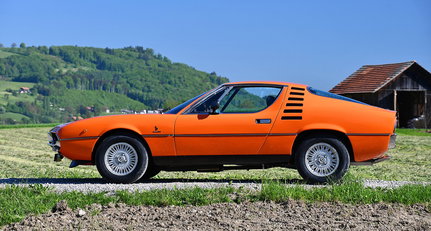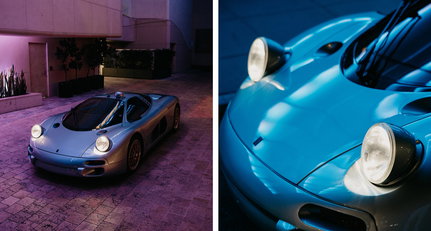





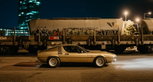
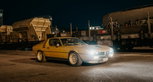

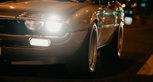
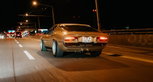
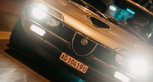
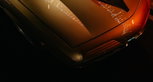
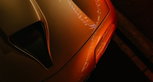





With a sweet V8 engine and even sweeter-looking bodywork penned by car design genius Marcello Gandini, the Alfa Romeo Montreal should have gone down in history as a smash-hit GT to rival the best from Ferrari, Lamborghini or Maserati. In reality the beautifully-styled two-plus-two failed to hit the mark in its day, with its high price tag and slightly underwhelming driving experience leading to fewer than 4,000 being sold between the model’s 1970 launch and the end of production seven years later.
But what would a Montreal be like if it was not only given the restomod treatment, but given it in such a way as to turn it into a true 21st century supercar that's outwardly identical to an original? That was the question asked by the anonymous owner of this stunning Oro Metallizzato example currently on sale with Swiss dealer Andreas Wuest – and one which Wuest answered by commissioning and overseeing a jaw-dropping re-development programme that required over three and half years to complete, totalling a staggering 1,300 hours of work.


From the outset, the work was only ever going to be entrusted to one person: world renowned Alfa Romeo tuning guru Oliver Koerfgen. Formerly a long-standing Ferrari engineer, Koerfgen is the founder of OKTech, the Muttenz-based go-to for anyone who wants to realise the full and often remarkable potential of their Alfa Romeo GTV6, 75 or, less commonly, Montreal. Koerfgen is such a specialist that these are the only three models he works on and, although his modifications are extensive, he insists that any car they are applied to should retain its original appearance as closely as possible.
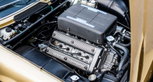
And there are no templates for his builds, either. Each one is treated as an individual project for which every alteration, every performance improvement and every upgraded component is tailor-made. That makes this car a true one of one, one that isn't likely to be repeated anytime soon. In the early stages Koerfgen enlisted a Sauber F1 engineer to create a 3D scan of the Montreal’s engine bay in order to assess how to minimise and re-position ancillaries to create the cleanest-possible showcase for the car’s piece de resistance: its fully custom-built motor. Although the Montreal’s original, 2.5 litre, race-derived V-8 might have seemed punchy enough in its day, it looks completely stone-age compared with what Koerfgen has created. As well as increasing cylinder capacity to 3.25 litres, he installed a bespoke, flat-plane crankshaft that drives specially manufactured con rods and pistons topped by a CNC-machined cylinder head with thinner valve guides and larger valves activated by high-performance camshafts ( connected, incidentally, by a timing chain specifically made for the build).

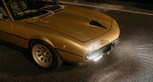
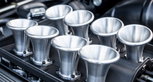
Along the way, Koerfgen focused on keeping everything as light as possible, while maintaining integrity and ensuring the engine remains as smooth and vibration-free at low revs as at its significantly extended red line – which now sits at a safe 9,000 rpm. It’s fed by a set of custom-made, independent throttle bodies topped by eight sculptural trumpets that breathe through the Montreal’s now fully functioning, bonnet-mounted ram air scoop which leads to an intake that, again, was 3D scanned and reconfigured to achieve optimum efficiency. The engine bay was also given some space to house an almighty radiator in front of the engine, designed to keep the mechanicals as cool as the ice-cold cool looks, even on the hottest of summer scorchers.


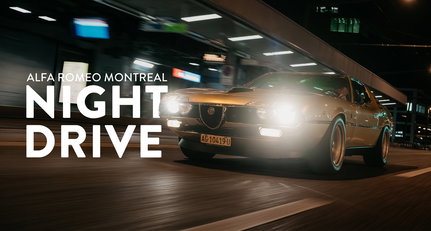
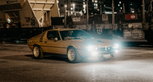
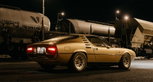
The mellifluous engine note you can hear as the Montreal prowls the streets of Zurich in our latest night drive video comes, meanwhile, courtesy of a set of hand-made, equal-length headers that lead to stock-looking tail pipes. The engine work all adds up to a power output that Koerfgen prefers not to disclose specifically, but which is believed to be ‘at least double’ the 200 horsepower of the original Montreal engine. That would, of course, be rather too much for the car’s standard underpinnings - which is why raising it on a lift and poking about underneath reveals yet more masterful engineering.
To make the most of the re-born Montreal’s massive performance potential, four-piston brake calipers have been fitted all round with suspension being taken care of by a modern-day, fully adjustable set-up supplied by UK-based racing specialist Intrax. While beneath the car, you’ll also notice a specially fabricated chassis mount – that’s there to support the reinforced gearbox which takes power from the engine through a custom clutch and feeds it to a bespoke axle with 45 per cent LSD.

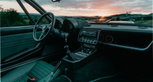
Moving to the mighty Montreal’s interior, you’ll see that it retains its groovy ‘70s appearance, with its green leather upholstery, perforated, three-spoke steering wheel and purposeful twin binnacles for rev counter and speedo.
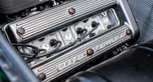
Each is bordered by an array of asymmetrical auxiliary gauges and flanked by a centre console with its bank of rocker switches - which suffer none of the demons associated with ‘classic’ Italian electrics thanks to the seamless integration of a complete, modern-day wiring loom. Take a look in the driver’s footwell, however, and you will find a beautifully sculpted set of bespoke control pedals that have been designed to further improve the driving experience. The one that opens-up those custom throttle bodies is, of course, the star of the show – according to the Montreal’s owner, it provokes an instant reaction from the motor which, he says ‘revs like a superbike’ and makes his Porsche 992.2 GT3 ‘seem as though it’s asleep’.


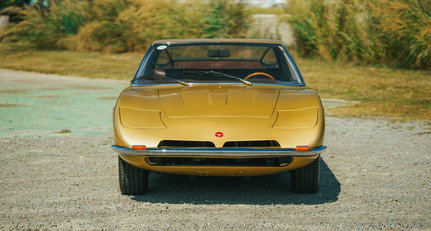
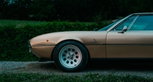
Helped by the car’s bespoke ECU, the revs not only rise rapidly, but in a clean, linear fashion that’s said to make the car a joy to drive fast or slow - with the comprehensive suspension upgrade and meticulously built engine ensuring a silky smooth, vibration-free ride regardless of road surface. To us, this really does seem to be the ultimate expression of the Montreal, a car that was never previously been allowed to realise its full potential. And perhaps the real genius of what Koerfgen has achieved lies in the fact that there has been no interference with the delicious silhouette created by Gandini, which was not far off the same as the concept car he penned for display on the Alfa stand at 1967’s International and Universal Exposition held in – you guessed it – Montreal.
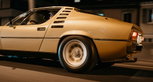
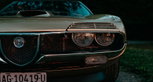
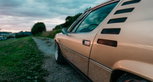
By then, Bertone’s precocious head of design (still only 31) had already made his mark with the Lamborghini Miura and clearly decided to apply some similarly unusual detailing to the Montreal such as its slotted, retractable headlamp blinds, the tower of vents cascading down behind the B pillar and the ‘hatchback’ rear window which made this two-plus-two coupe surprisingly practical. The original concept car commission required Alfa to display the ‘ultimate incarnation of motoring’ at the time, with the overall theme of the expo being ‘Man and His World’.

And, with its shark-nosed front, steep-raked windscreen and muscular back-end, the production Montreal seemed to be every bit the car that a cool, thinking person of the ‘70s might choose as stylish daily driver. Now, with Koerfgen’s incredible modifications, that person of 2026 can also enjoy a level of performance that more than matches those gorgeous looks.
Fotos von Alpineracer.ch & Remi Dargegen
Video von Alpineracer.ch