

Even a decade after its debut, the current Alfa Romeo Giulia remains one of the most emotional and engaging sports sedans on the market, above all the high-performance Quadrifoglio, whose 520-PS V6 carries Ferrari DNA. After an unusually long career, however, the model is starting to show its age. Just in time for the tenth anniversary of the current generation, the Stellantis brand is unveiling the Cuorerosso design study at the Paris Motor Show (October 12 to 18, 2026). Italian for "red heart," the concept openly embraces the brand’s rich heritage.
The name could hardly be more fitting, not only because of the paintwork, finished entirely in the new Liquid Ink Red, but also because its lines so clearly follow the deeply emotional tradition of Alfa’s "Cuore Sportivo." Details such as the coach doors may be classic show-car gimmicks that are unlikely to make it into production. Otherwise, though, the dynamically styled sedan can certainly be seen as a concrete preview of a Giulia successor.


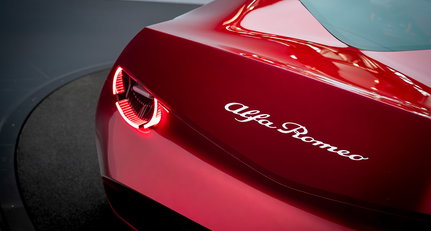
At the front, evolution rather than revolution seems to be the motto at the Centro Stile Alfa Romeo. The designers have subtly modernized the face of the still timeless-looking sedan. The hood, with its pointed V, is much more strongly sculpted, while the headlights, equipped with modern lighting technology, look a shade more menacing than before. As on the Junior, Alfa’s entry-level model, the brand logo is integrated into the signature grille known as the scudetto. At the rear, by contrast, Alfa Romeo is breaking new ground. Round taillights, given an aggressive look by a crease in the trunk lid reminiscent of furrowed brows, make the Cuorerosso look just as combative from behind.
The sporty character carries over to the interior, where four ergonomically shaped bucket seats provide plenty of lateral support. The shape of the dashboard pays homage to the limited-production Alfa Romeo 33 Stradale supercar and its historic predecessor from the late 1960s. At the center sits a large circular digital instrument display that reinterprets the brand’s signature telescope-style binnacle.


There is no shortage of historically inspired details elsewhere, either. Take the generously sized alloy wheels, which revive the telephone-dial theme that debuted on the 33 Stradale around 60 years ago. The designers followed the philosophy of "Bellezza Necessaria," or "necessary beauty," which is why the exterior design in particular is comparatively clean and close to production for a concept car.
Even so, the car is purely a design object, and the Italians have not released a full spec sheet. Alfa Romeo does mention, however, that it is based on the "STLA Large" multi-energy platform that can accommodate a revised version of the familiar V6 from the current Giulia Quadrifoglio. Fans of the "Cuore Sportivo" can therefore breathe a sigh of relief, even if additional hybrid and plug-in hybrid powertrains in any production version would likely be needed to bring down fleet emissions. Beyond that, Alfa does not lose itself in nostalgia, relying instead on modern technology such as steer-by-wire, which eliminates any mechanical connection between the steering wheel and the front wheels, as well as carbon-ceramic brakes and sport-tuned air suspension.


Alfa Romeo has not yet announced a firm timeline for the launch of a Giulia successor, but Alfisti should not have to wait too much longer. Production of the current model is due to end late next year.