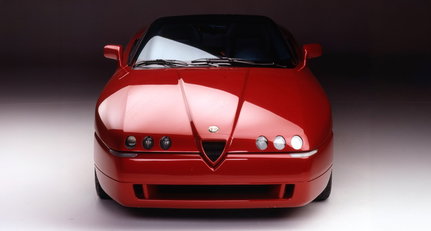



In the early nineties, Alfisti were eagerly awaiting a new Spider. Although the first generation of this iconic roadster had received several cosmetic updates over the years, it had basically been in production since 1966. Among fans, there was a consensus that the second iteration would adopt the brand's new design language introduced with the surprisingly successful Pininfarina-designed 164, making it significantly more angular.
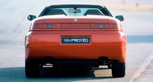
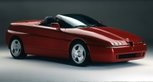
At the Geneva Motor Show in March 1991, Alfa Romeo unveiled a novelty closely linked to the second generation of the classic Italian roadster. Some journalists believed they were getting the real deal, but in the end they had to settle for a design study. However, that was easy to accept, as the styling of the 164 Proteo was spectacular. With its automatically retractable glass roof and four-wheel steering, the concept set new accents for Alfa Romeo. The Proteo anticipated the coupe-cabriolet trend of the late 1990s and 2000s, which truly kicked off with the 1996 Mercedes SLK.

Responsible for the design was not Pininfarina, but Alfa's head of in-house design, Walter Maria de Silva, who held the position from 1986 to 1999. He later moved to SEAT before taking over leadership of the Audi, SEAT, and Lamborghini brand group within VW in 2002, ascending to become one of the most influential figures in his field. From 2007, he oversaw the design of the entire Volkswagen Group. Under his leadership, key elements were created, including the singleframe grille and Audi's understated yet dynamic design line of the late 2000s and 2010s, which played a decisive role in establishing the Ingolstadt-based company as a true premium brand.
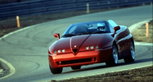
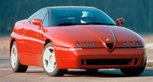
Underneath its de Silva-styled bodywork, the Proteo featured a 164 chassis shortened to 4.15 meters, the signature Busso V6 tuned to 260 hp, alongside an all-wheel-drive system co-developed with Steyr. Yet, there were hardly any visual parallels to Alfa Romeo's executive sedan of the time. Instead, the Proteo adopted the radical wedge shape of the SZ and RZ duo, albeit in a softened and modernized form.


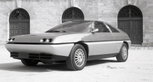
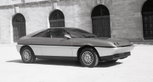
The same applies to the six-eyed lighting arrangement featuring three small light elements on each side. Instead of the familiar squares, de Silva opted for round lenses, a motif that originally debuted on Pininfarina's 1981 Audi Quartz concept, which was also known as the Quattro Quartz. Pininfarina designer Enrico Fumia, who had reinterpreted the Audi Quattro in his own way back then, later revisited this round headlight theme for the second-generation Alfa Spider, known as the 916 series.
Although the exterior design of the Spider had been finalized in 1988, the long-awaited production model did not arrive until 1994, featuring only two headlights per side instead of three. The Proteo took this detail, which was already set in stone during its design phase, and exaggerated it into its distinct six-eyed layout. Other details that ultimately reached production in modified forms included the placement of the Scudetto grille and the V-shaped powerdome on the hood. Essentially, the historic brand used the concept car to gauge public reaction to its new design direction. Alfa Romeo also paired the Spider with a closely related coupe named GTV. Nevertheless, this second generation, built completely from scratch, sold far worse than its predecessor and plays only a minor role in the classic car scene to this day.


The beltline of the Proteo rose sharply toward the rear, giving the car a distinct wedge shape. Compared to the RZ and SZ, however, its lines were significantly rounder. This made the concept car a typical product of the early 1990s. The rear, with a panel between the narrow taillights and a high, almost bulbous rear apron, is somewhat reminiscent of the back end of the second-generation Mitsubishi Eclipse. In contrast to the exterior, the all-gray cockpit was surprisingly conventional, pairing five round gauges with a five-speed manual transmission and a vast array of buttons on the center console.

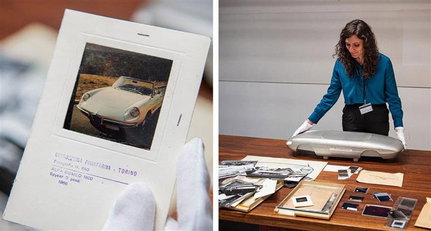
Around the time of the Proteo's presentation, rumors spread through the automotive press that Alfa Romeo was planning a limited production run of around 2,000 units. However, concrete evidence of the development of a further roadster positioned above the Spider never surfaced. Ultimately, only three prototypes were built, one of which is part of the official factory collection and was displayed a few years ago at the prestigious MAUTO museum in Turin.
In essence, Alfisti today would love a car just like the Proteo: a modern yet emotional roadster powered by the goosebump-inducing sound of the Busso V6, equipped with technology that serves driving pleasure rather than distracting from it.
Photos: Alfa Romeo, Audi AG