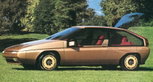
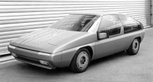

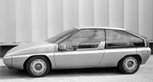
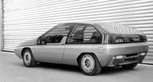

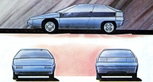





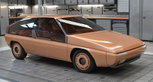



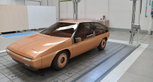
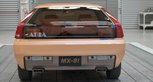
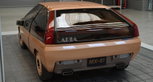
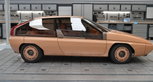


The MX-81 Aria was designed by Marc Deschamps, Bertone’s head of design at the time, who died on October 5, 2026, at the age of 82 at a hospital in Rivoli, near Turin. It was not Mazda’s first concept car, but it was the first Mazda to bear the “MX” prefix. It stood for Mazda “eXperimental” and was reserved for models that challenge conventions to create new values. And that is exactly what the MX-81 did – in spectacular fashion.
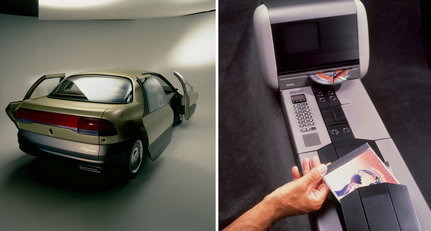
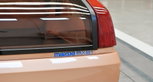
The gold two-door, four-seat coupe was based on the mechanicals of the second-generation Mazda 323 and epitomized a design era in which side windows extending down to a wraparound beltline were in vogue. At just 3,940 mm (155.1 inches) long, it was strikingly compact. The rear window was also exceptionally large – the generous glazing explains the name “Aria” (Italian for “air”). The vertical taillights integrated into the C-pillars were likewise progressive for the early 1980s. As with the Citroën XM and the Camargue concept, both of which he penned, Frenchman Deschamps favored angular, smooth surfaces with a few crisply defined lines and a sharply pointed front end.


The 1972 Camargue, incidentally, was his first concept car of his own at Bertone – and it owed its existence to chance: shortly after joining the company in Turin, Deschamps had bought a Citroën GS and simply suggested to Nuccio Bertone that they build a concept on that platform. Bertone agreed on the spot, and it took just five weeks to go from first sketches to finished body. The MX-81 Aria also shows unmistakable parallels to the 1979 Volvo Tundra, a Bertone concept overseen by Deschamps’s predecessor, Marcello Gandini. Its design language reached series production as early as 1982 in the Citroën BX, also penned by Gandini.


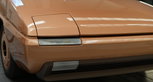
The wedge shape, meanwhile, had long been part of Carrozzeria Bertone’s DNA. A welcome side effect for the MX-81 Aria was a drag coefficient of 0.29, made possible in part by flush-mounted windows, pop-up headlights (which reached production in very similar form on the 1989 Mazda 323 F) and retractable windshield wipers. To ease access to the rear seats, the front seats could swivel to the side. Despite the car’s small footprint, there was ample room for four.
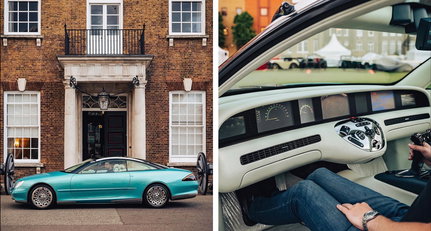
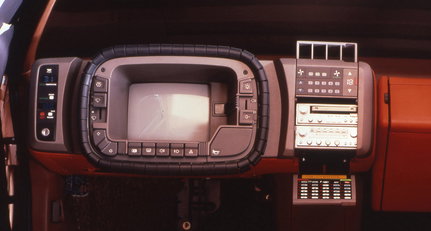
Bertone had already experimented with new, at times revolutionary instrument solutions in earlier concepts. In the MX-81 Aria, the driver looked at a CRT screen positioned directly ahead, styled like a miniature television, on which all key readouts appeared as soon as the ignition was switched on. Numerous push-button controls, including the horn, were grouped on its solid rectangular frame. Unlike a conventional steering wheel, the steering assembly itself did not rotate. Instead, a linked belt studded with black rubber nubs and covered in fabric slid around a track encircling the instrument pod. The idea behind it made perfect sense, as the controls in the central hub stayed in place; actually steering the Aria, however, must have been tricky, to say the least.


After the 1981 Tokyo Motor Show, the MX-81 Aria spent almost 40 years safely stored but forgotten in a Mazda warehouse in Hiroshima’s Fuchizaki district. It sat there gathering dust until former MX-5 program manager Nobuhiro Yamamoto – prompted by a request from Mazda Italia – came across this gold-colored treasure on Valentine’s Day 2020. Although dampness had taken a slight toll, the car showed no major damage. A thorough inspection followed at Mazda’s headquarters, focusing above all on the engine, a 1.5-liter turbocharged gasoline unit rated at 130 PS (128 hp). It was completely dismantled, after which mechanics went through every component, from the radiator and water pump to the battery and fuel tank. The brakes, steering and electrical system were also refurbished. Once the engine was running again after 39 years, the decision was made to send the car for its body and interior restoration to where it had once been designed. And so, in March 2020, it was time for the MX-81 Aria to go home!


In Turin, SuperStile, a company founded in 2015, was already waiting for the shipment from the Far East. Usually specializing in show cars, prototypes and scale models, its craftspeople aimed to preserve as much original material as possible. The paintwork and exterior surfaces have since regained their 1981 shine; inside, the main task was removing traces of moisture from the leather surfaces. The headlight lenses were also replaced and the pop-up mechanism restored to working order. Once everything was spick and span, Mazda couldn’t resist photographing the MX-81 Aria alongside the then-new MX-30 compact SUV – the brand’s first all-electric production model – in Milan’s Piazza del Duomo, the very spot where it had posed for its press photos in 1981.


Since July 2021, this fusion of Italian design artistry and Japanese ingenuity has been on display at the Mazda Classic – Automobil Museum Frey in Augsburg, Germany. Marc Deschamps was laid to rest on October 13 in the cemetery of Caprie in the Susa Valley – the very place where Bertone’s design center, birthplace of so many fantastic concept cars and production models, once stood.
Photos: Mazda