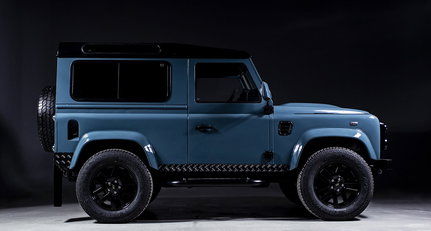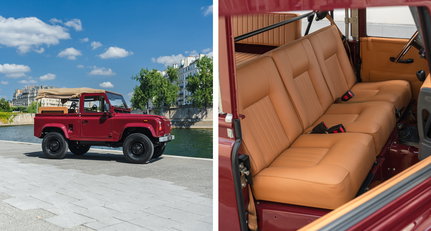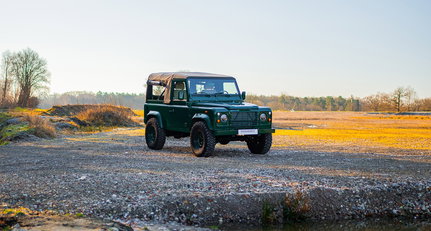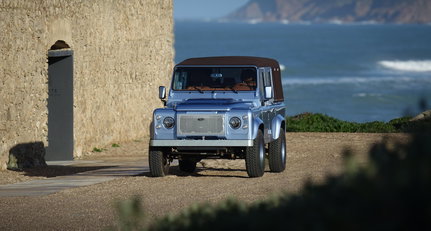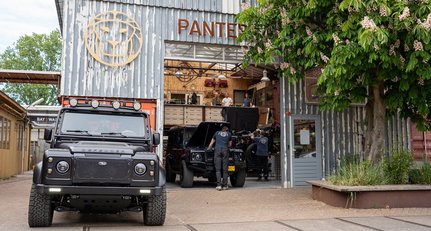





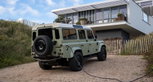



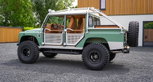



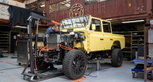
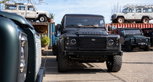


In recent decades, countless old factory buildings across Europe have been reimagined as lofts, studios, and creative workspaces. The Amsterdam compound that now houses The Landrovers started out exactly that way. Two university students moved into an empty factory on an industrial estate inside the city ring, lived there for free, fell in love with a broken-down army truck, and then converted the whole place into a workshop. What began as a personal obsession became a real production facility: a place where painting, upholstery, woodwork, wiring, and engineering all happen under one roof, producing the world's most thoroughly bespoke Defenders.


The Africa crossing that still needs to be finished
The story begins around 2009, when Peter and his friend Daniel were studying in Amsterdam and a mutual friend offered them a deal: move into an empty factory on an industrial estate, live for free, keep the building safe from squatters. They said yes.
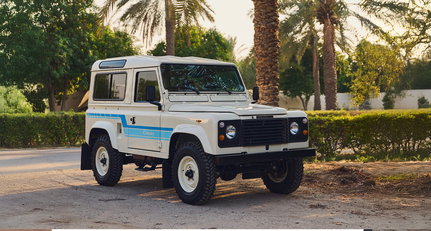
Daniel soon left for South Africa on an academic exchange, fell in love with the country and a South African woman, and eventually proposed something outrageous to Peter: buy an off-road vehicle and drive there. In their eyes there was only one vehicle suitable for a kind of trip like that. They bought a right-hand-drive ex-British Army Defender from the 1980s, with the naturally aspirated diesel that originally put out 68 horsepower, of which roughly 18 still felt alive. Neither of them had any mechanical experience. They taught themselves as they went. "We fell in love with the vehicle and with the process," Peter recalls. "We spent all our time and all our money on it."
Then the intercontinental relationship ended, the money ran out, and they listed the Defender online. By the next morning, two prospective buyers had shown up. The first bought it on the spot. The second arrived too late but was impressed by the two guys' work. He made a proposal instead: build me one exactly like this. He paid in advance. "That was basically our first custom order," Peter explains.


One year turned into fifteen
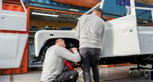
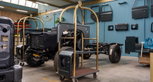
One commission led to another. Each customer wanted something slightly more ambitious than the last: bigger jobs, bespoke interiors, full engine overhauls or complete swaps. Five people became ten; ten slowly became twenty-five. The factory they had moved into as students quietly became their workshop, their atelier, their company headquarters. "It's not a standard factory hall with everything lined up," Peter says. "There are lots of small buildings, small shops. That combination of everything is The Landrovers."
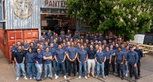
Today, over 75 people work on that property. A third owner, Frank Tijs, arrived wanting to electrify his old VW campervan. The Landrovers offered him the facility for free in exchange for his expertise, which led directly to the development of the Panterra Platform, the proprietary in-wheel motor system that now powers the company's electric Defenders, and Frank's ascent to co-ownership.


Impressive EV technology
In 2018, the three founders identified a manufacturer producing in-wheel electric motors and recognised their potential. "Having an engine under the bonnet, then a transmission, a transfer case, and props to transport the power to the wheels: it's stupid, in a way," Peter says. "In the past there was no other solution. But in-wheel motors, that's the future."
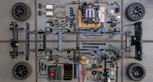
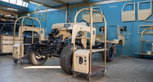
Building a Defender around these motors required rethinking the chassis entirely: independent suspension to compensate for the added unsprung mass, and with the drivetrain removed, the underfloor freed up for self-developed battery packs of up to 200 kWh, which is quite a lot — Tesla's Cybertruck for example "only" has a maximum capacity of 123 kWh. But the electrified Defenders just need bigger batteries to compensate their lousy drag coefficient, equivalent to that of a brick. The result is an impressive range of up to 375 miles or 600 kilometres. Electric variants currently account for roughly twenty percent of production, but The Landrovers expect this share to grow significantly in the coming years.


No is not the default
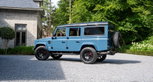
What separates The Landrovers from every other Defender specialist is its commitment to the customer's vision. "There are no limitations on specifications," Peter says. "We really build their dream." The project director is even more direct: "We never say 'no' in the beginning. Our design and engineering team investigate the possibilities, because we think it's the coolest thing ever to make a customer's dream come true. That's our power."
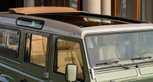
A case in point is the sliding roof. "We had a customer saying: I love that typical defender hardtop look, but I want to push a button and have the roof slide open from front to back. Can you do that?" The answer, characteristically, was: "We don't know yet, but we'll try." What followed was the development of a fully automated sliding panel integrated seamlessly into the hardtop roofline. One button press, and the roof glides fully open or fully closed within five seconds. The feature proved so popular that by now roughly half of all customers order it. It is a neat illustration of how The Landrovers operates: a client's seemingly outlandish request becomes a new standard. Before any such feature is signed off, however, the team verifies its compatibility with the local registration requirements of the country the vehicle will be delivered to. The last thing anyone wants, after almost a year of work, is a car that cannot be registered.


The design process
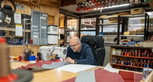
The design process unfolds in what The Landrovers calls the Dream Room, where clients are surrounded by material samples and colour references and work through every last detail of their build. There is no fixed schedule: some customers arrive once and decide quickly, others return several times as ideas evolve and refine. "People are used to going into a standard dealership, getting the keys and driving out," Peter says. "Here, the experience takes nine to twelve months." Decisions are made gradually as the build progresses, working inward from exterior colour through hundreds of individual details. "It's a super organic journey," the project director explains. "Everything organically develops during the building process." And then there is the name. Every customer gives their Defender its own: some name them after a dog, some after their children, some after the destinations they want to reach with their new adventure mobile.


Craft above all else
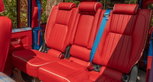
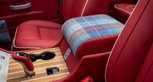
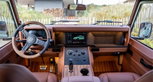
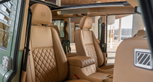
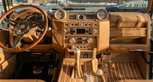
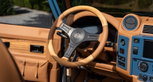
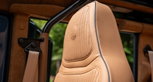
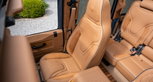
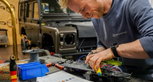
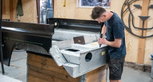
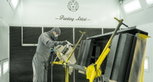
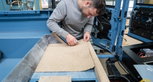
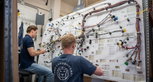
Almost everything is made in Amsterdam, by hand. Painting, upholstery, woodwork, wiring harnesses, CNC-machined and 3D-printed components: all produced on-site. The company even developed its own software to maintain full control over every circuit in every build. The virtually sole exception is the galvanising of the chassis. Everything else stays in.
Donor Defenders are sourced globally, most from Spain and Portugal, or in one memorable coup from Gambia, where the founders' network turned up 42 chassis at once. The red clay of West African roads had left them looking catastrophically rusty; in reality they were structurally excellent, with no salted roads and low humidity to cause hidden damage. Bodywork, panels, and trim are replaced entirely with new certified Land Rover components anyway.
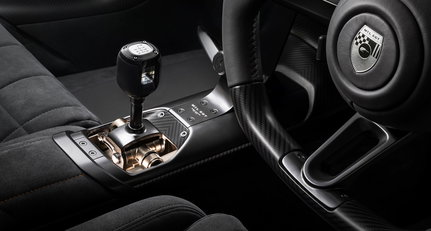
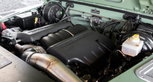
Engine choices run from the original Defender drivetrains, the 200 Tdi, Td5, and Puma, to Chevrolet's LS3, LT1, and LT4 V8s. The 650 hp Corvette engine propels the modernised off-road brick to 100 km/h within only 4.5 seconds. When it comes to the transmission, The Landrovers offer two options: a General Motors unit or ZF's eight-speed automatic. The V8s are also available with a stick-shift. A build takes between nine and eleven months, with around 30 vehicles leaving the workshop per year.


Tailored to the customer's lifestyle
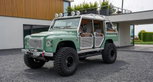
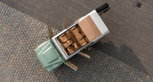
The Kalahari, currently under construction, illustrates what all of this makes possible. Named after the Namibian desert, it is finished in a classic old-school beige, the kind Toyota used on Land Cruisers for decades. The client is a committed Ironman competitor, and the build reflects that entirely. A roof rack, extra fuel and water tanks, modular storage, and custom rear racks for race bicycles are all part of the specification. The rear seats are designed for rapid removal via quick-release mechanisms, with dedicated attachment points near the front axle to keep the rack stable under load. "We always make sure to get to know the customer, so we get a more personal image around that person and his or her life. So we can build their car around that." This is not a car that will sit in a garage. It is a car built to be used hard, in exactly the conditions the Defender was born for.