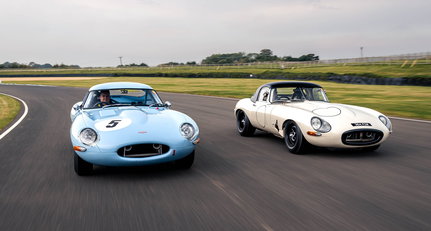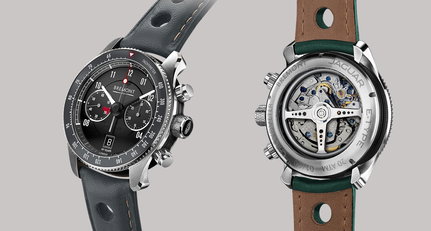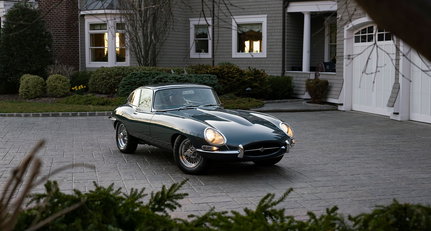

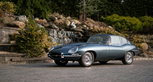
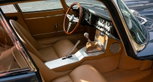
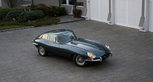

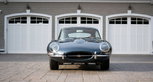
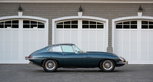
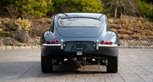









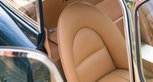
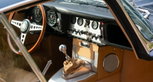

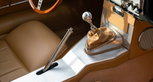
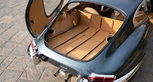


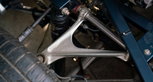
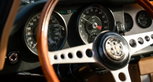

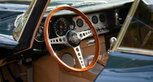


Sixty-five years have passed since those glorious days in Geneva, yet the E-Type’s design, crafted by aerodynamicist Malcolm Sayer primarily using mathematical methods (!), has lost none of its elegance and flair. The car was a major inspiration for the Toyota 2000GT, and its “long hood, short rear overhang” configuration became a defining stylistic hallmark of the sports car segment.
The layout came with drawbacks, though. The exceptionally long hood made maneuvering an adventure, taller drivers risked hitting their heads on the roof, and the rear seats of the later 2+2 were suitable only for children, or perhaps friends with a dry, British sense of humor. On the other hand, the newcomer, which inherited much of its DNA from the Le Mans-winning C-Type and D-Type racers, was one of the fastest production cars in the world at its debut, with a top speed of 150 mph.

What were the most important changes during its lifecycle?
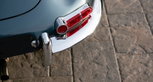
The Series 1 (1961–1968) featured headlights covered by glass fairings, a detail highly prized by collectors today, as well as a narrow, oval radiator grille and delicate turn signals and taillights. It is the purest expression of Malcolm Sayer’s design, untainted by later safety and emissions regulations.
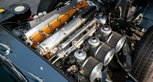
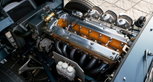
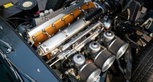
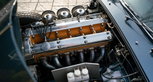
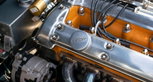
Power came from inline-six engines of the legendary XK family, initially with a 3.8-liter displacement and from 1964 onward with 4.2 liters. In a well-tuned example, the 265-bhp engine delivers effortless acceleration, even uphill, from as low as 1,500 rpm, thanks to its substantial torque.
With the introduction of the 4.2-liter engine, which offered the same horsepower but even more torque, a new, fully synchronized four-speed gearbox built in-house by Jaguar replaced the earlier, only partially synchronized “Moss” transmission.

The rare, early “flat-floor” models (built until 1962) are the most sought-after by collectors, despite a design drawback: the cramped footwell. It was later eased by slightly lowering the floor panels and adding a recess in the sheet metal to allow more seat travel.
In 1966, the 2+2 was introduced. It had a longer wheelbase and slightly more headroom, though its proportions were less harmonious, and it kept the glass-covered headlights. It was developed in response to demand from the U.S. market for a coupe suitable for families. The longer wheelbase also made room for a Borg-Warner Model 8 automatic, which was more popular with American buyers.
Toward the end of 1967 came the unofficially dubbed “Series 1½,” now with exposed headlights, a change many purists regarded as a departure from the original style.

The Series 2 (1968–1971) is easy to recognize by its significantly larger radiator opening and by front turn signals and taillights relocated beneath higher-mounted bumpers, changes made to comply with new U.S. legal requirements. The brakes, now supplied by Girling rather than Dunlop, were far less prone to fading. Power steering and air conditioning became available as options. Inside, the classic toggle switches gave way to modern rocker switches, and the door handles were redesigned to sit flush with the bodywork.
The Series 3 (1971–1974) had a longer wheelbase and a wider track, and it introduced a 5.3-liter V12 producing 275 hp, an engine that was also used in its successor, the XJ-S. This generation was offered only as a roadster or a 2+2 coupe. This final E-Type could reach 150 mph. Like the Series 2, it could be ordered with an automatic transmission and air conditioning, and for the first time, seat belts were offered as an extra. The front disc brakes were now ventilated, while the slatted radiator grille softened the E-Type’s original, aggressive look.

Which version should you buy?
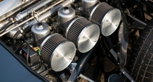
The answer begins with the choice of body style (coupe or roadster) and engine. The XK engine, derived directly from the D-Type’s, had its merits but also its quirks: its three SU carburetors required regular synchronization, and it was often reluctant to start in cold weather.
The 4.2-liter version, introduced in 1964, is the golden mean. It offers refined performance and strong pulling power even at low revs, and, for a British exotic, it is reliable enough for daily use. The new manual transmission was another significant improvement. Power steering, however, did not arrive until the Series 2, and even then only as an option.
With the arrival of the V12 in 1971, the E-Type drifted further from its original concept. The massive engine was thirstier, heavier, and more complex to maintain; four carburetors, for instance, now had to be tuned precisely. On the plus side, it delivered truck-like torque and unparalleled smoothness. The extra weight over the front axle compromised the handling, though, and the agile “big cat” of 1961 evolved into a ponderous boulevard cruiser, tailored primarily for the American market.

Marcus Holland of the Kent-based specialist E-Type UK calls the E-Type “an excellent car for those with no prior experience of classic cars. It is easy to maintain and offers a fantastic driving experience. For a newcomer, I would recommend a model with a 4.2-liter engine, from either the Series 1 or Series 2, as these already feature a fully synchronized gearbox and capable brakes.
“Those looking for something different might consider a Series 3 E-Type. In our view, it is a fantastic, yet often underrated, car. The longer wheelbase and V12 engine provide a driving experience quite distinct from the earlier models, but every bit as enjoyable.”

How much should you pay for a Jaguar E-Type?
The E-Type’s price range is wide: a Series 3 2+2 is one of several entry-level options, while a Series 1 3.8-liter roadster in top condition sits at the very top of the market. Collectors especially prize the Series 1 “flat-floor” models built until 1962, with rare features such as welded hood louvers and aluminum dashboard trim.
After a long period of near-explosive growth, prices for used E-Types are currently declining slightly: by about 10 percent in the EU, and by as much as 20–30 percent in the UK, where right-hand-drive models are relatively scarce.
The Series 1 (3.8 and 4.2 liters) is clearly the most valuable, with a wide spread from about €110,000 for an average car to well over €260,000 for an authentic, matching-numbers early example. The roadster premium is typically €10,000–20,000, except on the earliest cars, where coupes can be worth more because so few were built.

The Series 2 sits roughly 40–50 percent below the Series 1 in comparable condition (€60,000–130,000). The 2+2 and automatic cars are the least valuable, and high-quality cars are scarce.
The Series 3 starts at the same level as the Series 2 (€60,000–70,000) but climbs higher for very good cars (up to €150,000). The jump from “average” (€60,000–70,000) to “good” (€90,000–100,000) is unusually steep, which suggests condition matters a lot here.
Across all three series, condition and originality drive the price far more than the series label does, so a very good Series 2 or 3 can cost more than an average Series 1.
In short, a Series 1½ or Series 2 E-Type, particularly a coupe, offers the most affordable entry point. The same applies to the less popular 2+2 models, whose extended roofline makes them less aesthetically pleasing. The twelve-cylinder models are slightly more expensive and have attracted their own dedicated following.

For maintenance and minor repairs, budget €3,000–5,000 a year. A qualified E-Type specialist typically charges €100–150 per hour, and given the complexity of these big cats, costs can quickly add up to several thousand euros. A full restoration can easily reach €80,000–120,000.
Anyone setting their sights on an E-Type should, however, approach it with a critical eye. Even if the big cat’s coat gleams like silk, it may not always have been treated with the care it deserves. It is far better to choose an E-Type with 100,000 miles and a complete, unbroken maintenance history than a barn find with low mileage.

Oliver Schepp-Danne, sales manager at the Jaguar Land Rover Classic Center Germany, offers this advice: “Never inspect an E-Type alone; always bring an expert and make sure the car is up on a lift. Photos reveal only about 60 percent of a vehicle’s true condition. The market is full of ‘deceptive beauties,’ cars with glossy paintwork hiding thick layers of body filler. Therefore, always buy the better vehicle, even at a higher price. A ‘good’ or, worse, a mediocre car can quickly incur high five-figure repair and restoration costs, ultimately making it the more expensive option. If you are looking for a car with historical significance, also verify the authenticity of the engine and chassis numbers with a certificate from the Jaguar Daimler Heritage Trust.”
According to Schepp-Danne, the 2010s saw a surge of interest in the E-Type, partly driven by JLR’s own “Reborn” program. “Many smaller workshops jumped on the bandwagon and often miscalculated the costs of paintwork and mechanical restoration. As a result, the market is now flooded with mediocre cars, while truly high-quality examples are exceptionally rare.”

What are the technical issues?
The XK six-cylinder is one of the most famous British postwar engines. It is inherently robust and long-lasting; after all, it powered the C-Type and D-Type cars that won at Le Mans. With proper care and regular maintenance, these engines prove durable and reliable. Check the oil pressure with the engine warm: it should be at least 10 psi at idle and around 40 psi at 3,000 rpm.
Minor oil seepage is almost to be expected in cars of this age and is no cause for concern. Significant leaks from the rear main crankshaft seal, however, are a warning sign. Blue smoke on startup indicates worn valve stem seals, while persistent blue smoke under load points to worn piston rings and cylinder bores. The best approach is to bring the engine up to operating temperature on a test drive, then park the Jaguar and see whether it leaves a spot on the ground.

Cylinder head gasket problems are not uncommon in these inline-six engines. To check, let the engine cool completely, then open the radiator cap slowly, using a thick cloth to protect your hand; the cooling system is pressurized, and there is a risk of scalding. Then start the engine and look for telltale bubbles or foam. Foam or water on the underside of the oil filler cap is another symptom.
An uneven idle is often caused by the three SU carburetors, which are notoriously difficult to repair. Slight valve clatter and some rattling from the timing chain are considered normal.
The Moss gearbox requires double-clutching when downshifting into second gear. First gear should be engaged only at a standstill, and thanks to the engine’s substantial torque, it is generally needed only for pulling away.

The V12 is a silky-smooth engine but subject to high thermal stress. The cooling system must therefore be in perfect working order: overheating can warp the cylinder heads, and any neglect in maintenance, compounded by the extremely cramped engine bay, can result in astronomical repair bills. Engine repairs on an E-Type are generally very costly: around €7,000, and over €11,000 for a V12.
The independent rear suspension sits in a pressed-steel subframe bolted to the underbody. This frame is prone to rust, and corrosion compromises the rear suspension geometry and necessitates an expensive repair. Inspect the subframe’s mounting points and the frame itself carefully for signs of corrosion.

“Why do the English drink warm beer? Because they have refrigerators made by Lucas.” A classic, delightful joke that unfortunately also applies to the E-Type. You may encounter ground connections that come loose, fuses that blow for no apparent reason, or switches that work only when they feel like it. Electrical functions often suffer from amateurishly repaired wiring harnesses or patch jobs with electrical tape or haphazardly crimped wires.
There is only one solution: clean the contacts, check the ground connections, and inspect the wiring for breaks. In the 3.8-liter Series 1 models, the electrical system was still powered by a DC generator (dynamo). Only with the enlarged 4.2-liter engine in 1964 did an alternator arrive, together with a switch to a negative-ground electrical system.

What problems occur with age?
The Jaguar E-Type is a classic with sophisticated engineering that becomes quite delicate with age. An engine overhaul or complex bodywork requires a great deal of specialized expertise and can become very costly, very quickly. Always bear that in mind.
Drawing on the example of successful Le Mans race cars, the E-Type has a semi-monocoque body with a separate front subframe, made of chrome-molybdenum steel, that carries the engine and front axle. This is a double-edged sword, because the monocoque can effectively conceal rust. The subframe and monocoque are bolted together at four reinforced points, and the lower mounting points are particularly prone to rust, as they are exposed to road spray.

The subframe itself, built from square and round high-strength tubing, may look perfectly sound at first glance yet be severely corroded from the inside. Its many internal cavities are especially vulnerable, since many were never painted at the factory. A damaged or bent subframe must therefore never be repaired by welding; it has to be replaced entirely.
Other corrosion hotspots include the floor panels (especially in roadsters), the triple-layered sills, the bottom edges of the doors, the front valance, the engine mounts (particularly near the battery, where acid accelerates corrosion), the rear wheel arches, the junction between sills and floor panels, the seat wells, the trunk floor, and the area behind the headlights, where water can accumulate unnoticed for a long time. The rear frame rails are particularly notorious; restoring them can easily cost tens of thousands of euros.

The experts at the Jaguar Land Rover Classic Center Germany advise: “Even on a freshly painted car that looks flawless, always open up the sills, A-pillars, the outer skin of the rear wheel arches, and the lower rear quarter panels for inspection.”
The front-hinged hood consists of four components bolted together from the inside, and rust often begins at the seams behind the chrome trim. It is not always immediately apparent and may show only on closer examination of these seams. A magnet moved across the bodywork can reveal body filler, and an ice pick or similar pointed tool, carefully applied to the sills and floor panels, can show how much rust lurks beneath the surface.
On an E-Type, the fit and alignment of body panels matter for more than aesthetics: because of the car’s unibody construction, significant structural rust can stop the doors and hood from closing properly. A key indicator of overall condition is the panel gap between the hood and the cowl. A well-fitted hood suggests that the car has escaped major accidents and poorly executed restoration work.

Many cars for sale have been shoddily repaired or contain large amounts of body filler. “The bodywork of an E-Type is absolutely critical,” emphasizes Marcus Holland. “Mechanical issues are easier and less expensive to rectify.”
Reaching the clutch requires removing the engine and transmission as a single unit, so check its condition on the test drive. Any slipping, juddering, or difficulty shifting should be identified before, not after, the purchase. At the front axle, look for leaking shock absorbers, damaged steering rack boots, and worn wheel bearings.
And make sure the disc brakes work evenly. If maintenance has been neglected, the pistons are prone to seizing. The rear, inboard-mounted brakes can also become contaminated with oil leaking from the differential, and the handbrake mechanism may seize from rust. Replacing the rear brake discs or pads typically requires removing the complete rear axle assembly, which significantly increases labor costs.

Marcus Holland stresses that an E-Type should feel “taut, direct, and quite precise.” If it doesn’t, the bushings of the upper or lower wishbones, or the ball joints, may be worn. He also advises checking the steering for play, which could come from the steering column’s universal joints, the tie-rod ends, or the steering rack itself. If the shock absorbers feel soft, remember that the rear suspension uses two dampers per side.
U.S. imports are a topic in their own right. Many cars on the market are reimports from the U.S. Because of U.S. emissions regulations at the time, they were often “neutered” with Zenith-Stromberg carburetors, sometimes producing only 140–150 hp. Many have since been retrofitted with triple SU or Weber carburetors. In the U.S., cooling systems were typically not filled with antifreeze, so they must be inspected meticulously for corrosion and damage.

Is it worth buying a Jaguar E-Type?
Yes! First, the availability of spare parts is the least of your worries. For the XK engine in particular, the situation is practically idyllic. Almost every component can be replaced if it has succumbed to age or wear, and only a few V12 parts can occasionally be hard to find. In fact, is there anything that can’t be found? Recently, Jaguar’s Classic division even began offering brand-new cast-iron engine blocks for the 3.8-liter engine, after they had been unavailable for nearly 50 years.
Second, there is an E-Type for everyone. By 1974, Jaguar had produced approximately 38,400 units of the Series 1 E-Type, 18,800 of the Series 2, and 15,300 of the Series 3. Around 80 percent of all E-Types were exported to the United States, so there are plenty of left-hand-drive cars around.

For driving pleasure and value, look for a Series 1 4.2-liter roadster or coupe. For comfort and power, a Series 3 V12 roadster is your perfect fit. As an entry-level option, consider a well-maintained Series 2 or Series 3 2+2. If you want to avoid the high maintenance and operating costs of the Series 1 or a Series 3 V12, a rust-free, well-maintained Series 2 is your best choice. It offers the full E-Type experience without the quirks of the Series 1.
Whichever version you happily put into your garage, it’s fair to say that the E-Type is a true automotive legend and design icon in its own right. This is proven by the fact that since 1996, an E-Type roadster has been one of only a handful of cars in the permanent collection of the Museum of Modern Art in New York.
And that is despite the fact that the E-Type was never perfect. The electrics came from Lucas, jokingly known as the “Prince of Darkness”; the early brakes (discs, which were advanced for the time) tended to overheat under spirited driving; and, as mentioned, rust could do thorough damage. It wasn’t as fast as a Ferrari 250 GT and broke down more often than a Porsche 911, yet in 1961 it cost only half as much as an Aston Martin DB4 and a third as much as the Ferrari.

Once you have one in your garage, people will often ask to take a photo, because those with an eye for balanced proportions instinctively sense that in the E-Type, aerodynamics became art. It is a sculpture defined by a single, continuous line from front to rear, so flawless that Sir William Lyons and Malcolm Sayer had no need to commission a design house like Pininfarina, Ghia, or Michelotti.
Our thanks go to Marcus Holland of Kent-based specialist E-Type UK and Oliver Schepp-Danne of the Jaguar Land Rover Classic Center Germany, who provided valuable insider information for this buying guide.
Photos: Erik Fuller for RM Sotheby's