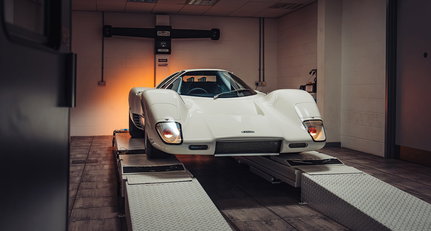


















For McLaren, the year 2026 is clearly defined by a return to the roots of the carmaker. Back in July, MSO (McLaren Special Operations), the division responsible for bespoke customer requests, completely rebuilt an M6GT. This was the first supercar from McLaren, of which a total of three prototypes were created in 1969 and 1970. The advanced mid-engine sports car with Can-Am DNA never reached series production, but it is widely considered the foundation of all road-going McLarens today.
Presenting this newly rebuilt ancestor of today's McLaren supercars to the public at the Goodwood Festival of Speed was an early indicator that this journey into the past could be connected to the realignment of the model portfolio. And indeed, about a month later, the circle is complete. During Monterey Car Week at the "House of McLaren", the British brand introduced the upcoming McL 6GT. This coupe not only recalls Bruce McLaren's once unfulfilled supercar dream by name, but it is also a visual and conceptual homage to the pioneering prototype.


Since the brand's rebirth in 2010, it has primarily made a name for itself with progressive, aerodynamic design and cutting-edge technology laced with motorsport DNA. Instead of an analog driving feel, the main priorities were maximum efficiency on all levels, pure speed and breaking lap records.
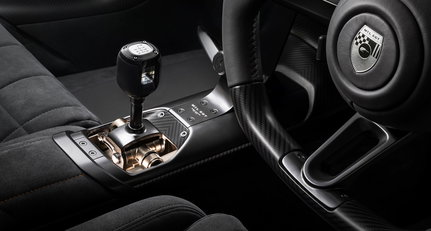
With the modern McL 6GT, the manufacturer is presenting a completely different side of itself. Instead of opting for almost extraterrestrial shapes, the initial concept, which is slated to become a production car by 2028, relies on an almost minimalist retro design. This aesthetic clearly recalls the sports prototypes of the late sixties and naturally also Bruce McLaren's first road-legal car. The exact same purpose is served by the Kiwi logos on the gear knob, which features an exposed shift gate, and the fuel cap, pointing to the New Zealand origins of the pioneer.


You read that right. The McL 6GT is the first McLaren since the legendary F1 from 1992 to feature a classic manual transmission. Paired with hydraulic steering, plenty of aluminum in the interior and tactile switches, the driver is supposed to experience a distinctly mechanical and analog feel that is unparalleled in McLaren's current model range.
The concept of electrification is also entirely absent from the press release. Just like the historic original, the lightweight monocoque made completely of carbon fiber houses a powerful and sonorous V8 engine. The British brand has not yet published specific performance figures or further technical details. With the production car planned for 2028, McLaren aims to serve customers who appreciate a pure connection between man and machine more than astronomical acceleration or downforce figures.


"The McLaren McL 6GT imagines what our inspirational founder had wished to complete but with six additional decades of innovation and passion woven through every element, creating a modern icon of driver connection. It is symbolic of the bold, provocative and hugely exciting future that we are preparing to realize.," says Nick Collins, CEO of McLaren Automotive.