















While working on his 1970 Mustang as a hobby in his own garage, Chris Ashton found himself asking a question: What would a Trans-Am team from that era have done if they had access to modern technology and could work full steam without the constraints of motorsport regulations? By this time, he already had 25 years of autocross racing experience under his belt, plus a 25-year career as an artist, graphic designer, and—most recently—co-founder and design director of leading video game studio Turtle Rock. Earlier in his career, he was also involved in the creation of the popular first-person shooter Counter-Strike. Over the years, he had driven many exciting and exclusive cars, ranging from Lamborghini Gallardo to McLaren 720S, AMG GT-R to Corvette ZR1, to name a few. But eventually, he reached a point where he no longer wanted to buy cars but rather build them himself. Not to sell, either, just something he could enjoy and call his own.
This question preoccupied Ashton so deeply that he took the decision to leave the digital world to found Ruffian Cars in Fountain Valley, Orange County, Southern California, alongside a small team of like-minded individuals. Their motto: "We do not recreate the past – we make the past relevant for today." His debut project—the Mustang—was an instant hit. The same went for its successor, the Ruffian40 shown here, a reinterpretation of the famous Ford GT40 Mk1. First unveiled at SEMA 2021 at the Toyo Tires Treadpass, it was this car that paved the way for the founding of Ruffian Cars the following year.


Anyone stepping into these hallowed workshops simply cannot get over the sheer amazement of it all. Standing alongside a widebody 1967 Mustang and other "wild horses" are spectacular unicorns like a mid-engined, 1,000-hp Chevrolet El Camino and a hot rod inspired by a 1935 Plymouth—powered by the Dodge Viper's mighty 9.0-liter V10 engine delivering 800 hp and combining the artistry of a vintage hot rod with the performance of a modern race car. It's dubbed the Plymouth GT-1.


CTEK brought Ruffian's creations to Europe
However, there are two models that particularly caught our eye — not least because both marked Ruffian Cars' European debut this year on CTEK's booth at Ultrace Poland in Gdańsk. The partnership between the Swedish company, global leader in battery management solutions, and Ruffian began at SEMA in 2025, when Chris Ashton unveiled the Plymouth GT-1 hot rod at the CTEK stand. As with all Ruffian models, reliable power management is paramount and thanks to CTEK's advanced charging technology the high-performance electrical systems remain optimized for both street and track use. The Ruffian GT-1 also serves as a perfect example of the passion and precision that define both Ruffian Cars and CTEK.
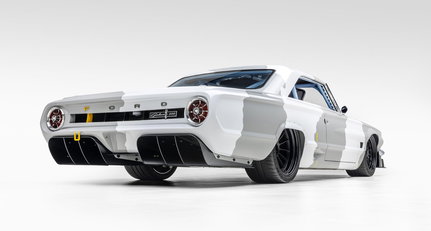
One of the two 2026 Ultrace showstoppers at the CTEK stand was a 1964 Ford Galaxie 500 boasting 700 hp and a perfect 50:50 weight distribution; it featured a camouflage livery, a flat underbody, a massive rear diffuser, and a front spoiler that could easily double as a snowplow. Penske dampers optimize the handling of this lowered cruiser, and even "air jacks" are installed to facilitate rapid tire changes.
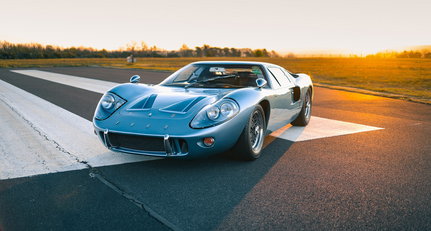
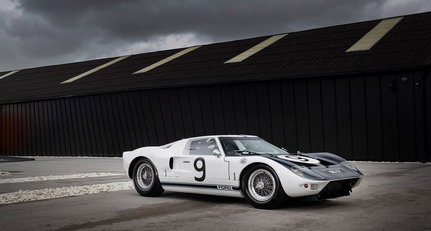
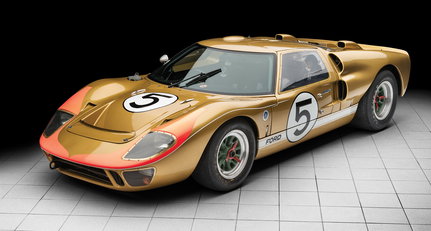
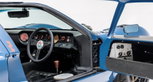
The second one was the Ruffian40, a carbon-fibered wide-body reinterpretation of the Ford GT40 Mk1—a car that earned its status in the 1960s through multiple Le Mans victories and a very popular road-legal version. Ashton began with a rolling chassis, but the initial plan to fit only a modern engine and transmission soon became a full rebuild that also reshaped the car's appearance. Its Ford Racing 5.2-liter DOHC V8, closely related to the Shelby GT350 engine, produces 580 hp and 445 ft-lbs of torque, revving to a redline of 8,000 rpm.


Like the Le Mans GT40s, the Ruffian40 is RHD, too
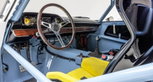
Visual highlights include the large intake snorkel at the roofline, the bronze-coated U-shaped intake manifold, and headlights designed by Ashton himself and produced via 3D printing. A KW coilover suspension with Bilstein dampers and a track width increased by four inches optimize the handling of this unicorn, which sports a massive mixed tire setup (345/30x19 rear, 295/30x18 front). There is even a rearview camera, but—like the Le Mans race cars—the Ruffian40 is right-hand drive with the gear shifter positioned also to the right. This layout was chosen because most of the world's racetracks run clockwise, resulting in more right-hand than left-hand corners. Inside, the Alcantara-upholstered, rivet-studded seats also pay homage to the historic original.
Ruffian Cars focuses primarily on classic models built up to 1975, without limiting itself to any specific decade, vehicle segment, or body style. What all these cars have in common is a celebration of iconic design combined with modern—and thus safer and more reliable—technologies. Especially when it comes to electrical systems and energy management, complemented by ECUs, thermal management, and aerodynamics. According to Ashton, the company's cars are intended not merely to make a strong statement but to form a unique, holistic work of art through a blend of vision, modern engineering, and superior craftsmanship.


Each model is a one-of-a-kind creation, designed around a specific theme and in consultation with the client. Discussions beforehand clarify how and where the vehicle will be used, as well as the importance placed on driving experience and performance. To ensure a perfect fit, pedal and seat positions are precisely adjusted to the client's individual physique during a fitting session.
As a rule, cars from Ruffian Cars are wider and lower than the originals, featuring custom spoilers and side skirts and reduced ground clearance, yet incorporating modern headlight and safety systems. But engine tuning is a must. "After all," emphasizes Chris Ashton, "our cars shouldn't just look fast—they should actually be fast."
Visit www.ctek.com if you want to find out more about the company's charging products.