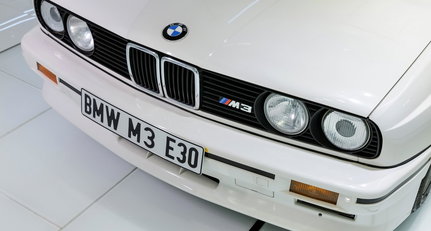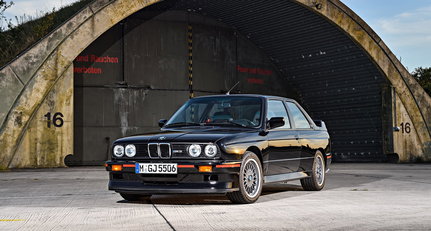
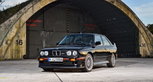
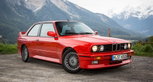
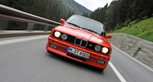
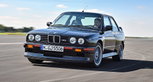
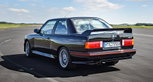


The original BMW M3 has enjoyed one of the most meteoric revaluations in modern classic car history. For much of the late nineties and early 2000s, these wide-arched coupés could be found at modest prices on used car lots. Occasionally rusty, often neglected, and rarely appreciated for what they truly were. The broader public saw them as just another sporty BMW, often carrying a dubious image in its home country because non-car people frequently couldn't distinguish them from heavily modified 316is. Compared to the standard 3 Series of the time, the M3 was harder to live with and considerably more expensive to fix. This didn’t hold back young drivers with little to no money from servicing the S14 engine properly. Quite a lot of cars were thrashed so hard that they didn’t survive this era.
Purists, meanwhile, knew better. To those in the know, the E30 M3 was always something special: a thinly disguised touring car that happened to carry number plates and was still celebrated for its outstanding racing career. That understanding has now spread far beyond the inner circle. What was once a cult classic has become a blue-chip collectible, with clean examples routinely selling for sums that would have seemed absurd to buyers even ten years ago. Yet the E30 M3 is more than just an investment vehicle. It remains one of the finest expressions of what a sports car can be: nimble, mechanical, deeply communicative, and driving one today is a vivid reminder of how much the industry has lost in the pursuit of power, safety, and comfort.


Not your average E30
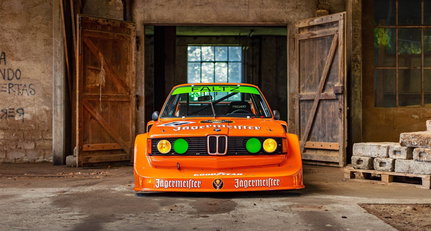
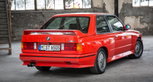
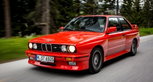
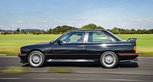
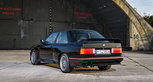
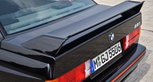
The E30 M3 did not begin as a road car that was later taken racing. It was conceived in precisely the opposite direction. When BMW entered the Group A touring car racing regulations in the mid-eighties, it needed a homologation special: a production car that was mechanically close enough to its racing counterpart to satisfy the rulebook. The result, unveiled at the Frankfurt Motor Show in 1985 and produced from 1986, was a car that shared almost nothing with the standard E30 3 Series below the roofline. The rear window was steeply raked to reduce drag, the bodywork was flared at all four corners to accommodate wider tracks, and a prominent boot lid spoiler was added to generate downforce. These were not styling flourishes but engineering necessities in pursuit of success on international circuits.
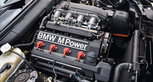
The S14 engine of the first M3, a 2.3-litre four-cylinder derived from BMW Motorsport’s racing expertise, was nothing short of legendary. That a company praised for its smooth and powerful inline-sixes chose a four-cylinder surprised many observers.. But the S14 was no ordinary four. With its individual throttle bodies, high-revving character, and a specific output that rivalled dedicated sports cars of the era, it delivered 195 horsepower in early catalytic European specification. The non-catalytic version put out 200 horsepower. While not a breathtaking number by today's standards, it was remarkable for a naturally aspirated engine in 1986. Combined with a curb weight of just under 1,200 kilograms, the result was a car with a power-to-weight ratio that made it genuinely fast by any contemporary measure.
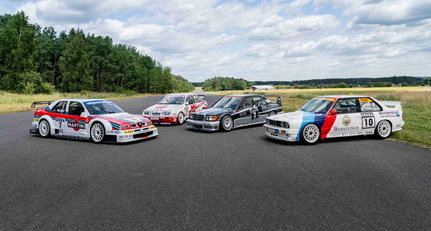
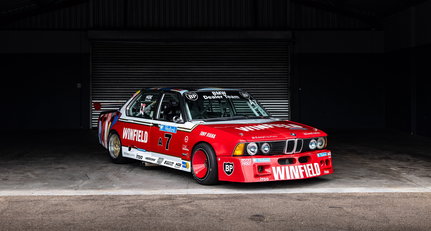
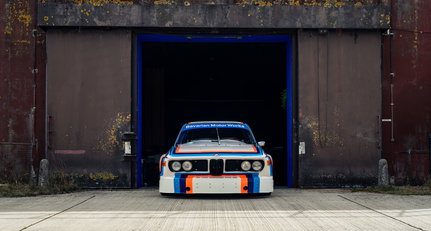
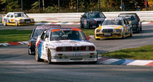
On the track, it proved devastating. The E30 M3 won the World Touring Car Championship in 1987, went on to dominate the DTM, and became one of the most successful touring cars in motorsport history. It even won the 1987 Tour de Corse, a gruelling rally that was part of the WRC calendar. On the tight, winding roads of the Mediterranean island, agile handling and immediate throttle response were far more important than sheer power and torque. Names like Roberto Ravaglia, Johnny Cecotto, and Markus Oestreich became synonymous with the car. For BMW, it was the founding chapter of an M3 dynasty that now spans six generations.

A successful homologation special
BMW produced the E30 M3 from 1986 until 1991, and the car evolved significantly across that period. The standard model was joined by a few limited Evolution variants, each developed to exploit the homologation rules and extract more performance.
The Evolution I of 1987 brought minor engine tweaks and subtle aerodynamic revisions. The Evolution II, launched a year later, raised output to 220 horsepower through revised pistons, a higher compression ratio, a more efficient air intake, a lightened flywheel, and reprogrammed engine management. It also gained a more aggressive rear spoiler and a revised front bumper. The pinnacle of the road-going E30 M3, however, was the Sport Evolution of 1989. With a 2.5-litre enlargement of the S14, output climbed to 238 horsepower, and the aerodynamic package became adjustable, allowing owners to tune downforce to their preferences. Only 600 examples were built.
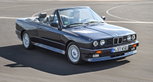
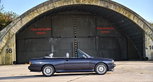
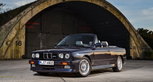
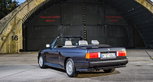
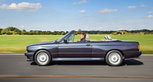
Alongside the performance variants, BMW also offered a Cabriolet version, a soft-top derivative that sacrificed some structural rigidity but brought the M3 experience to open-air enthusiasts. A limited run of special editions, including the Europameister Edition celebrating Roberto Ravaglia's 1987 championship title, further diversified the lineup. In total, BMW produced approximately 17,970 E30 M3s across all variants. This was far more than necessary to fulfil the homologation requirement, but scarce enough to ensure rarity today.


The maintenance shouldn’t be underestimated
The S14 engine is generally robust when properly maintained, but its high-revving nature means that neglect is punishing. Low oil pressure at idle, which can indicate worn main bearings or a tired oil pump, is the single most important warning sign to check. The engine should be warm when assessed, and any rumble or tapping from the bottom end warrants immediate concern. Head gasket failures are not uncommon, particularly on cars that have been overheated, and a compression test before purchase is strongly advisable.
The individual throttle body system, while glorious in operation, requires periodic balancing to ensure even mixture distribution across all cylinders. An unbalanced setup leads to rough idling, flat spots, and increased fuel consumption. Specialist knowledge is required to set these correctly. A test drive that reveals an uneven idle or hesitation under light throttle is a sign of deferred maintenance rather than a defect — but it does indicate that there’s work on the horizon.
Rust is the E30 M3's most serious structural concern. The sills, rear wheel arches, and the area around the rear subframe mounts are all prone to corrosion, and a badly rusted subframe mounting point is not only expensive to rectify but potentially dangerous. The inner sills should be inspected with a flashlight and a mirror, as cosmetically tidy outer sills sometimes conceal serious decay beneath. Any car with signs of filler or fresh paint in these areas should be approached with extreme caution.
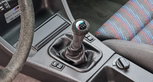
The gearbox, a close-ratio five-speed unit on European cars, is largely reliable but can suffer from synchromesh wear on second and third gears in high-mileage examples. A notchy or baulky change during the test drive is a sign of a tired box. The limited-slip differential, which is standard on all M3s, should lock up progressively and smoothly under power; any clunking or hesitation points to wear in the clutch plates.
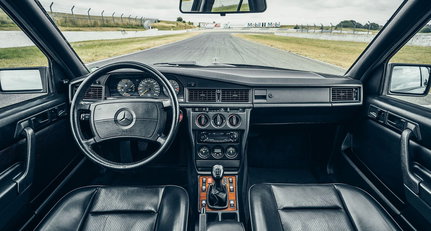
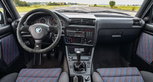
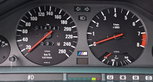
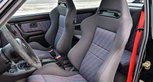
Interior trim is increasingly difficult to source, and the E30 M3 used a number of M-specific components that never found their way into the normal 3 Series of this era. Check the condition of the door cards, the sport seats, and the instrument cluster carefully, because replacements are not just hard to find but also expensive.


Prepare yourself for a six-figure investment
The era of affordable E30 M3s ended some years ago and shows no sign of returning. High-mileage examples in tired condition begin at around 65,000 euros, though such cars frequently require substantial investment before they can be considered roadworthy to a high standard. Solid, honest examples with clean bodywork and documented histories typically sell in the 90,000-to-130,000-euro range, depending on specification and mileage.
Evolution II models command a meaningful premium over standard cars, and the Sport Evolution occupies an entirely different market tier. Well-preserved examples of the 238-horsepower variant sometimes go for more than 200,000 euros at auction, with exceptional low-mileage cars breaking well beyond that threshold. Special editions such as the Roberto Ravaglia Edition follow a similar trajectory.
Photos: BMW Group