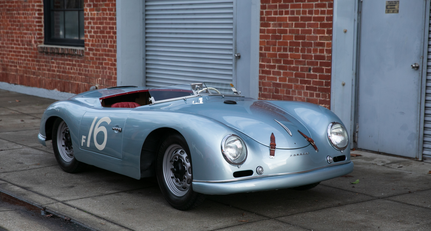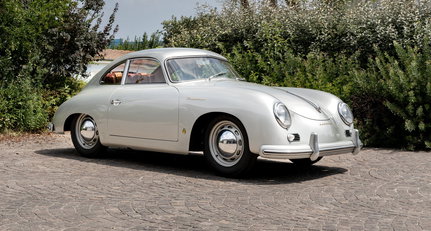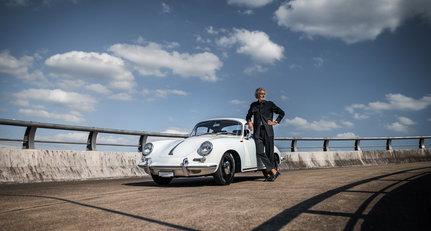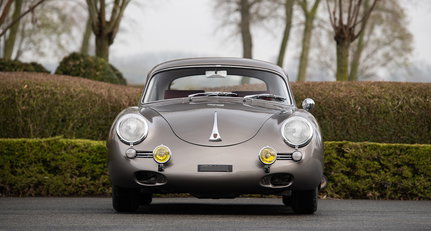











The very first Porsche, the “No. 1” of 1948, was already a roadster. When the 356 went into series production two years later, it was available from the start as both a cabriolet and a coupé. The forefather of the Speedster, however, is considered to be the 356 America Roadster (internal code Project 540). It appeared in 1952 and, as its name suggested, targeted American customers looking for an affordable alternative to English roadsters, on the road as well as on the racetrack. Thanks to its hand-built aluminum body, the America Roadster was about 353 pounds lighter than the coupé and, with 70 hp, reached an impressive top speed of 112 mph for the time. In the end, only 17 were built (16 in aluminum, one in steel), after the coachbuilder Gläser/Heuer filed for bankruptcy.
But Porsche’s love affair with the roadster was far from over; it was only getting started. As with the America Roadster, the impetus came from Max Hoffman, the enterprising New York-based U.S. importer of European luxury brands. Austrian-born Hoffman asked Porsche for a stripped-down open car priced under $3,000, which meant $1,500 below the cabriolet. In the fall of 1954, Porsche granted his wish with the first 356 “Speedster.” It combined the cabriolet’s sheet-steel body with a low windshield, a spartan interior, and an emergency top. The price: $2,995.


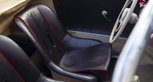
The body, built at the Reutter coachworks, adhered more closely to the regular 356 design and looked more harmonious overall than the America Roadster, whose disproportionate rear hump was often criticized. A low, curved windshield, a minimal top, side screens, and simple seats brought the weight down to 1,676–1,698 pounds. Parts of the sound insulation, the sun visors, the rear emergency seats, and other frills not strictly necessary for driving also fell victim to the weight-loss program. At just 4 feet tall, the Speedster was again markedly lower than the 356 coupé, yet it offered considerably more weather protection than the America Roadster.
In September 1955, the Speedster also received the modifications that turned the 356 into the 356 A. Engine displacement rose from 1.5 to 1.6 liters, and from then on the car could also be bought in Germany. In 1956, the windshield, with its rounded upper corners, grew by 2 inches; in 1957, the Speedster received teardrop-shaped taillights. Otherwise, it was built largely unchanged until August 1958, with 4,822 units in total (including the few, very expensive Carrera versions with the four-cam engine).


The Speedster contributed significantly to Porsche’s market position in the U.S.; in 1955, almost half of all Porsches went to the States. Hollywood icon James Dean played a part in that success: in 1955 he traded his MG TD for a 356 Speedster Super and even competed in a few races with it. It is easy to understand why Americans were nearly hooked on the compact sports car (13 feet long, 5.5 feet wide) from Germany. The weather in California especially suited an open car, while back in Germany the Speedster remained more of an exception, and those who did buy one were mostly racing drivers or motorsport enthusiasts.
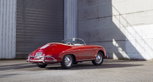
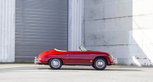
In 1958, the Convertible D replaced the Speedster. It had “normal” side windows and more comfortable seats, which meant not only more weight and less sportiness but also higher prices. The Speedster’s charm was gone. But the 356 A 1600 Speedster (Type 356A T1) coming up for auction at RM Sotheby’s on October 28 takes us, and its future owner, straight back to the days of James Dean, California dreaming, and Surfin’ USA. Delivered new to the U.S. via Max Hoffman in July 1957, the car returned to Germany in 2012 and was acquired in 2015 by the father of the current owner. The car, chassis number 83554, has covered roughly 100.000 miles to date and made a widely noted appearance in the Preservation Class at the Pebble Beach Concours in 2011; it also took part in the Tour d’Elegance.


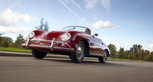
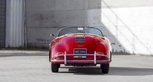
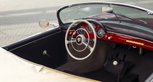
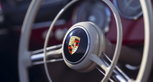
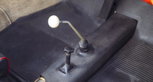
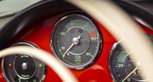
Fitted with the U.S. version’s bow-shaped bumpers, the car charms with its ruby red color, sealed-beam headlights, the chrome trim strip at door-handle height, and gold Speedster lettering on the front fenders. The interior highlights are three VDO gauges with English labeling, with the tachometer placed somewhat higher and in the center. The ignition switch sits on the right, unlike on other Porsches, and instead of a glove box there is another badge and a grab handle for the passenger.
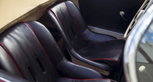
According to Porsche specialist Jochen Bader, this Speedster still has its original air-cooled 1600 engine (Type 616/1, 60 hp) and the Type 644 four-speed transmission. Apart from a few minor cosmetic touch-ups, it also wears its original paint. The interior is authentic as well, right down to the seat covers and floor carpets. Even the fuel tank bears the date “June 1957.”


This Speedster has aged beautifully and enchants with a patina that is unique for a car almost 70 years old, one that would disappear forever with a full restoration. Above all, it is ready to drive, which makes it an ideal car for the 2027 Mille Miglia, the anniversary edition marking 100 years of the legendary endurance race through Italy.
For any collector who values originality over a complete restoration, this Porsche is an unrepeatable opportunity to acquire one of the most remarkable Porsche 356s in existence.