
















Who is a classic Range Rover for?
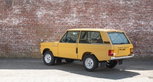
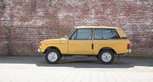
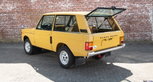
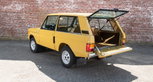
In 1970, and to complement the rugged Land Rover, the Rover brand introduced a type of vehicle the automobile market had never seen before. It was perfectly suited for confidently navigating off-road terrain — thanks to permanent all-wheel drive, a large greenhouse with slender pillars, and an elevated seating position — yet equally capable of pulling up to the opera for an evening out after a quick visit to the car wash. It was also swift on the highway, boasting a top speed of around 100 mph — an impressive figure by the standards of the day. Mounted on a steel box-section frame, the bodywork was constructed primarily of aluminum (except for the hood and the upper section of the split tailgate), while the suspension featured progressive coil springs. These were technical advantages that none of its segment rivals at the time could match.
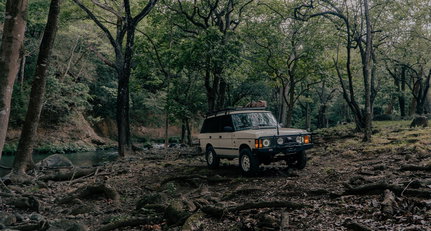
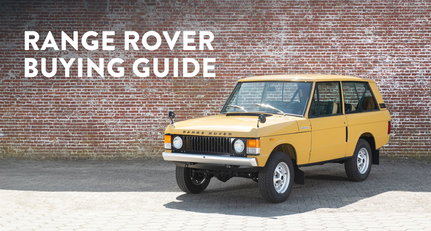
Anyone with a fondness for British automobiles — and an appreciation for the Range Rover's purposeful design and understated character—is sure to be happy with such an icon. Its unobtrusive, timeless shape offers excellent all-round visibility, while two ridges on the hood serve as useful reference points, providing significant advantages —especially when driving off-road. The high seating position — you rather sit ON the vehicle than IN it — allows the driver to survey the terrain from a commanding vantage point simply by turning his or her head. Furthermore, versions equipped with optional air suspension make the Range Rover well-suited for towing duties, too.


Which version should you buy?
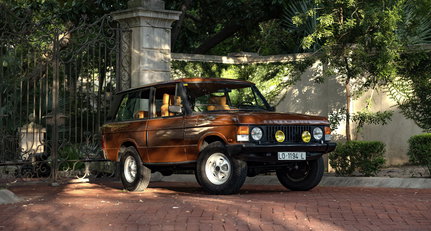
After Peter Monteverdi had successfully marketed five-door conversions in Switzerland, Rover itself switched from the initial three-door variant to a five-door model starting in 1982. The radiator grille also changed — shifting from vertical to horizontal slats in 1986 — and remained unaltered until production ended in 1994.
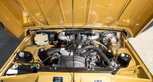
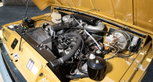
Beyond the choice between the iconic three-door and the more family-friendly five-door, the primary consideration is selecting the right engine. At launch, Rover equipped its new model with a 3.5-liter V8 based on a Buick engine block. It is flexible and free revving, though not particularly fuel-efficient. In later years, the displacement of this compact, lightweight, all-aluminum engine was progressively increased to 3.9 and 4.2 liters. In 1985, fuel-injected (EFI) engines replaced the carbureted powerplants.

The diesel lineup kicked off in 1986 with a 2.4-liter naturally aspirated engine from Italy's VM, followed by two in-house direct-injection turbodiesels (the 200 Tdi in 1992 and the 300 Tdi in 1994). They offer plenty of torque and excellent fuel economy, though they are certainly not quiet. On the plus side, they require very little maintenance, making them highly popular among owners who take their vehicles on desert expeditions and other survival-style trips.
Anyone unwilling to forgo the muscular punch of a V8 will naturally prefer it to the diesels. However, the 3.5-liter EFI is something of a "problem engine" because components for the fuel injection system — such as those controlling the idle speed — are difficult to source today due to the engine's short production run.

Thanks to the much longer production cycle, this problem was eliminated with the 3.9-liter. However, German customers in particular could face problems with 3.9-liter models, which were exported in large quantities to Portugal in the early 1990s. Depending on the chassis number, cars from there may lack a G-KAT, which was already mandatory for vehicles registered in Germany but, together with the corresponding ECU, cannot be retrofitted.
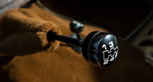
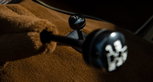
And what about shifting gears? The Range Rover was initially available with four-speed and later five-speed manual transmissions, as well as two different automatic options. The four-speed manual is notchy, requires more physical effort, and has long gear throws. The five-speed introduced in 1983 offers a much smoother action and shorter throws. Crucially, you should test the low-range transfer case before buying — because it often goes unused. Even worse, it frequently fails to work, which would leave you in a precarious situation on steep inclines! In 1983, a more robust ZF automatic transmission replaced the earlier, rather sluggish TorqueFlite of American origin.


What should you pay for a first-gen Range Rover?
According to Marius Brune of German classic-car market analyst Classic Data, the price curve for the original Range Rover follows a funnel-shaped pattern. The highest values are commanded by early three-door models with the 3.5-liter carbureted engine and the very late Vogue SE and LSE versions featuring 3.9- or 4.2-liter V8 engines, along with leather upholstery, wood trim, air conditioning, ABS, and other luxury amenities; both groups range (in Condition 2) from 41,000 to 45,000 euros.
In contrast, Oliver Schepp-Danne, Sales Manager at the Jaguar Land Rover Classic Center Europe based in Essen, estimates the value of absolute top-tier models with full equipment at between 55,000 and 65,000 — or even up to 79,000 euros. The most affordable options are models from the intermediate period — for example, a five-door with carburetor or EFI engine (120 kW) from the mid-1980s, which Classic Data values at between 26,500 and 28,000 euros.


What are the technical problems?
The V8 engine is prone to oil leaks and camshaft wear (though hardened replacement camshafts are now available). Typically, the camshafts and tappets require replacement after 100,000 kilometers. A surefire sign of wear is loud knocking or ticking during acceleration; the engine will also feel sluggish and lack pulling power. With fuel-injected (EFI) models, check for a steady idle and smooth throttle response, as the throttle body and potentiometers can fail.
Always check the service history as well. Have oil changes been performed regularly and at the recommended intervals? Failure to do so can lead to oil sludge buildup. Land Rover Classic recommends 20W-50 synthetic oil as the optimal lubricant.
Automatic transmissions should shift smoothly. A whining sound from the transfer case — usually noticeable during load changes — warrants a workshop inspection, as does a "singing" noise from the rear differential. The viscous coupling can also wear out over time; specifically, the internal pump mechanism is prone to having its strainer become clogged.

The air suspension system offered from the 1992/93 model year onwards — a first for an off-road vehicle — suffered from issues such as faulty valve blocks, air bellows becoming porous, and compressors operating at insufficient pressure. If the sensors responsible for regulating ride height (road vs. off-road) malfunction, the vehicle body rises slowly or unevenly.
Converting to a conventional steel suspension is possible without significant expense or effort; this simply involves deactivating the compressor and control units. However, new components are now available that are far less prone to failure. The advantages of air suspension are obvious though: the rear end does not sag even with heavy loads or when towing a trailer, and the ride comfort is noticeably smoother.


What problems occur with age?
As with so many cars from this era, rust is the number one enemy of the classic Range Rover too. The key issue is galvanic corrosion — wherever the aluminum body panels come into contact with the steel frame components, often at rivet points, hidden aluminum corrosion sets in. The aluminum effectively "blooms," producing a white, powdery substance.
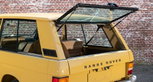
Conventional rust tends to attack the engine bay, inner sills, wheel arches, bulkhead, and the area where the hood meets the body. The tailgate — whose upper section is made of steel (aluminum replacements are available) — should be checked for proper fit and corrosion, as rust frequently targets the upper frame section and the hinges. The underbody is also highly susceptible, particularly the rear third, where road spray, dirt, and above all road salt cling to the metal like a moisture-retaining sponge. The rear crossmember is almost certain to be the first to go.
Land Rover Classic's preferred method for refurbishing the underbody is dry-ice blasting: cold and pressure shatter the surface coating and reveal the bare metal, showing exactly where and how deep the corrosion runs. The underbody is then preserved with a flexible, wax-based coating.

It is also crucial to inspect the rear axle vibration damper. If it is leaking, the axle takes on a distinct, immediately noticeable life of its own while driving, as if the rear end were trying to overtake the front. The good news: since the body and ladder-frame chassis can be separated, even badly rusted examples can be brought back.
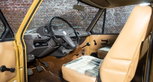
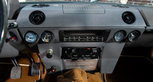
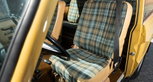
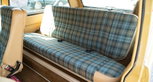
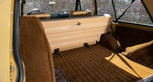
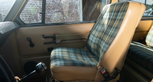
Finally, the interior: sagging headliners that have come loose are very common and no isolated problem for the era, as even Jaguar models were affected. Today it is a quick fix, though: apply a modern, better adhesive and reupholster, and you're done. Early models had an instrument panel made of hard plastic, while later cars used a softer-material unit from the Discovery. The original instrument panels and center consoles are now very hard to source, as are switches such as those for the windows, whose plastic tabs tend to snap off. At least the instrument panels are protected against fading, thanks to the steeply raked windscreen — unlike in sports cars.


Is it worth buying a first-series Range Rover?
The answer is a clear "yes." Following the tips and advice outlined here, a first-series original Range Rover — commonly known today as the "Classic" — represents a manageable risk. This is especially true for models built from 1985 onwards; these not only offer better rust protection but are also generally more refined and technically advanced (featuring ZF automatic transmissions, fuel injection, viscous couplings, etc.). Well-maintained three-door models from the 1970s — still equipped with carburetors and cloth interiors — are hard to come by. Otherwise, the long production run means there is still a wide selection available, particularly in markets like France (where the Range Rover was a favorite of the upper-middle class) and Italy (where diesel versions were especially popular); alongside the UK and the USA, these were among the model's strongest markets.
A well-preserved Range Rover in the iconic shade of "Bahama Gold" remains a head-turner, demonstrating just how stylish — and practical for everyday use — the SUV wave began some 55 years ago.
We would like to thank the Jaguar Land Rover Classic Center Europe in Essen-Kettwig for the wealth of valuable information that contributed to this buying guide.
Photos by Dirk de Jager for RM Sotheby's