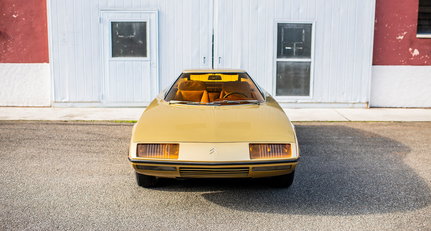


























While its former arch-rival Peugeot relied on Pininfarina for almost every design from the 1955 403 onwards, Citroën preferred to do its own thing, in styling as well as engineering. Still, there was no mistaking a touch of Italian futurism: from 1932 until his death in 1964, the in-house design department was headed by Flaminio Bertoni, a sculptor from Varese whose work included icons like the 2CV and the DS.
His successor, Robert Opron, kept faith with the in-house team too, and the GS was no exception. Short for “Grande Série”, it was meant to bridge the huge gap between the Ami 8 and the D models. Its shape is said to have been inspired by Pininfarina’s BMC 1800 Berlina Aerodinamica concept, but the volume model was a Citroën through and through.


Hydropneumatic suspension, disc brakes all round (inboard at the front), a futuristic interior, an air-cooled flat-four and modern styling made the GS stand out in the small family car class and left most of its rivals looking dated. Unsurprisingly, it was voted European Car of the Year 1971. Build quality and reliability left something to be desired, but the GS sold superbly: 1.9 million had left the production line by 1979.
One of its early buyers was a young car designer called Marc Deschamps. He had started out in Peugeot’s in-house design studio, partly because he was fascinated by Pininfarina, the storied design house the Lion brand worked with so closely. After further stints at Simca and Ghia, he headed to Bertone in Turin. Deschamps, who died on 5 October 2026 at the age of 82, had barely arrived when, with the Geneva Motor Show looming, he came up with the idea of a concept car based on his new Citroën. The result, the Citroën GS Camargue, would go down in history as his first major work.


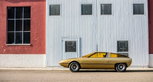
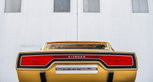
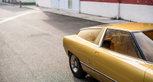
Because Marcello Gandini was in charge of Bertone’s design department at the time, the concept, named after the famous Rhône delta in southern France, is often credited to the father of the automotive wedge. And with its beltline rising steeply towards the rear and its sharp cut-off tail, it certainly has something of Gandini about it. In reality, though, both the idea and the design were Deschamps’ own. In an interview, he explained that Gandini’s only contribution was the right-hand side of the dashboard, where he moved the handbrake lever to a vertical position. Beyond that, Deschamps seems to have had a free hand, not least because Gandini and Eugenio Pagliano were busy with concept cars for the Turin and Brussels motor shows.


Looking back, it’s no surprise that company boss Nuccio Bertone was immediately taken with the idea of a Citroën-based study. The Turin firm quietly hoped to wean the carmaker off doing all its design in-house, and it had its eye on a partnership with the Paris company. In the early 1970s, fresh from launching the SM, Citroën was at the peak of its innovative powers, and its image was at an all-time high. The aim was to emulate the lucrative partnership between Peugeot and Pininfarina.
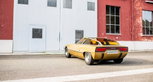
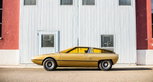
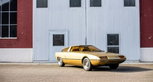
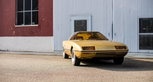
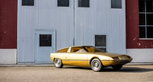
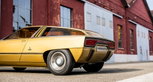
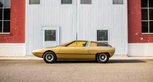
According to Deschamps, it took just five weeks to go from first sketch to finished car, engineering drawings and bodywork included, which says a lot about the talent and work ethic of the Bertone team. At 4.12 metres, the Camargue was about as long as the regular GS, but a good seven centimetres wider and, standing 1.15 metres tall, almost 20 centimetres lower than the production saloon. It looked a lot faster than it was, though: under the bonnet sat the GS’s unmodified 1.0-litre flat-four, with a modest 54 PS and 72 Nm of torque.


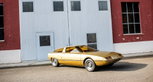
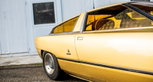
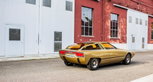
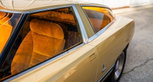
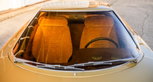
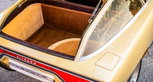
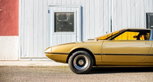
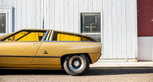
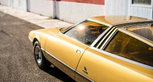
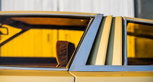
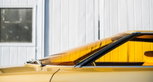
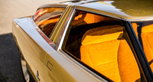
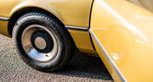
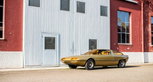
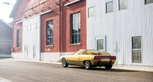
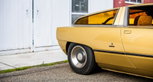
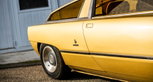
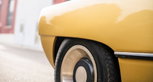
Conceptually, the GS Camargue is hard to pin down. It has the basic shape of a two-door coupé, but with its large tailgate and generously glazed greenhouse it could just as easily pass for a shooting brake. The warm gold paint and gold-tinted glass mark it out as a product of its time, while its subwoofer-style wheels would have made it the perfect centrepiece on the dance floor of a 1970s Milan discotheque.


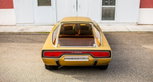
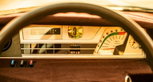
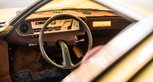
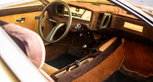
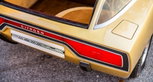
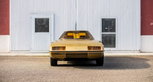
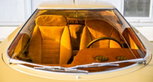
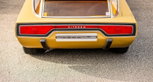
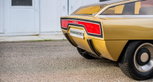
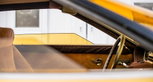
Inside, Bertone kept the GS dashboard, including its famous rotating drum speedometer, but covered it in brown fabric and reworked the centre console. The seats are a lot plusher than in the production car, because the Italians fitted the ones from the Lamborghini Espada. From the back, with its linked tail lights, the Camargue could easily be mistaken for an American car. The designers in northern Italy had apparently looked to contemporary muscle cars like the Dodge Charger and Challenger for inspiration on the rear end. Intriguingly, the tail also anticipates the Maserati Khamsin, which Bertone unveiled later that year with styling by Gandini.


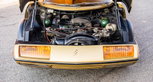
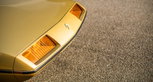
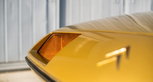
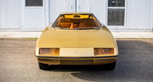
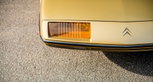
But it was the front that really showed the way forward. The sharply tapered nose with its slim rectangular headlights would later reach production, in modified form, on the Citroën XM. The resemblance to Citroën’s 1990s flagship is no coincidence. Deschamps had left Bertone after only about a year, moving on to coachbuilder Chapron and then Ligier before joining Renault in 1976, where his work included the legendary R5 Turbo. At the end of 1979, though, he returned to Bertone as chief designer, and in that role he drew the CX’s successor during the 1980s. It was unveiled in 1989, no fewer than 17 years after the GS Camargue.


As expected, the 1972 study never made it into production, but it had done its job for Bertone all the same. Its styling turned heads in Paris too, which is why the GS Camargue can be seen as the seed of the successful partnership between the French carmaker and the Turin design house. In the late 1970s, Marcello Gandini designed the first and most successful production Citroën styled by Bertone: the uncompromisingly angular BX, which sold an impressive 2.3 million units between 1982 and 1994. The front of this GS successor, too, already echoes the Camargue in places.


After its debut at the 1972 Geneva Motor Show, which made headlines internationally, the wonderfully futuristic concept car spent years tucked away in Bertone’s company collection. When the firm went bankrupt in 2014, the 79-piece collection was sold to the Automotoclub Storico Italiano (ASI) in 2015 for 3.4 million euros. Since then, the GS Camargue has belonged to this non-profit umbrella body for classic car clubs, which is devoted to preserving Italy’s automotive heritage. The Bertone study is a regular sight at major events such as Rétromobile in Paris and the Concorso d’Eleganza Villa d’Este, and 54 years on, it has lost none of its futuristic charm.
Photos: Rémi Dargegen