



The galactic world of Group B, which would push the boundaries of rallying to the extreme, was still more than a year away. But even this Group 4 version of the Renault R5 Turbo was already making a big impression. The idea of transforming the popular front-driven "R Cinq" – advertised in the US as "Le Car", to emphasize its French origin, small size and cuteness" – into a rear-wheel-driven rally winner came from Jan Terramorsi, deputy director of Renault product planning, around 1977. He envisaged an architecture with a turbocharged four-cylinder engine, longitudinally mounted in front of the rear axle, a reinforced chassis, a material mix for the bodywork of steel, plastic, and aluminum, and a dramatically widened rear track. The first series of the road-going version, built from mid-1980 to the end of 1982, already extracted 160 hp from just under 1.4 liters of displacement and could even compete with a contemporary Porsche 911 SC in the 0-100 km/h acceleration time (6.9 seconds). Only the top speed was rather poor at 205 km/h – aerodynamics simply wasn't a priority in rallies.
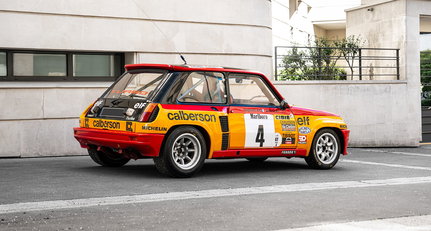
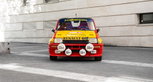
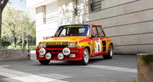
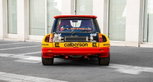
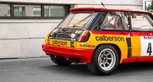
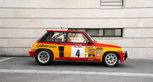
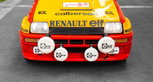
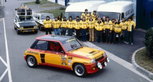
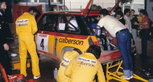
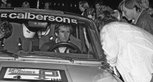
This competition R5 Turbo was first registered on September 8th, 1980 as the first factory-built rally car to Group 4 regulations. It is also the last surviving example in the iconic colors of the French transport and logistics company Calberson. A livery already seen earlier on A310 V6s, R5 Alpines, and an A442 entered in the 1978 24 Hours of Le Mans. And it's also the sole Group 4 car to have been built at Renault's Formula 1 team's headquarters – which means in the same workshops as Alain Prost's and René Arnoux's Renault Turbo single-seaters. With top French rally driver Jean Ragnotti, affectionately known to fans as "Jeannot" or "The Acrobat," this R5 with chassis number #B000036 won numerous stages of the 1980 edition of the Tour de France Automobile and also gave the favorites a good run for their money at the Tour de Corse soon after, an all-tarmac event counting for the World Rally Championship. Now, this broad-cheeked R5 is up for sale on May 2nd at the Aguttes on Wheels Tour Auto Auction, with an estimated value of 400,000 to 600,000 Euro.


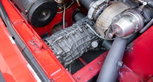
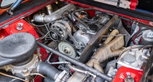
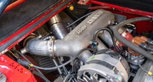
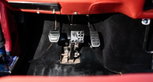
The Group 4 engine, assembled under the watchful eye of legendary Renault mechanic and Renault-Alpine expert Alain Coco Prié and installed in this car, thanks to a fat Garrett Turbocharger developing between 180 and 220 hp, depending on the event. Chassis #B000036 therefore is a true factory car, both technically and visually. This is primarily evident from its mechanical specifications: Chausson air/water intercooler, turbocharger without an integrated wastegate, dedicated exhaust manifold, dry sump lubrication, close-ratio gearbox with 40 % limited-slip differential, pedal box with dual master cylinders and a large airflow sensor plate sourced from the Porsche 928.
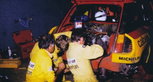
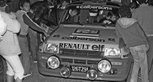
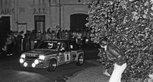
This Calberson-R5 Turbo made its debut with Ragnotti and co-driver Jean-Marc Andrié at the Tour de France Automobile, which ran from September 17th to 20th, 1980, covering about 1680 miles. Ragnotti set the fastest time on the very first special stage – despite a spin at high speed which forced him to reverse 200 meters against the direction of travel. Six more fastest times followed, including one on the foggy "Burzet" stage, where he beat Bernard Darniche in the Lancia Stratos by over two minutes. At the service station in Nîmes, the mechanics changed the gearbox in a record time of twelve minutes before transmission maladies brought the brilliant performance to an end just six stages from the finish. Nevertheless, this debut was enough to make the Stratos suddenly look rather outdated.


At the Rally Corsica in October, Ragnotti – profiting from further accelerated turbo response – was fastest again in the first four special stages. A puncture briefly set him back, but he reclaimed the lead from Darniche and extended it further in the heavily rain-soaked "Castagniccia" stage. With victory already in sight, the alternator belt broke on SS14 – and another spectacular show was over. In 1981, Renault entered new R5 Turbos for the Monte Carlo Rally, its livery now matching the yellow/white/black scheme of the Formula 1 cars. Prior to this traditional start to the new WRC season, Ragnotti – who would win the "Monte" in one of the new R5 Turbos – conducted tire tests on snow with #B000036. At the request of Renault Formula 1 team principal Jean Sage, the car was subsequently stored at Renault Sport's premises before being brought out again as a test mule for gravel tests – in a direct comparison with a brand-new Audi Quattro. In May 1989, this R5 Turbo was sold to a collector from the Loire region, before in 1997 passing through renowned auctioneer and racing driver Hervé Poulain to another French collector who entered it in the Rallye du Var and, in the late 2010s, in the Tour de Corse Historique. As fate would have it, his son – an admirer of the R5 Turbo from childhood – repurchased the car at RM Sotheby's Monaco auction in 2022 and, to the great delight of numerous fans, decided to again compete with it in the historic Tour de Corse.


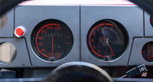
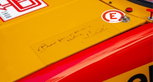
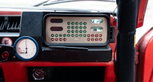
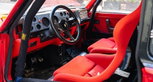
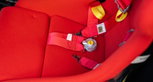
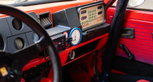
46 years after its completion, this early competition R5 Turbo thanks to extensive work carried out by William Roze from Heritage Mécanique near Tours, presents itself in a condition true to its original state. To start with, there are the mechanical components (large Garrett turbocharger type Tour de Corse, four-piston brake calipers, rare 15-inch Minilite magnesium wheels), complemented by the Calberson livery, the hood fasteners, and the beautifully patinated red interior with eight auxiliary gauges and a rare on-board computer. The only deviations from the original are a more recent boost gauge, a slightly reinforced rear section of the roll cage, and Recaro bucket seats with Sabelt harnesses compliant with FIA historic racing regulations. A handwritten signature by Ragnotti is still preserved on the hood: "Bravo pour mon ancienne voiture! – Bravo for my old car!” What a declaration of love!