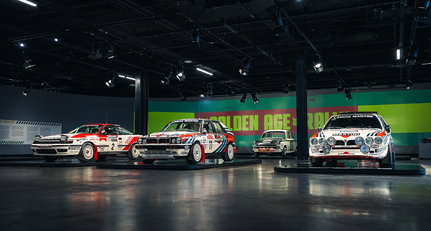

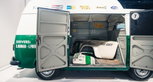

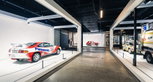

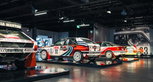
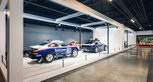




Some say that it is not Formula One, but rather rallying that represents the true pinnacle of motorsport. Just imagine blasting flat out at over 200 km/h down a narrow forest track or covering thousands of kilometers in the scorching desert heat. This ultimate test of human courage and mechanical endurance takes center stage in the exhibition “The Golden Age of Rally”, hosted at Galleria610 in Luxembourg. Located within the GRIDX multi-experience center, this 2,100 square meter gallery treats historic automobiles not merely as vehicles, but as genuine works of art and testaments of their respective time. Following the success of its inaugural presentation dedicated to Ayrton Senna, the venue now shifts its focus from the smooth tarmac of the racetrack to the unpredictable gravel of the rally stages.
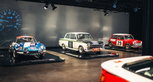
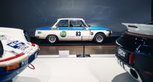
In partnership with Turin’s prestigious "Museo Nazionale dell’Automobile" and the "Fondazione Gino Macaluso per l’Auto Storica", the curation avoids a simple line-up of vehicles, opting instead to tell the story of a rapid technological evolution spanning from the 1960s to the 2000s. The journey begins in an era when compact and light cars, which stayed relatively close to the regular production versions, challenged the race-bred establishment. The 1966 BMC Mini Cooper S with a tiny 95 hp four-cylinder proved that agility could beat pure power. The display model carries genuine racing history, having competed in the 1966 Monte Carlo Rally and won the 1967 1000 Lakes Rally in Finland under Timo Mäkinen, who famously drove part of a stage with a wide-open bonnet after the latch failed, jumping blindly over crests. Parked alongside is its contemporary rival, the 1966 Ford Cortina Lotus Mk1, which claimed victory at the RAC Rally that same year.


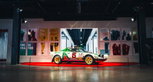
As the sport progressed into the 1970s and the World Rally Championship was established, manufacturers began building cars specifically for this motorsport discipline. The exhibition highlights this shift with the 170 hp Alpine Renault A110 1800, which won the brutal 1973 Rally of Morocco where only 12 of 72 starters reached the finish line. The small company from Normandy ended up writing history as the first official WRC Manufacturers' Champion. The wedge-shaped 1976 Lancia Stratos represents the next leap forward; its 280 hp Ferrari-V6 and uncompromising layout were designed solely to win championships. The exhibition also highlights rarer footnotes of this era, such as the mid-engined 1974 Fiat X1/9 Abarth Prototipo, a promising project that was abruptly halted by the global oil crisis.
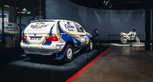
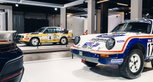
The exhibition reaches its mechanical peak with the extreme creations of the early Paris-Dakar Rally and the Group B era. The Porsche 953 Dakar is undisputably one of the biggest stars at the venue. This heavily modified 911 featured an early, manually controlled four-wheel-drive system that paved the way for the legendary 959. Driven by Jacky Ickx and Claude Brasseur at the 1984 edition of the most grueling rally of its time, this exact car suffered a wiring fire but fought back to finish sixth, while its sister car took the overall victory. Close by, another desert beast joins the grid: an original factory-built 2004 BMW X5 Diesel, which France's Luc Alphand drove to a strong 4th place finish after a grueling 11,000 km race across the sands.


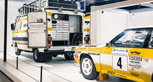
Right next to it, the exhibition showcases a true milestone of all-wheel-drive history: one of only 22 original factory-built Audi Sport Quattro Group B competition cars. This specific car was the second Sport Quattro ever used in a World Championship event, driven by the legendary all-female duo Michèle Mouton and Fabrizia Pons at the 1984 Acropolis Rally and the 1000 Lakes Rally. After serving as a testing car for Stig Blomqvist and even undergoing long-term PDK gearbox development at Porsche Weissach until 1987, the 470 hp, five-cylinder powerhouse with permanent all-wheel drive was fully rebuilt by its current owner and is now completely operational again.
Nearby, the 550 hp Lancia Delta S4 showcases the raw power of twin-charging — utilizing both a supercharger and a turbocharger — which pushed Group B regulations to their absolute limits and marked the absolute pinnacle of this technological arms race, debuting just one season before Group B was banned by the FIA after a few fatal accidents for safety reasons.


The narrative concludes with the high-tech precision of the 1990s. Visitors can lay their eyes on a Toyota Celica GT-Four ST165, the machine Carlos Sainz used to break the traditional Nordic dominance in the sport. The Celica line holds a legendary yet controversial place in history: while the early ST165 brought immense championship success, the later ST205 model became infamous for a highly sophisticated, illegal turbo restrictor device in 1995 that resulted in a factory ban, yet was famously called "the most ingenious thing in motorsport" by the FIA. Standing alongside the Toyota is the Group A icon, a 1990 Lancia Delta HF Integrale 16V, which secured the manufacturers' title after a fierce victory at the Sanremo Rally with Didier Auriol.

For anyone who appreciates the era of unfiltered mechanics and pure driving skill, this collection offers a rare chance to stand face-to-face with the machines that shaped motorsport history. The Golden Age of Rally runs from now until late autumn 2026. The gallery welcomes visitors from Wednesday through Sunday. Tickets can be purchased online via the GRIDX platform or directly at the entrance. Adults pay 14 Euros, while the reduced rate for students is 12 Euros. Children under 8 receive free admission.
Photos by Igor Sinitsin