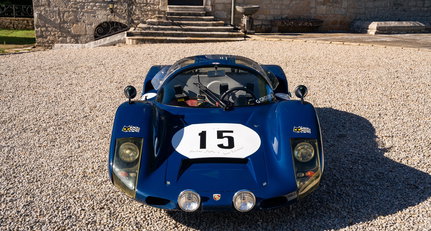
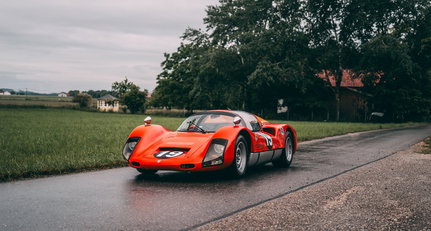
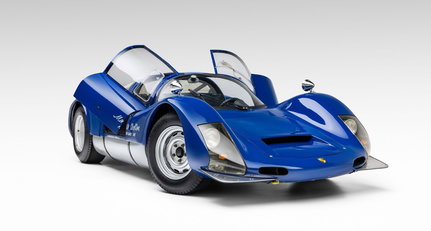
In German-speaking regions, the term "Carrera-Bahn" in the second half of the 1960s became synonymous with slot car tracks. And it fit the picture that the Porsche Carrera 6 developed into the must-have toy for this exciting new way to bring some motor racing flair into living rooms. The new contender from Zuffenhausen was internally known as the 906 but – as rumor had it – was officially sold as the Carrera 6 in order not to upset Peugeot who had secured trademark protection for all three-digit numbers with a zero in the middle. The term "Carrera" was also a nod to the grueling Mexican road race, in whose final edition of 1954 Porsche came home third and fourth behind two much more powerful Ferraris.


Unlike previous racing Porsches, the body of the Carrera 6 Coupe (developed from the open 906 Bergspyder of 1965) was tested in a wind tunnel, resulting in a top speed of 170 mph at the Mulsanne straight – quite a feat for a two-liter car at Le Mans. Its design was also a precursor to future Porsche racing prototypes, exemplified by gullwing doors and a mid-ship mounted engine covered with a large Plexiglas cover. In charge of overall design, at the age of just 28, was the newly appointed head of racecar development, Ferdinand Piëch, grandson of Ferdinand Porsche. Instead of the ladder frame with a load-bearing fiberglass body found on the 904, he and his team went for a lightweight tubular space frame clad with a non-load-bearing fiberglass shell. The result was higher rigidity and a considerable weight loss. A dry weight of only 1,280 lbs was around 150 lbs lighter than the 904/6. With a healthy 210 hp at 8000 rpm the car became so popular among privateers that instead of the 50 units originally planned to fulfill homologation requirements in total 65 cars were built. The majority (52 units) were powered by the two-liter carburetor flat six (901/20), derived from the 904/6.


Thanks to its advanced chassis and reliable powertrain the Carrera 6 rapidly became the most successful two-liter race car of its era. Already in its very first outing in 1966, a works-906 driven by Hans Herrmann and Herbert Linge secured a class victory at the 24 Hours of Daytona and came sixth overall. Further class victories followed at Sebring, Monza, Spa and at the Nürburgring, while at the Targa Florio and on the Circuito del Mugello, the agile compact Porsche even won overall. Additionally, 906s finished 4th, 5th, 6th, and 7th at the 24 Hours of Le Mans—behind the 7-liter-Fords and once again combined with a commanding class victory.


While the Porsche works gradually switched to the 910 during the summer of 1966, customers were busy racing their freshly supplied Carrera 6s. Among them was Chassis 906-113. It had been delivered just in time for the 12 Hours of Sebring of 1966 to American Ed Hugus, a renowned driver who already had a Le Mans class win (1957 in a Porsche 550 A) under his belt and later appeared at the 24 hours behind the wheel of various Ferraris and a Porsche 718 RSK. With the brand-new car Hugus and Lake Underwood finished 4th in class and 8th overall. After the Florida classic, Hugus entered it in SCCA races, only to sell the Carrera 6 at the end of 1966 to Clive Philipps, who went on to compete in numerous US-events in 1967 and 1968.


After the 500 Miles of Road America in 1968 the Porsche was acquired by Mike Rahal, father of future Indy 500-winner, F1-driver and team owner Bobby Rahal. He entered it at three successive Sebring 12 hours (1969, 1970 and 1971) and even modified the bodywork to improve the performance.
In 1974, 906-113 was sold to Charles Allshouse, who passed it on a year later to Rudi Klein. The German-born collector ran Porsche Foreign Auto, a scrapyard in southern Los Angeles, and became famous for his secretive collection of "sleeping beauties" known as The Junkyard, which was auctioned by RM Sotheby's in 2024. The Carrera 6 remained in Klein's possession for twelve years. It was not until 1987 that it found its way back to Germany, when Wolfgang Klotz acquired it with the aim of restoring it to its original specification. In the end, he did not find the time to carry out the work, and the current custodian – a discerning collector and gentleman driver well known at Peter Auto race meetings – took on the task.


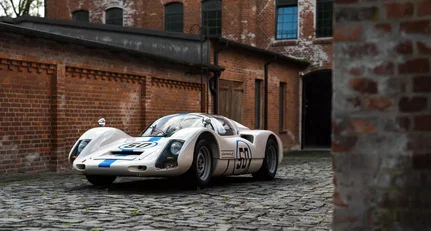
Today, this 906 still has its original chassis and gearbox, bearing starting number 50 and a white bodywork with a blue stripe – exactly as it did way back at Sebring in 1966. Its two-liter engine, which was lost during its racing days, has been replaced by a more powerful 2.7-litre unit. Since the restoration was completed, 906-113 has covered just under 1,000 km. For every collector and classic driver this Carrera 6 from a golden era of sportscar and endurance racing is an opportunity not to be missed. With beautiful lines, a mesmerizing sound and joyful handling characteristics it ticks all the boxes to compete in events like Le Mans Classic, Tour Auto, Goodwood, and all Peter Auto or MRL events. As one of just 65 units and 52 with the air-cooled two-liter-six with carbs it is now on offer by Aguttes for an attractive estimate of 1,2 to 1,6 million Euros.
 Brussels, 10 Oct