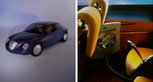


Even though Stellantis is currently trying to relaunch Lancia, the marque today is a mere shadow of its former self. The gradual decline of the storied manufacturer began, at least in the upper segment, roughly thirty years ago. Technologically and stylistically, the Thema still held its own, rolling off the line more than 350,000 times between 1984 and 1994. Its successor, the Kappa, was a different story: with a total of around 117,000 units, it could barely keep pace with the foreign competition, above all from Germany.
Towards the end of the 1990s, as the new millennium approached, the Turin marque set out to reconnect with the glory days of the Aurelia and Flaminia, at least visually. Its answer was the Diàlogos, a concept car unveiled at its home motor show in 1998. It offered a first glimpse of Lancia's design language for the early 2000s and already anticipated the fundamental shape of the later Thesis.

The basic design of the nearly five-metre saloon is credited to Lancia's chief designer at the time, the American Mike Robinson. The exterior itself was the work of Pietro Camardella and Marco Tencone, while Flavio Manzoni took care of the interior. The finishing touches to the exterior came from Ermanno Cressoni, an architect and car designer who had shaped the lines of several important Alfa Romeos in the 1970s and 1980s.
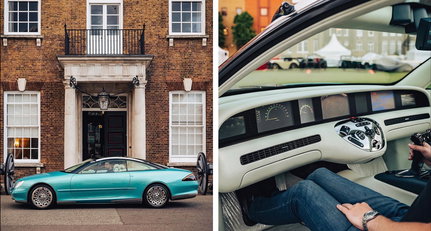
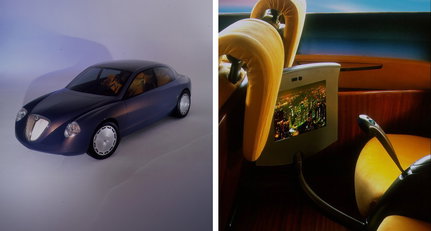
The Diàlogos broke with the rather angular shapes of its two predecessors. In their place it fused two directions that were both very much in vogue at the time: nature-inspired biomorphic forms and fashionable retro styling. Aerodynamically honed, Lancia's vision of its new flagship also looked, like so many cars of that era, a touch soft and rounded-off in places.

At the same time, the design team drew on the brand's own history. Consider the shield-shaped chrome grille. The whole front end, from the unusual diamond-shaped headlights to the strikingly sculpted bonnet, took its cue from the groundbreaking Aurelia of the 1950s. Known as the scudo, this chromed mask went on to become Lancia's defining stylistic signature throughout the 2000s, from the Ypsilon supermini to the E-Class rival Thesis.
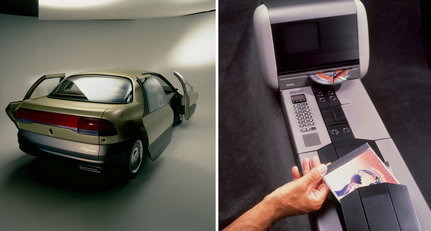
The oppositely hinged coach doors were another nod to the past, borrowed not from Rolls-Royce but from the Lancia saloons of the 1950s, which already opened this way and did without a B-pillar. The slim, angled tail lights, meanwhile, were most likely inspired by the revolutionary Lancia Florida, a Pininfarina concept car from 1955, or rather by the Flaminia that grew out of it, whose fin-like lamps come closest to the Diàlogos rear. Together with the large chrome wheels, it all makes the Diàlogos look like a retro-futuristic reinterpretation of a grand 1950s Lancia.

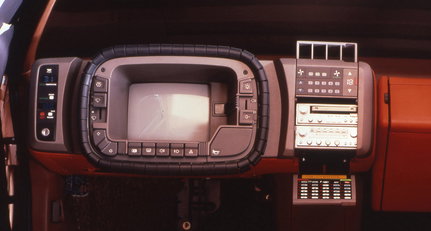
Inside, the era's Y2K futurism sets an entirely opposite tone. The joysticks catch the eye at once: a central one up front and one at each seat. Beyond voice control, the front joystick also operates the infotainment system, the on-board computer and the cruise control. On paper, at least, the study comes with an intelligent radar-based speed-regulation system.
Steering, though, is not digital. It relies instead on the U-shaped control element that replaces the classic steering wheel. Each passenger, meanwhile, can set their own personal micro-climate with a dedicated stick, adjusting not just the air conditioning but the light and sound at their seat. In the rear, two retractable screens and headphones built into the head restraints handle entertainment. Access is made easier by the front seats, which swivel through 90 degrees and, like all the seating in the Diàlogos, are trimmed in nubuck, a sanded and refined form of cowhide.

Its historical role model, the Aurelia, had once pioneered the V6 engine. The Diàlogos, by contrast, came with no engine details at all, for the simple reason that it had none. With this vision of Lancia's future, the focus lay mainly on aesthetics. The drivetrain concept, at least, is on record: in theory, power was to be split variably between both axles, and thus among all four wheels.
The chassis showed real innovation, even if only some of the ideas reached production. The large saloon paired an active differential with an elaborate, fully adaptive multilink suspension at both axles, built around two virtual pivot points. At the front, the virtual steering axis ran precisely through the centre of the wheel, so that potholes and rough tarmac would not set it shaking. At the rear, a virtual pitch centre let the wheel give way slightly over a bump, keeping the impact away from the body.


Lancia's creeping decline in the new millennium had many causes: Fiat's corporate strategy, the state of the Italian economy, competition from abroad and a series of management missteps around the model range. Yet the brand design that the Diàlogos previewed likely played its part too. To this day, few cars in the segment split opinion as sharply as the Lancia Thesis, which inherited the concept's striking face and its arc-shaped tail lights.

In time, connoisseurs would hail it as a modern classic, but most luxury buyers of the day gave it the cold shoulder. Fewer than 17,000 were built between 2001 and 2009, which makes it a genuine rarity today. The picture among the smaller models was mixed. The Ypsilon, wearing the same design language, became the best-selling Lancia of all, while the Delta of 2008 turned into a flop. In the end, the thoroughly elegant Diàlogos did not usher in the new golden age Lancia had hoped for. It marked the beginning of a full-blown collapse for the once-proud marque, which for years was no longer seen as a premium name and, until its recent relaunch, survived almost solely in Italy on the strength of the Ypsilon, its last surviving model.
Photos: Stellantis