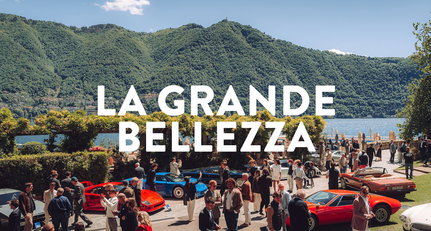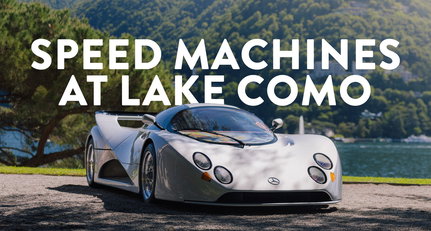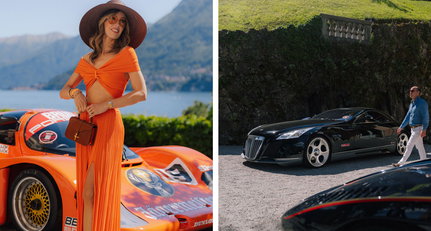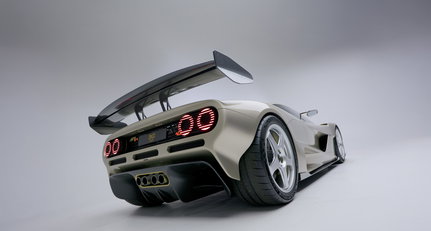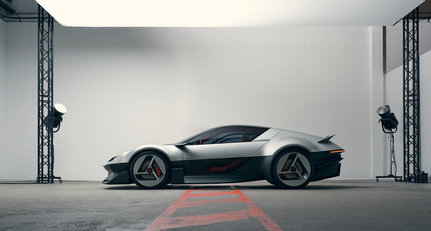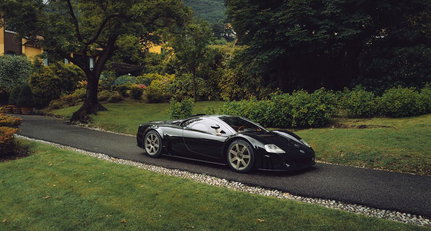


The famous ducks of Lake Como have seen many exotic cars crossing the terrace of the Grand Hotel Villa d'Este — from pre-war elegance and art-déco opulence to the most sculptural expressions of modern design. But last weekend during the Concorso d'Eleganza Villa d’Este, one car quietly redrew the narrative: a Volkswagen W12 Nardò.


It marked the first time a Volkswagen had appeared at the Concorso since it was first held in 1929 — a fact that alone would have been enough to make it notable. Yet what unfolded over the weekend went far beyond historical footnote. The black W12 arrived with its owner Gregor, who brought the car as a deeply personal tribute to his father — a gesture that gave the prototype an emotional gravity rarely seen in the hypercar paddock. And then there was Fabrizio Giugiaro alongside his father, Giorgetto Giugiaro, who didn’t just accompany the car, but arrived with the original design drawings from Italdesign, effectively bridging the gap between concept sketch and concours lawn.


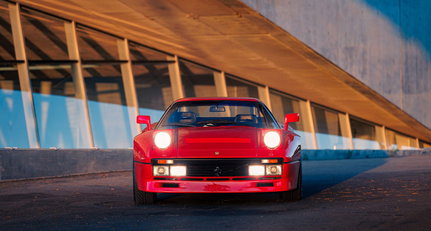
What followed was a kind of takeover: Despite unicorns and blue-chip sensations like a Ferrari 250 GTO or a white-and-gold Lamborghini Miura, the wedge-shaped W12 became the undisputed star of the show, drawing constant crowds and attention as a near-forgotten yet fundamentally important chapter in Ferdinand Piëch’s and the Volkswagen Group’s hypercar ambitions. Our Instagram reel alone crossed 5 million views, underlining just how strongly this story resonated with a new generation discovering it for the very first time.


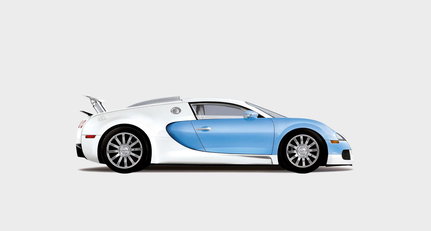
In a decisive moment for the class, the Volkswagen went on to claim the hypercar category win — beating, among others, a Bugatti Veyron prototype, itself born from the same Piëch-era ambition that would later eclipse the W12 Nardò as Volkswagen’s most extreme engineering statement. The W12 story, of course, begins with Ferdinand Piëch’s insistence that Volkswagen prove it could operate far beyond the world of volume production.

Developed by Italdesign under Giorgetto Giugiaro, the mid-engined W12 concept series evolved through a sequence of motor show statements: the Syncro in Tokyo in 1997, the Roadster in Geneva in 1998, and finally the closed Nardò version in 2001. Each iteration sharpened the idea — a full-scale testbed for a radical new engine architecture. At its core sat the now-legendary W12, formed by combining two narrow-angle VR6 units into a compact twelve-cylinder layout. In naturally aspirated form it produced around 420 hp from 5.6 litres, later evolving into a 6.0-litre twin-turbo unit with roughly 600 hp. Compact enough to fit a mid-engined, all-wheel-drive chassis barely longer than a Golf, it was as much an exercise in packaging as it was in performance.


That engineering ambition culminated not just in theoretical promise, but in real-world endurance: In February 2002, the Nardò test program in southern Italy saw the car cover 7,740.5 km in 24 hours at an average speed of 322.9 km/h — a record-setting demonstration of sustained high-speed capability that still reads as almost absurd today.


Although whispers of limited production once floated through Wolfsburg — 200 units, then 50 — the project ultimately remained a prototype lineage. Yet its influence is undeniable: the W12 architecture went on to underpin the Bentley Continental GT and Volkswagen Phaeton, and indirectly fed into the thinking that would later culminate in the Bugatti Veyron. The car shown at Villa d’Este captures that moment in its purest form: a private, preserved snapshot of Volkswagen’s most ambitious experimental phase.
And for those who want the full story, we spoke with both Gregor and Fabrizio Giugiaro in our feature film — out now on YouTube.