

De Tomaso collectors should mark 7 November in their calendars. On that autumn Saturday, Broad Arrow will offer no fewer than four models, each of which played its own important role in the history of the Argentine-Italian manufacturer. Born in Buenos Aires but of Italian descent on his father’s side, racing driver Alejandro de Tomaso moved to the Old World for political reasons in the 1950s. He initially raced Maseratis and OSCAs before founding De Tomaso Automobili in Modena in 1959, backed by his wealthy wife, Isabelle Haskell.
At first, he concentrated entirely on pure-bred racers, but in 1963 he made the leap to road cars. The Vallelunga, named after a circuit near Rome, introduced the basic recipe that would define the best-known De Tomasos: a backbone chassis combined with a mid-mounted, mass-produced Ford engine. In this first model, of which only around 50 were built, that engine was still a four-cylinder from the Ford Cortina. The American V8 power so closely associated with the brand only arrived with its successor.


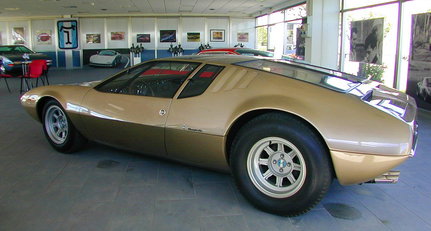
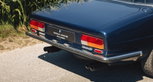
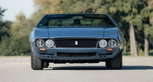
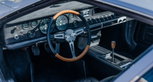
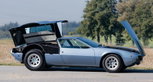
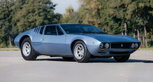
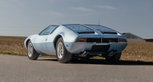
1969 De Tomaso Mangusta
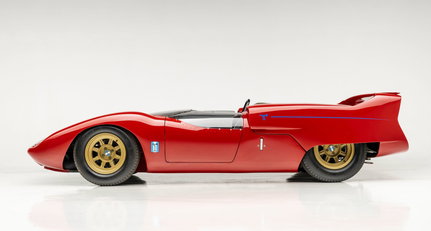
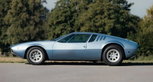
The 1966 Turin Motor Show marked the turning point at which De Tomaso began to be taken seriously as a car maker. It was there that the Mangusta made its debut, the seed of all later V8 De Tomasos and a sports car with unmistakable racing genes. Yet it was not unveiled on a stand of the young manufacturer’s own, but on that of coachbuilder Ghia, because the Mangusta, strikingly modern for its time, had been penned by none other than Giorgetto Giugiaro. The design had originally been intended for a mid-engined Iso that never came to fruition. De Tomaso fell for its lines and combined them with another project that had recently fallen through: the mid-engined P70 racing car he had developed with American motorsport legend Carroll Shelby.


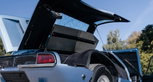
Alongside the sheer force of the 4.7-litre, 305 PS V8 in European specification, the split engine cover with its two upward-opening halves and a limited-slip differential were defining features of this forerunner of today’s supercars. The US version had a slightly larger displacement of 4.9 litres. With the Mangusta, the Modena manufacturer slowly but surely edged its way out of its niche, building a respectable 401 examples by 1971. The 1969 car offered by Broad Arrow was originally delivered to the USA but made its way back across the Atlantic as early as 1990 and was subsequently restored in Germany. Broad Arrow estimates it at CHF 230,000 to 275,000, or roughly €245,000 to €295,000.


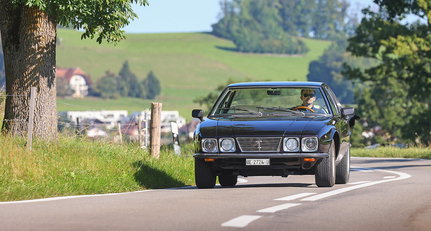
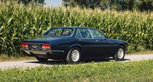
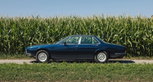
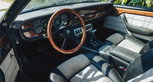
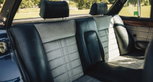
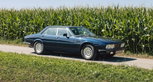
1980 De Tomaso Deauville
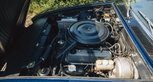
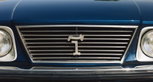
Unveiled in 1970 and named after the famous Normandy seaside resort, the Deauville saw De Tomaso expand its range with a sports saloon. Its new, more comfort-oriented approach was meant not only to boost production numbers, but also to fill the gap left by the Maserati Quattroporte I, which had been discontinued the year before. De Tomaso also had the Jaguar XJ6 in its sights as a rival for the Ghia-styled four-door GT, and wagging tongues at the time claimed the Italians had taken rather too much inspiration from Coventry. Here too, De Tomaso relied on a Ford V8, although in this grand tourer it naturally sat up front, drawing around 290 PS from 5.7 litres. Befitting the saloon’s character, the Deauville was also the first model from the marque to be offered with an automatic gearbox.


In 1978, De Tomaso introduced a second series of the Deauville, in which the engine was moved ten centimetres further back to improve weight distribution. The suspension was also revised and a new ZF steering system fitted, which De Tomaso hoped would sharpen the handling even further. The car going under the hammer on 7 November dates from 1980 and is one of just 244 Deauvilles built in total. Originally delivered to the Netherlands, this well-documented example has spent the past twelve years in a Munich collection. The estimate is CHF 30,000 to 55,000 (approximately €32,000 to €59,000).


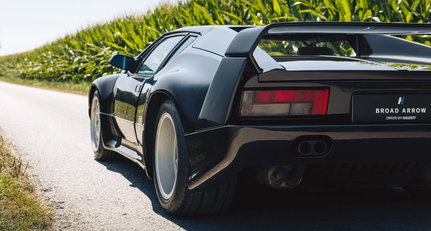
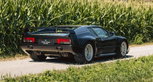
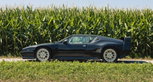
1991 De Tomaso Pantera Si
The Pantera, essentially a more accessible successor to the Mangusta, went down in history as the most famous and best-selling De Tomaso. With the big cat launched in 1971, the Italians had their eyes firmly on the American market. De Tomaso and Ford had agreed a distribution deal under which the sports car was sold in the US through the dealer network of Ford’s Lincoln and Mercury brands. Its positioning made the coupé a genuine success. In America it cost more than a Chevrolet Corvette, but thanks to its mass-produced components, including Ford’s Cleveland V8, it was considerably cheaper than Italian sports cars such as Ferrari’s Dino or the Lamborghini Miura. The Pantera was, in effect, an exotic at a bargain price.


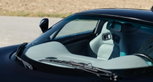
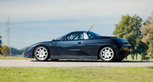
The model went on to enjoy an exceptionally long career. In 1990, the Pantera received its final makeover, styled by Marcello Gandini, the father of the automotive wedge and creator of Italian legends such as the Lancia Stratos and the Lamborghini Miura. With its spoilers and plastic add-ons, the Pantera Si was very much a child of the early 1990s. Behind the seats sat a 5.0-litre version of the Ford V8, sending 247 PS to a ZF five-speed manual gearbox. The auction car is one of only 41 examples of this final evolution, which remained in the range until 1993, out of a total of 7,260 Panteras. It was delivered new through a Stuttgart dealer in 1991 and has remained in German ownership for the past 35 years. The estimate is CHF 210,000 to 255,000 (approximately €225,000 to €275,000).


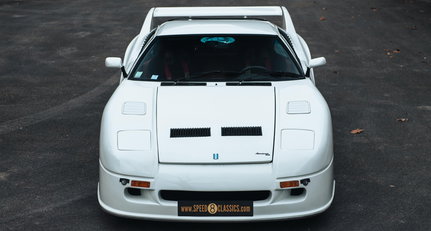
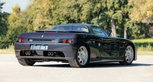
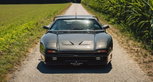
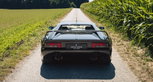
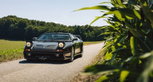
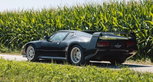
1996 De Tomaso Guarà
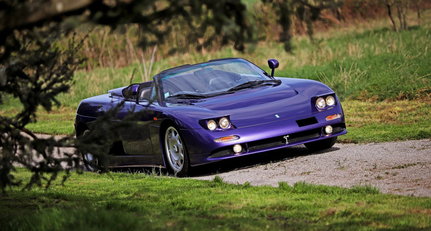
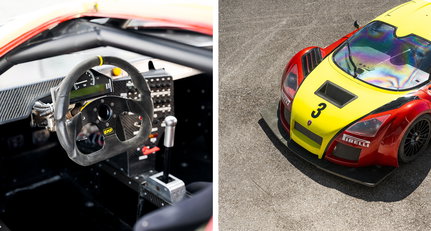
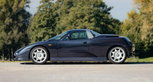
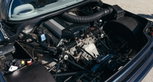
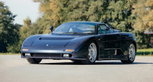
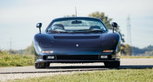
For more than two decades, the Pantera had flown the flag for the marque, but by the early 1990s it was clear that its time was up. At the 1993 Geneva Motor Show, De Tomaso finally unveiled its long-awaited heir, and with it the last chapter Alejandro de Tomaso would write himself before his death in 2003. The Guarà’s styling was decidedly unconventional, while its engineering drew on a Maserati concept, the 1991 Barchetta Stradale. Beneath the skin lay an aluminium honeycomb backbone, while the body was made from a blend of Kevlar, carbon fibre and glassfibre. The suspension, featuring rose joints, was the work of seasoned Formula 1 engineer Enrique Scalabroni. The engine strategy followed company tradition too, except that this time the heart came from Bavaria in the form of a 4.0-litre BMW V8. The partnership with Munich did not last long, though, as the Modena firm soon switched back to a cheaper 4.6-litre Ford V8.


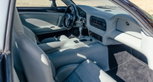
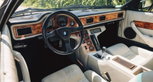
It is this powertrain that makes the Guarà offered in Zürich so special. Only around 21 coupés were built in total, and after 1995 just a handful still received the Munich V8. Built in 1996, this example still wears its original Porsche Blue Metallic paintwork, paired with grey leather, and according to the accompanying certificate left the factory in September 1997. It was first registered in London two years later. Under its second British keeper, the car even made it onto the pages of BMW Car and Classic & Sportscar. The current owner acquired it in 2012, took it off the road in 2014 and has driven it only occasionally since, which is why the odometer shows just around 25,000 kilometres. Broad Arrow estimates the coupé at CHF 70,000 to 110,000 (approximately €75,000 to €120,000).
 Zürich, 7 Nov