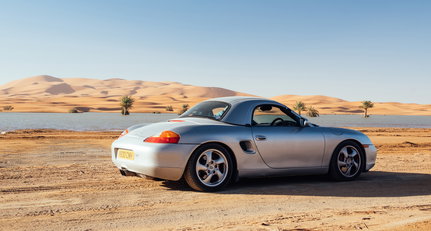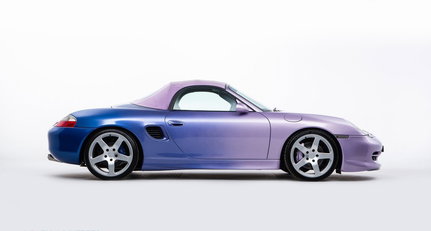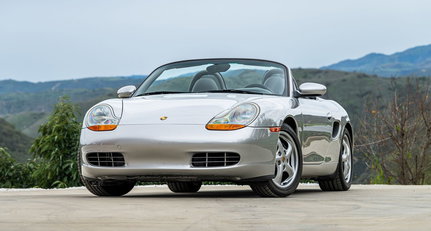
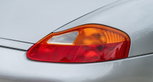
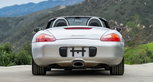
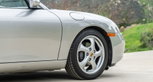
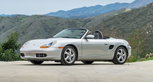
The original Boxster has had a turbulent two decades. While it initially drew thousands of buyers to Porsche’s showrooms as an affordable driving machine, it spent years being dismissed as a 'housewife’s Porsche' on the used market. Many snobbish 911 owners looked down on the small roadster, seeing it as the Porsche for those who simply couldn't afford a Carrera. And financially speaking, they had a point: when the 986 launched thirty years ago, it cost over 40 percent less than the standard 911. At its lowest point, you could pick up a decent used example for well under 10,000 euros.
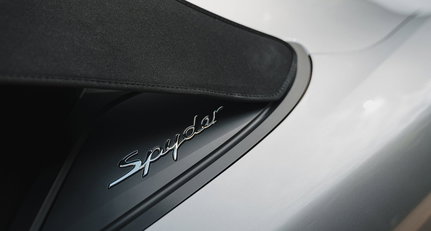
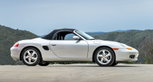
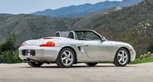
But the Boxster, whose name is a blend of the words 'Roadster' and 'Boxer', was anything but a watered-down 'budget Porsche.' With its compact dimensions, a relatively low curb weight of around 1.3 tons, agile handling, trademark direct steering and its hunkered-down design, it evoked the classic open-top Porsches of the fifties and early sixties — most notably the legendary 550 Spyder. Just like its historic predecessor, it featured a mid-engine rather than a rear-engine layout, resulting in far superior weight distribution and a lower center of gravity.


A Turning Point for Zuffenhausen
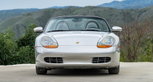
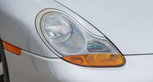
Even if its past image might suggest otherwise, the original Boxster plays a pivotal role in the brand’s history. If you exclude the water-cooled cylinder heads of the limited-run 959, it was the first regularly available Porsche to feature a water-cooled flat-six. With the Boxster Concept unveiled at the 1993 Detroit Auto Show, Harm Lagaay and his team introduced the headlights that critics would later mockingly dub 'fried eggs.' These were two characteristic details that eventually also found their way onto the new 911 generation (996) in 1997. In fact, the front-ends of these two models were almost identical.
The entry-level model appealed to a broader audience and played a crucial role in stabilizing the struggling company. At the beginning of the decade, the automaker was on the brink of collapse, with sales more than halving in just a few years. This was compounded by a weak dollar and low margins due to inefficient production and the lack of a consistent parts-sharing strategy. Inspired by the success of the Mazda MX-5, the Zuffenhausen-based company decided to build a compact roadster that would share a large portion of its components with the upcoming 911 generation. It was a plan that ultimately paid off: by 2004, a total of 164,874 units of the first-generation Boxster were sold.


Output ranging from 204 to 252 hp
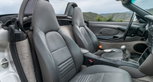
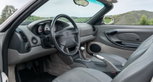
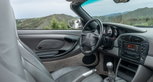
The kinship with its bigger brother ensured that it feels like a true Porsche inside, even if the cost-cutting measures in the interior are noticeable. Typical for the era, the cockpit features plenty of hard plastic and some materials that haven't aged well. However, the signature Porsche layout with its three circular dials and the low seating position more than make up for it. While most competitors relied on front-mounted engines and four-cylinder base models, Porsche’s entry-level car always featured the brand's trademark flat-six placed right behind the seats.
There wasn't a real choice when it came to the engines during the first four years. Only a 204 hp 2.5-liter unit was available, which provided adequate performance without turning the roadster into a rocket. In 2000, this was replaced by a 2.7-liter engine that bumped output to 220 hp, while the Boxster S topped off the range with its 252 hp 3.2-liter flat-six.
The latter benefited from a six-speed gearbox and sprinted to 100 km/h in 5.9 seconds. This made it 0.7 seconds faster than the five-speed manual base model. The Boxster S eventually tops out at 260 km/h. In 2003, the 2.7-liter unit received a further boost of eight horsepower. A five-speed 'Tiptronic' automatic was also available as an option, though some power was lost in the torque converter and a bit of that puristic driving feel was sacrificed in the process.


Engine Issues Are Not Uncommon
While the 986's engines are responsive, sonorous, and offer great flexibility, one technical flaw in particular haunts its reputation to this day: the notorious IMS bearing. This intermediate shaft bearing is considered a structural weak point, as its failure almost inevitably leads to catastrophic engine damage. Particular caution is advised for models from the year 2000 onwards, when Porsche switched to a single-row bearing, which is even more prone to malfunction than the dual-row bearing used previously.
But this is not the only risk. Especially with the 2.5 and 2.7-liter base engines, there is a danger of cylinder liner damage, known as "bore scoring." In these cases, the Lokasil coating on the cylinder walls wears down, leading to scoring, increased oil consumption, and eventually a clearly audible knocking sound. Most experts recommend a cylinder endoscopy before purchase.
Additionally, this generation is known for the typical leaking rear main seal (RMS), which can allow oil to escape onto the clutch disc. The cooling system also requires attention: to prevent overheating damage, the water pump and the front radiators, which often corrode due to accumulated debris and leaves, should be serviced regularly. A comprehensive service history and a well-maintained logbook are absolutely essential for the first Boxster.
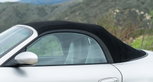
Beyond the drivetrain, the roadster has a few other weaknesses. These include convertible top leaks, mechanisms that sometimes fail to close automatically, faulty power windows and tachometers, headlights that become cloudy over time, and cracked plastic rear windows. While the body is fully galvanized, rust can still take hold if previous accident damage was poorly repaired. However, those who inspect the car thoroughly before buying and insist on a full service history will find the 986 generation to be a reliable and durable roadster. It is a car that puts a smile on your face during every drive and is perfectly capable of serving as a daily driver in the summer.

The fun begins at just under 20,000 euro
The first Boxster hit rock bottom in terms of pricing a good ten years ago. Ever since the 996, which was also long-shunned by the Porsche community, has become a scene favorite amid the Y2K revival, the image of the Boxster 986 has steadily improved. This is also reflected in the prices.
Poorly modified automatic Boxsters with over 200.000 kilometers and no service history can be found starting at around 10.000 euro. In contrast, decent manual examples cost at least 16.000 Euro, while Boxster S models in top condition have now crossed the 30.000 euro threshold.
The "50 Jahre 550 Spyder" special edition, limited to 1.953 units, can sometimes fetch 50.000 euro or even more. This small roadster offers pure Porsche feel, combined with compact dimensions and the distinct spirit of its era. The few examples remaining in top condition are expected to continue appreciating in value in the coming years.
Photos: Broad Arrow