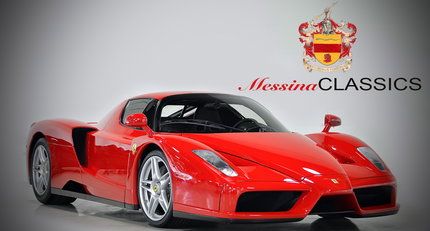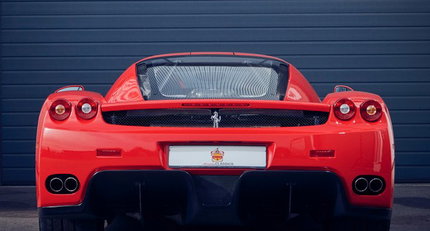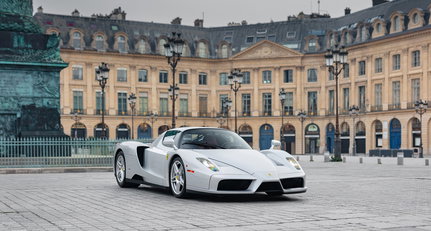
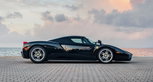
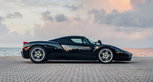


When Ferrari unveiled its latest showstopper at the Paris Salon in September 2002, the Formula 1 team was riding the crest of a wave. Michael Schumacher was well on his way to securing the third of his five world championship titles, and the Scuderia had effectively made the Constructors' Championship its own since 1999. Against this backdrop, Maranello was working at full steam on a successor to the F40 and F50. Project "F60" was eventually launched as the "Enzo", a tribute to the company's founder. Conceived as the rolling embodiment of everything the racing division had learned during those years, the Enzo was limited to just 399 units. Only existing F40 and F50 owners had the opportunity to buy one; a 400th example was gifted to Pope John Paul II and subsequently auctioned off for charity, fetching 1.1 million dollars.
While the F50, with its V12 engine derived directly from the 1990 Formula 1 car, is widely considered the last analogue Ferrari supercar, the Italian manufacturer broke new ground with the Enzo. For the first time, electronic chassis aids, active aerodynamics and new materials were incorporated into a hypercar tailored to the demands of public-road driving, all with the aim of giving customers an experience as close to Formula 1 as possible.


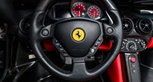
The electronic aids not only managed the flow of power between the engine and the driven axle but also took care of the appropriate chassis set-up. The system adjusted the shift speed of the sequential six-speed transmission as required; gear changes via the steering-wheel-mounted paddles took just 150 milliseconds. LEDs embedded in the upper rim of the steering wheel flashed red in sequence, Formula 1 style, as the gears went up. While the F40 and F50 relied on fixed spoilers to press the car against the asphalt, the Enzo's active aero package (not permitted in Formula 1) generated considerable downforce through front underbody flaps, a small adjustable rear spoiler and a rear diffuser, which work in conjunction to produce a maximum of 1,709 lbs at 186 mph before it decreases to 1,290 lbs at the top speed of 220 mph.
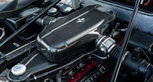
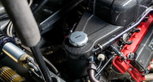
At the heart of the Enzo sat the completely newly developed F140 engine, an all-aluminium 65-degree V12 that generated 660 hp from a displacement of 5,998 cc at 7,800 rpm. It was the most powerful engine ever installed in a production sports car at the time, propelling the fastest road-legal Ferrari ever built to 60 mph in 3.14 seconds and to 100 mph in 6.6 seconds.


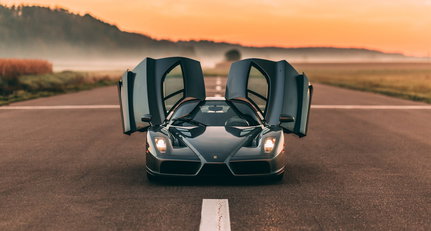
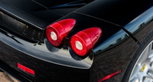
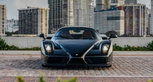
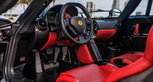
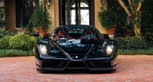
The striking bodywork, developed at Pininfarina under the direction of Ken Okuyama and featuring scissor doors and a nose section unmistakably inspired by Formula 1, enveloped a monocoque chassis of carbon fibre and Nomex honeycomb. For the first time in a Ferrari, carbon-fibre-reinforced silicon carbide ceramic composite discs ensured maximum stopping power. Various chassis settings, such as damper configuration and traction control, could be selected via pushbuttons on the steering wheel. Otherwise, the cockpit was spartan: leather was used only on surfaces that might come into contact with the driver's body. There was no sound system, and the windows had to be wound up by hand.
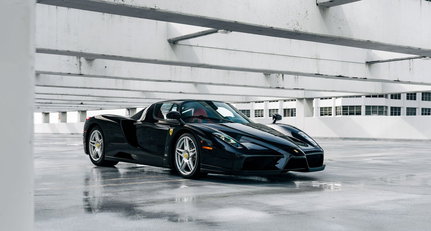
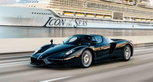
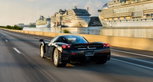
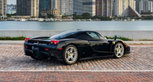
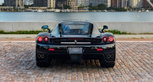
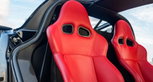
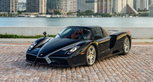
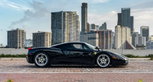
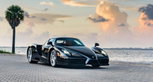
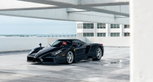
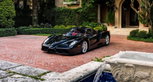
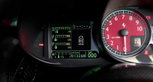
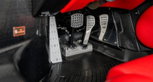
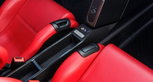
Unlike its predecessors, the Enzo was the definitive supercar from the very day of its launch, and more than two decades later that legendary status has only grown more brilliant rather than faded. The example now offered by Broad Arrow was completed in April 2003 and is one of only a dozen Enzos delivered to the US in Nero D.S., and one of just three of those with a red leather interior. Black carpets, red instrument dials and red racing seats further heighten the dramatic effect of the black-and-red theme.


According to the CARFAX Vehicle History Report, the black Enzo has spent its entire life to date in the USA. It travelled from Nevada through California and Colorado to Arizona before arriving in Florida in 2022, alongside its owner and with 11,359 miles on the clock. In 2026, the Enzo received Ferrari Classiche certification, confirming the originality of key components such as the powertrain, bodywork, suspension, brakes and exhaust system.
Black Enzos are exceedingly rare, and rarer still when paired with a red interior, which allows them to stand out distinctly from the crowd of cars predominantly finished in Rosso Corsa. Few configurations offer a more compelling and even menacing way to experience Ferrari's turn-of-the-millennium technological tour de force. Thanks to its Classiche certification, an unbroken history since delivery and recently completed inspections and technical updates, the next owner need do little more than enjoy this example, which had covered just 13,268 miles at the time of cataloguing, and drive it exactly as its creators intended.
 Carmel, 14 Aug