






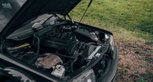


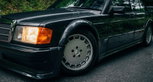


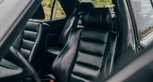



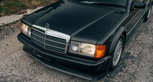



















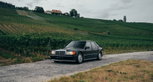




Who is a Mercedes-Benz 190 E for?
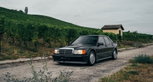
When the 190, internally designated the 'W201', made its public debut in 1982, it not only looked remarkably modern but also set the stylistic direction for future Daimler models. For instance, instead of the old-fashioned foot-operated parking brake so typical of Mercedes vehicles up to that point, the 190 featured a 'conventional' handbrake on the centre console. It was just one of several technical firsts. Initially, only its high starting price, relative to the larger W123, prevented it from becoming an overnight success. However, the compact Mercedes soon became a bestseller. By August 1993, nearly 1.9 million units had rolled off the assembly lines at the Bremen and Sindelfingen plants, 53 per cent of which remained in Germany.
Today, a car like this represents the ideal entry point into the classic car market, especially for younger buyers. Spare parts are plentiful and readily available, though not for the sporty 190 E 2.3-16 and 2.5-16 models. There is an active online community offering advice and support, and a well-maintained 190 E is considered reliable enough to serve as a daily driver. Even the petrol models typically cover 200,000 kilometres without complaint, while the diesel versions are virtually indestructible.
Another target group for the Baby Benz consists of late baby boomers who rode in their parents' cars as children or teenagers, or who lacked the funds to buy one back in the day. They now wish to drive a W201 themselves for nostalgic reasons.


Which version should you buy?
The W201 was offered with a wide range of engines; from 1990 onwards, petrol engines were available exclusively with fuel injection. In 1988, the entire model line-up was significantly upgraded as part of a major facelift.
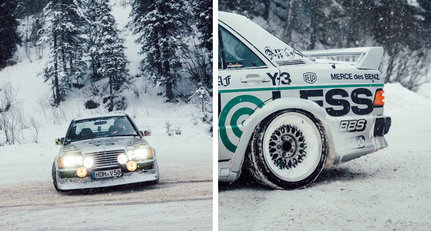
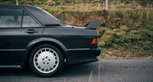
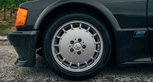
It all kicked off with the 190 and 190 E; in the autumn of 1983, the 72 hp 190 D and the 185 hp 190 E 2.3-16 joined the range. From 1985, the line-up expanded to include the naturally aspirated 90 hp 190 D 2.5 (a five-cylinder diesel), the 136 hp 190 E 2.3 and the 190 E 2.6, powered by a 166 hp inline six. In 1987, the 190 D 2.5 gained a turbocharger, boosting output to 122 hp. The 190 E 2.5-16 followed in 1988, making its debut at the Paris Motor Show. It produced 195 hp thanks to a Cosworth-developed four-valve cylinder head similar to that of the 2.3-16, which it replaced. The Evo I and Evo II played a special role, having been developed as homologation specials for future DTM race cars. These winged monsters were built in only 502 units each.


From 1989, the standard line-up was complemented by the new 'Sportline' models. They featured a body lowered by 22 millimetres, firmer sports suspension and more direct steering. They also had sports seats with a chequered pattern, borrowed from the 190 E 2.5-16, and 205/55 R15 tyres. Finally, in 1992, Mercedes rounded off the series with the visually striking 'Avantgarde' versions of the 190, named Azzurro, Rosso and Verde. A total of 4,000 were built, the majority of which (around 2,300) were painted red.
Among the solid four-cylinder fuel-injected models, the 2.0-litre (122 hp) is preferable to the somewhat sluggish 1.8-litre (109 hp). An early 190 with a carburetted engine (105 hp) offers a combination of simple technology, low running costs and a nostalgic charm that some classic car enthusiasts actively seek out. However, the best all-rounder among the fuel-injected petrol models is undoubtedly the 190 E 2.3: it consumes barely more fuel than the smaller versions yet offers stronger pulling power. The six-cylinder engine is exceptionally smooth and elevates the Baby Benz to a different level. The naturally aspirated four-cylinder diesels, meanwhile, are extremely robust and economical, though rather sluggish, which makes them ideal for a more leisurely pace. The story is different with the five-cylinder diesel, which, in its final 126 hp turbocharged iteration, reaches a top speed of just over 118 mph (190 km/h) while averaging around 7.9 l/100 km (35.8 mpg).

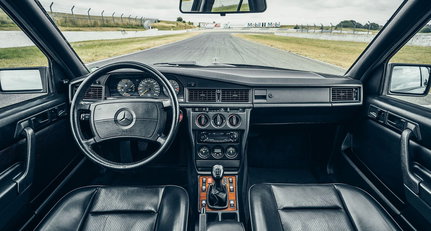
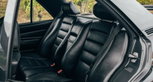
In 1988, the W201 underwent a major facelift, known in Daimler terminology as 'MoPf' (Modellpflege). Key upgrades included painted bumpers and side cladding (the so-called 'Sacco boards'), redesigned seats with tilt adjustment, revised upholstery and foam-core (rather than spring-core) seat cushions. The facelift also brought height-adjustable front seatbelts, a passenger-side door mirror as standard and a slightly shorter final drive ratio for better pulling power in fifth gear. It is therefore well worth keeping an eye out for these later models. At the same time, the 190 E 2.5-16 replaced the 190 E 2.3-16, benefiting from a more reliable duplex timing chain for its camshaft drive. In 1991, ABS became standard on almost all models, with the exception of the 190 D and the 190 E 1.8.


What should you pay for a Mercedes-Benz 190 E?
While the Baby Benz is renowned for its extreme durability, even the youngest examples are now over 30 years old, so a close inspection before purchase is advisable. Prices naturally depend heavily on engine, mileage and overall condition, though with the 190, condition should always take precedence over mileage. On average, a W201 in 'Condition 1' (pristine) costs between €7,500 and €9,800. Cars requiring work ('project cars') sell for under €4,000, while solid daily drivers go for €4,500 to €8,000. Collector-grade examples, including Sportline models, command €8,000 to €15,000. Rare 190 E 2.6 models can even exceed the €20,000 mark.
Classic Data currently values a 190 E 2.3 in Conditions 2 and 3 at €11,400 and €5,300 respectively; a 190 E 2.6 at €13,700 and €6,100; a 190 E 2.3-16 at €30,900 and €16,300; and a 190 E 2.5-16 at €38,000 and €20,200. A 190 D 2.5 Turbo is valued at €10,600 and €4,800 respectively. According to Classic Data expert Sascha Best, prices are currently stagnating. He anticipates that the gap between low-mileage, well-maintained collector vehicles and cars intended for daily use will widen further. The Evo I and II are pure investment assets, commanding prices (in Condition 2) of €100,000 to €185,000 and, in some cases, up to €300,000.


In general, cars featuring the upgrades from the 1988 facelift are preferable thanks to improved rust protection, more durable seats and the attractive Sacco boards. Specific examples worth seeking out include a 190 E 2.6 with an intact cylinder head gasket or a 2.3-16 with matching numbers and a full service history. With a bit of luck and a long search, you might find one of the Avantgarde models released just before the W202 took over. One such car, a red 190 E 1.8 in top condition, is currently listed on mobile.de for €19,980. Well-maintained Sportline models are also true gems. You should set aside around 20 per cent of the purchase price to cover potential repairs and maintenance. As a rule of thumb, it is advisable to budget just over €1,000 a year for an eight-valve model and up to €3,000 a year for the 16-valve sports models.

What are the technical problems?
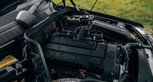
In mid-1988, Mercedes switched from simplex to duplex timing chains for the W201 series. This change affected both the M102 four-cylinder engine (including the new 190 E 2.5-16) and the M103 six-cylinder. Earlier models built before the facelift still had a simplex timing chain, which needed replacing every 200,000 kilometres at the latest. Typical warning signs are a rattling timing chain or clattering hydraulic tappets, especially on a cold start. Anyone who notices them should replace the chain, the guide rails and ideally the chain tensioner immediately; otherwise, costly consequential damage may follow.
The most common issues with the mechanical-electronic Bosch KE-Jetronic in the M102 engine include leaks at the fuel distributor and injectors. Another is a fluctuating idle speed, caused by unmetered air entering the system through brittle intake hoses or hardened seals. Regular maintenance and seal inspections are crucial to preventing starting problems and ensuring optimum engine performance. Diagnosis and subsequent repairs should be carried out by a specialist workshop, though experts note that such specialists are becoming increasingly rare. Nevertheless, a professional assessment is vital, as damage to the KE-Jetronic can quickly lead to repair bills running into thousands of euros.


Cylinder head gasket problems frequently occur on the 190 E 2.6 (M103 engine). The rearmost (sixth) cylinder is particularly prone to issues, as oil can leak into the coolant there. If a leak is suspected, the cylinder head should be removed to inspect the gasket and check for cracks. As always, it pays to act quickly at the first sign of trouble. Furthermore, with Mercedes engines of this era, not only in the W201 but also in the W124 and W126, a minor issue can cause major damage. If the expansion tank cap sticks (clogged valve), pressure in the cooling system can no longer escape. It builds up and can ultimately damage the cylinder head.
A quick word on the transmissions: the manual gearboxes, available with either four or five speeds, are considered robust and relatively trouble-free. Worn gearshift bushes are a common issue; however, they are inexpensive to replace. New brass bushes are the best option, as they improve shift precision and shorten the throw. The four-speed automatic does not cope well with frequent kickdowns or manual shifting. It is also prone to leaks, so check for these during a test drive and make sure gear changes are smooth and free of slippage.

What problems occur with age?
Mercedes gave its new entry-level model good rust protection by the standards of the day, but age has taken its toll on many examples. Rust prevention was further improved with the first facelift (MoPf 1) in autumn 1988. The first thing to check should be the four mounting points of the rear axle carrier. If these are sound and the floor pans are dry, you can generally assume the car has otherwise been well maintained. Be aware, however, that the cost of repairing structural rust at the rear subframe mounts or suspension turrets can easily exceed the value of any W201 other than a 16-valve model.
The jacking points are classic rust traps, especially on the right-hand side (or the left in the UK). The sills, wheel arches and boot are also affected. Because the rear light seals often become brittle, water can get in and potentially cause the spare wheel well to rust through. To inspect this, remove the plastic side trims in the boot to get a clear view of the wheel arches and side compartments. Other rust-prone areas include the rear window frame, the corners of the front wings beneath the indicators, the bottom edges of the doors, the area around the aerial and the battery compartment.


On cars fitted with Sacco boards, it is advisable to remove not only the plastic jacking-point covers but also the boards themselves, as the 'brown plague' tends to spread underneath them. The Baby Benz's multi-link rear suspension was hailed as revolutionary at the time. It did give the 190 excellent handling, earning it wins in comparison tests. The rubber bushes should be checked for wear; a clunking noise from the rear axle indicates worn control arm bushes. At the front, the ball joints are prone to developing play and rarely last beyond 100,000 kilometres.
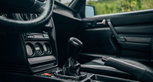
If there is noticeable play in the steering, meaning more than two fingers' worth of movement before the wheels respond, readjustment is of only limited help. While track rod ends are inexpensive to replace, overhauling the steering box is a costly affair. Finally, differential problems often manifest themselves as a faint whine or a film of oil. Repairs become unavoidable once heavy oil loss or loud howling occurs. Inside the cabin, the seat bolsters are often worn through, especially on the driver's side. Heat and UV radiation cause the fabric or leatherette on the upper door panels to come loose. As mentioned above, new seats were introduced from the 1989 model year onwards; these are significantly more comfortable and durable.
The linkage of the ingenious single-arm wiper with its eccentric lift function requires regular lubrication. If the wiper does not move smoothly, the (expensive) motor can burn out. The colour of the instrument needles can help you judge whether the stated mileage is plausible. Ideally, they should be orange rather than yellow or faded.


Is it worth buying a Mercedes-Benz 190?
A well-maintained, garaged car with a full service history that hasn't been left standing for long periods is almost always preferable to a neglected example, even one with seemingly impressive equipment. Rust and accident damage are the biggest potential money pits. If you want an economical classic for daily driving, opt for a diesel; if you are looking for a weekend gem, the six-cylinder is the better choice. Those who frequently drive on the motorway should look for a car with a five-speed gearbox.
The 190 E 1.8 and 2.0 are classic entry-level models; their wide availability keeps prices moderate. Buy on condition, not mileage. The 2.3 is highly popular because it strikes the right balance between strong acceleration and moderate fuel consumption. The six-cylinder 2.6 impresses with its incredibly smooth running, though good examples with a manual gearbox are harder to find than automatics.

Good, unmodified examples with desirable features such as an electric sunroof, air conditioning and rare paint colours are always in demand. Another advantage of all 190 models, at least in Germany, is that they already qualify for 'H' plates (historic vehicle registration), which allows for low-cost insurance. Although the supply of parts is slowly dwindling and prices are rising, the large number of cars still on the road means that replacements, including OEM-quality parts, are still readily available from independent suppliers. A great source of W201 spare parts is rpmdepot.de.
The outlook for spare parts for the 16-valve models, however, is very bleak. According to Marco Dahlke, chairman of the German Mercedes-Benz W201 16V Club, this is unlikely to change any time soon. That is hardly surprising, given how small production figures were compared with the 'bread-and-butter' versions: just under 20,000 units of the 190 E 2.3-16 were built, and a mere 6,700 of the 190 E 2.5-16. Regardless of availability, many parts made specifically for the 16-valve models, especially internal engine components, are consistently much more expensive than those for a standard 190. Carry-over parts such as the headlights or radiator grille, by contrast, are priced normally.

Today, the Mercedes 190 E is an everyday classic with excellent long-term durability. It is no wonder that so many well-maintained Baby Benzes can still be seen on the road, and they don't really look their age. They are practical classics that allow anyone to fulfil the dream of owning their own (and perhaps even their first) Mercedes-Benz.
You can find plenty Mercedes 190E for sale in the Classic Driver Market
Photos: Leuba Collection