



The late eighties were a period of resurrection for Renault. Back in the middle of the decade, the state-owned enterprise was stuck in a life-threatening crisis. The financial results for the 1984 financial year showed a loss in the billions, and Europe's formerly largest automaker had dropped to sixth place in European sales. However, the cost-cutting measures and brand restructuring initiated by turnaround manager Georges Besse, who fell victim to a politically motivated assassination in 1986, finally began to bear fruit.
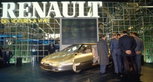
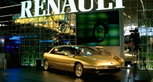
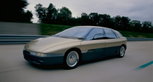
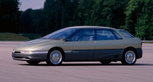
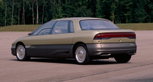
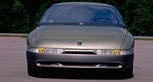
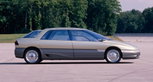
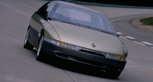
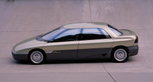
At the 1988 Paris Motor Show, the company unveiled a design study that perfectly embodied this regained confidence. The Mégane Concept Car represented a fresh start in many ways, including the nomenclature. Ever since the groundbreaking R4 of 1961, Renault had classified its passenger cars using a numerical system, with the exceptions of the Fuego and Espace. For the nineties, the brand planned a complete switch to elegant-sounding nouns.


The Clio kicked things off in 1990 as the successor to the R5. By 1995, the designation Mégane, coined by German naming consultant Manfred Gotta, finally found its way into the regular Renault lineup. However, the production model entered the compact class to compete against the VW Golf as the successor to the Renault 19. The 4.95-meter-long concept revealed seven years earlier provided more of a preview of Renault's future flagship, the Safrane, which was set to replace the long-serving R25 from 1992 onwards.
Designing the concept car was one of the first tasks for the new chief designer Patrick Le Quément. He had started his career at Simca, later worked for Ford and Volkswagen, and was brought in from 1987 to breathe new life into Renault's creative department. Previously, their in-house designs often had to make way for those from external studios like Giorgetto Giugiaro's Italdesign. Le Quément is considered one of the most unconventional figures in his profession. During his long tenure at Renault, he would later be responsible for the iconic Twingo as well as the eccentric luxury experiments Vel Satis and Avantime, which were genuinely a few years too far ahead of their time.


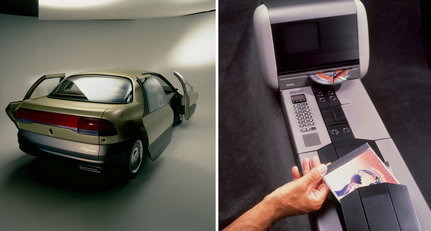
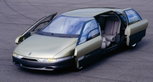
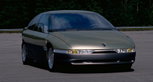
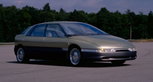
His debut creation for France's largest automaker was deliberately futuristic and unconventional. Instead of a traditional notchback sedan, he and his team devised a novel layout that combined a three-box shape with the spaciousness of a van. It could even be transformed into a fastback using an electrically sliding rear window. Above all, the exterior was designed to be aerodynamically efficient. The Mégane Concept actually achieved a drag coefficient of just 0.21, a figure that production cars of the time could not even come close to. Even Renault's top model at the time, the R25, which launched in 1984 as the most aerodynamic production car in the world with a drag coefficient of 0.28, fell noticeably short with its Robert Opron-styled body. This value remains excellent by modern standards, considering the Lucid Air, the current record holder among production models available in Europe, is rated at 0.197.
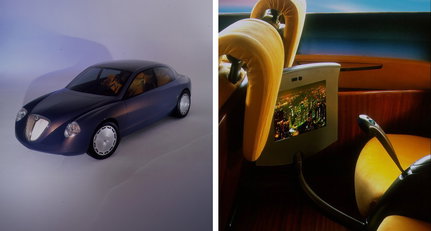
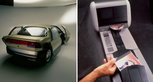
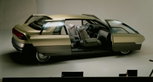
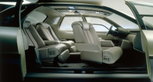
The overhangs of the concept were kept short to stretch the wheelbase to a generous 3.11 meters and maximize interior space. Passengers can relax on thickly padded, swiveling lounge seats. The passenger seat can even be rotated by 180 degrees so the occupant can fully face the rear passengers. Meanwhile, time flies thanks to modern entertainment features. Flip-down mini televisions from Philips are integrated into the headliner, allowing passengers to watch the booming music video channels of the late eighties.


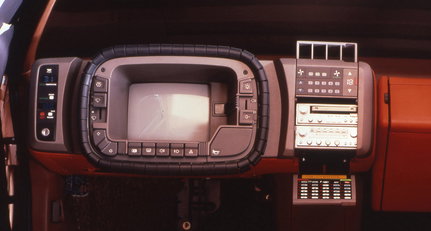
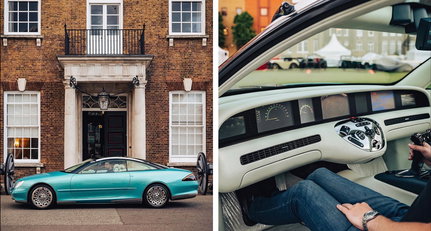
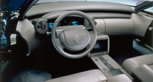
An Atlas computer is housed in the center console and can be fed with a wide variety of information via CDs. Whether it is tourist information about a holiday region or a digital version of the car manual, the only limit was the storage medium itself. On the instrument cluster, two classic analog dials are flanked by two small screens. These display the feed from the rear cameras that capture the action behind the car in place of traditional exterior mirrors.
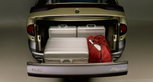
While the Safrane received a large tailgate, Renault opted for a small trunk opening on the Mégane Concept. To ensure the luggage compartment remained easily accessible, the storage floor could be pulled out like a drawer. Naturally, just like the massive sliding doors and the sliding rear window, this detail never made it into production.


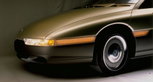
When Renault's actual flagship Safrane debuted four years later, the reactions were rather disappointed. Although Le Quément's team roughly maintained the organic design language, the concept car had promised a bit too much with its spectacular exterior. The rounded front of the R25 successor appeared rather conservative in direct comparison. However, from the B-pillar backwards, there were indeed some visual parallels between the concept car and Renault's nineties executive sedan. The large illuminated rear panel, for example, found its way into production in a modified form as a defining styling element.
Under the flat hood of the Mégane Concept sat a transversely mounted 3.0-liter turbo V6. This was the famous PRV V6, also known as the Europa V6, which also powered the Alpine A610. The engine produced 250 horsepower that was distributed to all four wheels. Thanks to its streamlined shape, the sedan reached a top speed of over 250 km/h, and the all-wheel drive provided such excellent traction that the car hit 100 km/h in 8.3 seconds.


In essence, the design study already previewed the powertrain of the later top-of-the-range Safrane, a highly interesting German-French joint venture. From 1994 to 1996, Renault offered the Safrane Biturbo, based on the V6 Quadra all-wheel-drive version. The BMW tuning specialist Hartge used two KKK turbochargers to boost the core V6 engine to 268 horsepower in the all-wheel-drive sedan, while Irmscher was responsible for modifying the bodywork and final assembly. With a top speed of 250 km/h and a zero to one hundred time of 7.2 seconds, the luxuriously equipped Renault became a serious competitor to BMW and Mercedes. However, the high price tag and the brand's lack of prestige prevented any major success. A total of only 806 Safrane Biturbo models were built, making it rarer than a Ferrari F40.


There was one major drivetrain difference between the futuristic vision and the production model. While a classic five-speed manual transmission handled power delivery in the fastest Safrane, the Mégane Concept featured a semi-automatic gearbox. The clutch pedal was removed, but the driver still changed gears manually. The concept also proved visionary in terms of its chassis. It featured an adaptive setup with three settings ranging from sport to comfort, an idea later picked up by the Safrane Biturbo, whose Sachs-Boge suspension could also be adjusted in three ways.
Even if it might not seem obvious at first glance, the 1988 Mégane Concept ultimately anticipated significantly more technical and visual details of future Renault models than expected. This rings true even beyond the famous name that remains a permanent fixture in the manufacturer's core lineup today.
Photos by Renault Group