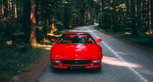
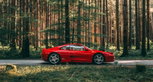
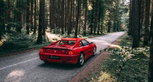
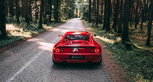
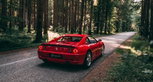
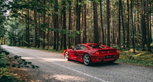
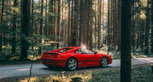

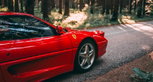
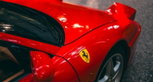
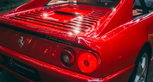
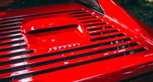



Who is the Ferrari F355 for?
Essentially, this is a car for anyone seeking classic Ferrari qualities without the usual temperamental quirks. Introduced in 1994 as the successor to the 348 GTB and GTS, the Ferrari F355 marks the transition from analog purism to a modern driving feel and everyday usability while retaining a strong character. While Ferrari took only a cautious evolutionary step visually, the car represented a massive leap forward in handling, performance, and overall quality compared to its predecessor, which was fundamentally an 1980s construction.
It can easily be understood as an indirect answer to the Honda NSX, which had shaken up the sports car world at the start of the decade. The Japanese precision tool felt modern and managed to combine supercar performance with an uncomplicated nature suitable for a daily commute. Like many other sports car manufacturers, the Italian brand followed suit.

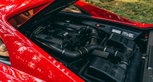
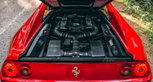
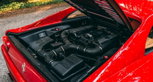
The 3.5-liter V8 engine catapulted Ferrari's entry-level model onto a new level. As a thorough development of the 348 engine, the unit delivered 375 hp thanks to new cylinder heads with five valves per cylinder, a longer stroke, and titanium connecting rods. Revving up to 8,500 rpm, it boasted the highest specific output of any naturally aspirated production engine at its debut. A new Bosch Motronic engine management system made the car far more docile, while the six-speed manual gearbox received a heat exchanger that brought the transmission oil to temperature faster, taming its stubbornness in city traffic.
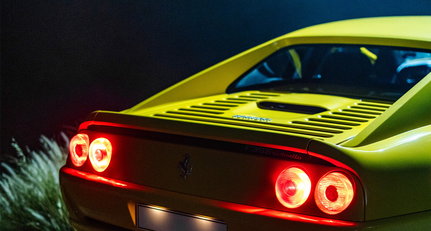
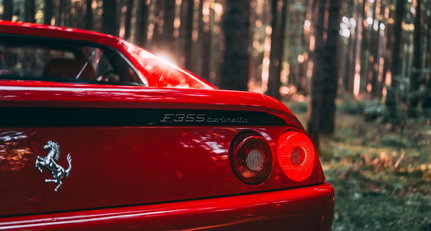
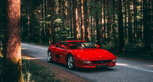
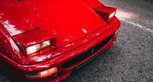
Accelerating from zero to 100 kph in 4.7 seconds with a top speed of 295 kph, the 1,350-kilogram F355 was a top performer in its segment. Its proportions, drawn by Pininfarina, make it one of the most attractive sports cars of the 1990s. Alongside the 456, Maranello bid farewell to pop-up headlights, which had been a defining design trait of the brand since the seventies. At a compact length of 4.25 meters, this car marked the end of an era.


Which version should you buy?
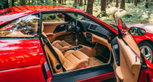
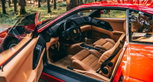
The F355 debuted in the spring of 1994 as the GTB coupe and the GTS with a targa roof. The open F355 Spider followed a year later. Its electric soft top was a significant improvement over the previous model. It eliminated the hassle of operating the roof by hand and gained aerodynamic efficiency through Pininfarina’s wind tunnel refinement. Engineers managed to keep the additional weight of the Spider remarkably low while reinforcing the chassis. Torsional rigidity remained impressive for a convertible, meaning handling was barely compromised compared to the closed version.
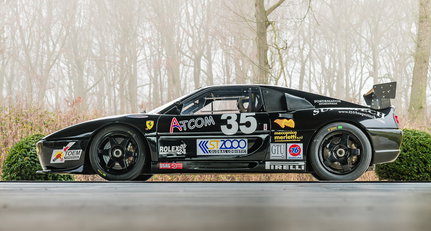
In 1995, Ferrari introduced the uncompromising F355 Challenge, a non-street-legal race version. Near the end of production, Maranello bid farewell to the series with the limited Serie Fiorano edition of 104 units, mostly intended for the North American market. This special model moved closer to the F355 Challenge in terms of suspension and braking setup, offering top-tier driving dynamics.

For the 1996 model year, Ferrari gave the F355 a technical update. The engine management switched to the more modern Bosch Motronic 5.2, primarily to comply with US regulations. Purists still debate this move. While the earlier setup felt slightly punchier, the new engine management provided a smoother throttle response in city traffic, a steadier idle, and lower emissions.
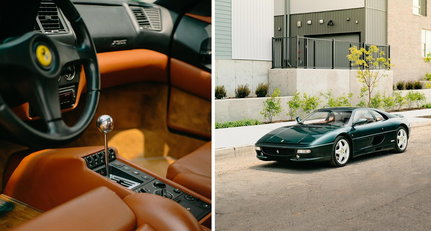
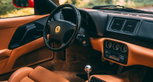
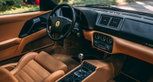
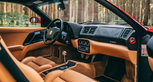
Their distinct character is why many connoisseurs prefer early 2.7 cars today. Early models were also equipped with an elegant three-spoke Momo steering wheel. In mid-1995, this was replaced by a somewhat clumsy four-spoke wheel with an integrated airbag, which felt like a major aesthetic downgrade. Over the years, many owners have retrofitted the earlier wheel.
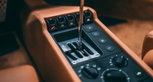
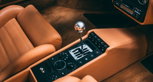
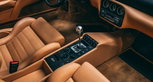
In late 1997, Ferrari introduced the sequential F1 transmission with an automated clutch and six speeds. The F355 became the first production car in the world with paddle shifters behind the steering wheel. Driving it smoothly requires some adjustment, and contemporary motoring journalists were not entirely convinced. Combined with its late introduction and higher price when new, cars with the F1 transmission account for only about a quarter of total production. For many, the authentic Ferrari experience is complete only with the gated manual transmission.


What should you pay for a Ferrari F355?
By 1999, roughly 11,300 units of the F355 had left the Maranello factory, making it one of the most produced Ferrari models up to that point. Aside from the Challenge and Serie Fiorano, it is not a rare car. However, like its siblings, it remains a highly emotional and striking machine, ensuring strong value retention when combined with the iconic badge.
While never cheap, market values hit a bottom around 2013, when usable examples could be bought for under 40,000 euros. Prices have risen steadily ever since, with growth accelerating in recent years. Good cars once available for under 100,000 euros now start in six-figure territory unless you are willing to invest heavily in mechanical and cosmetic restoration.
Prices vary widely across the market. Late-production models with moderate mileage start around 120,000 euros, while restored early 2.7 cars with full documentation can exceed 200,000 euros. Buyers consistently pay a premium of tens of thousands of euros for gated manual cars. The classic Berlinetta remains the most sought after, though every body style maintains strong demand.


What are the technical problems?
While the drivetrain is generally robust, financial pitfalls can lurk beneath the engine cover. Original exhaust manifolds tend to crack due to extreme heat and vibration, which is a structural flaw rather than normal wear. Beyond repair costs, this poses a danger to the V8. Heat-damaged debris from the pre-catalysts can be drawn back into the combustion chamber, causing severe engine failure. Many cars have already been upgraded with aftermarket headers.
Main catalytic converters also fail over time. Factory replacements are expensive, leading some owners to install test pipes, which creates problems during emissions inspections. Exhaust bypass valves wear out as well, revealing themselves through rattling at idle.


The five-valve engines of early cars suffer from soft bronze valve guides that wear prematurely. This leads to blue smoke on cold starts and high oil consumption. Ferrari transitioned to durable steel guides late in the production run. Ignoring this wear leads to costly engine damage. Another major expense is the timing belt replacement, mandated every three years or 48,000 kilometers. Performing this service requires removing the entire engine and gearbox assembly, taking a substantial chunk out of your maintenance budget.
On F1 models, the hydraulic pump is a primary weak point, and failure is costly. Clutches on F1 cars wear faster than on manual models and also require an engine-out procedure to replace. Manual models are not entirely worry-free either, as the clutch slave cylinder is prone to leaking over time.


What problems occur with age?
Although build quality improved significantly over the 348, the F355 still displays age-related flaws. Fine hairline cracks often form in the paint where the C-pillars meet the rear fenders due to body flex. Serious rust is less common than on the 348, but it can appear on wheel arches, lower door edges, and under window seals if neglected.
The adaptive suspension featuring electronically adjustable Bilstein dampers presents another vulnerability. Actuators atop the dampers fail due to broken internal plastic gears, triggering a warning light on the dashboard. Aged suspension bushings and worn ball joints also degrade handling precision at higher mileages.
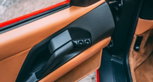
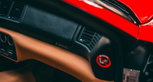
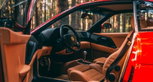
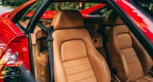
Inside the cabin, the F355 suffers from sticky buttons, a problem shared with nearly all Ferraris from this era. The soft-touch coating on switches, air vents, and door handles degrades from heat and skin oils, turning into a sticky residue. Furthermore, leather on the dashboard shrinks, warps, and pulls away under UV exposure.


Is it worth buying a Ferrari F355?
For fans of the Cavallino Rampante, the answer is a straight yes. The high-revving V8 and the balance of usable engineering with an analog driving feel make it compelling, particularly with a manual gearbox. Its timeless Pininfarina design marks an important milestone as the last newly launched Ferrari model with pop-up headlights, following the 456 introduced two years earlier.
The car is far more robust than its exotic reputation implies too. Financially, while V8 Berlinettas lagged behind V12 models for years, growing collector demand gives the F355 solid long-term appreciation potential.
Photos by Stephan Bauer for Schaltkulisse GmbH