

Jean Sage (1940-2009) was one of the figureheads in French motorsport throughout the 1970s, 1980s, and 1990s. Most of you will remember him as the racing director of the Renault F1 team. But Sage had a career both before and after his time at the helm of Renault Sport which lasted from 1977 to 1985.
Born in Annecy he started his career as a co-driver in rallying, at the young age of 19 with André Simon in a Ferrari 250, entered for the Mont Blanc Rally. Next he started a career in single-seater racing but after good results in Formula 3 were lacking he realized that his talents were more in organizing and developing a new racing team. Thus in 1973 he founded Écurie Elf in Switzerland, with well-known racing driver Gérard Larrousse and Paul Archambeaud, a Swiss Mercedes dealer at the time. They started with sportscars but soon focused on Formula 2 clinching the European title with Jean-Pierre Jabouille as early as 1976.
When Larrousse was hired by Renault at the end of 1976, he brought Sage with him to run the manufacturer's newly created Renault Sport Motorsport division. From then on and after a steep learning curve they brought the first turbocharged F1 car to top level, culminating in the first Turbo-victory ever at the French GP of 1979 with Jabouille at the wheel.


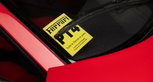
After having departed with Renault at the end of the 1985 season, Sage – already a long-time and ardent collector of Ferraris – joined Ferrari France (Charles Pozzi S.A.) in 1989. In his new role he managed an IMSA GTO program in the US, with a Japanese-sponsored, Ferrari France-entered F40 driven by French star drivers Jabouille, Jean-Louis Schlesser and even Jean Alesi. Of the ten races in which the red car competed until the end of 1990, they took home five podium finishes. Although the program was discontinued for 1991 Jean Sage now knew the F40 inside out – and its potential whetted his appetite for more.
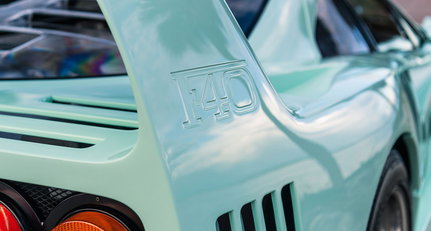
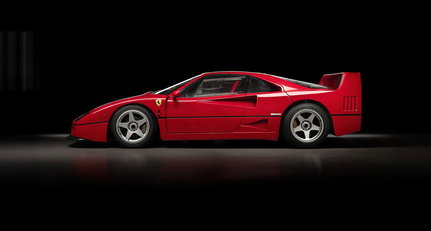
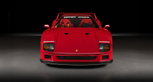
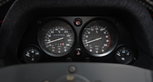
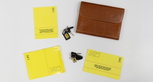
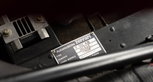
To start with he acquired a 1989 model-year F40 for private use via his employer Charles Pozzi. Chassis 84642 was listed as a "non-cat, non-adjust" example (without catalytic converter and adjustable suspension), was issued with its factory warranty in April 1990 and registered to Sage's Annecy address in May. Come 1994, and with just slightly over 16,200 kms on the odometer, he approached Michelotto with a commission to heavily modify his car. But in a way that wouldn't endanger its road-legal status. By that time Michelotto had already modified 18 F40s to F40 LM-derivatives. For entries – as the acronym suggested – at the 24 hours of Le Mans.


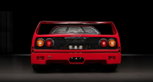
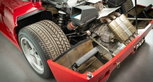
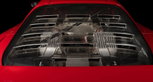
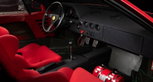
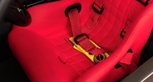
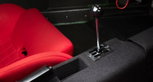
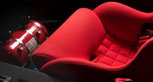
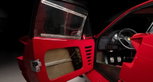
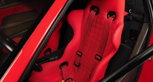
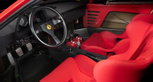
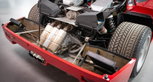
On top of the job-list for Sage's F40 were measurements for lightening, power increase, plus suspension and brake upgrades, all close to CSAI-GT-specs. Michelotto went to work without any major limits, rebuilding the original V8 with two I.H.I. type-B52 turbochargers and a lightweight exhaust system by Chabord. This pushed power output to 527 hp (an increase of 49 hp), with a peak torque of 626 lb-ft (a staggering jump of 200 lb-ft). 30 kilos of weight were saved by lightweight front and rear clamshells, sliding windows, the removal of the air-con and F40 LM-type carbon fibre seats neatly trimmed in red cloth with a quilted pattern to the center. When it left the workshop the scale even showed a total weight loss of 136 kilos – meaning that this F40 was both more powerful and lighter than the later F50!
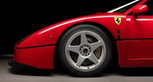
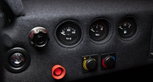
As per the Michelotto build sheet, this most extreme of all F40s was a car to be used on the road and on the track – thanks to major modifications to the chassis systems. They comprised new OZ Racing 17-inch monoblock wheels, aluminum Koni adjustable shocks, an F40 LM braking system, a cockpit-mounted brake bias adjuster, and cooling ducts for the front and rear brakes. A chunkier, US-type front splitter was fitted to improve downforce.


Jean Sage continued driving his galactic F40 on the road but the records also show two excursions onto racetracks. In October 1994 he loaned the car to Pozzi manager Daniel Marin to compete in the Ferrari 348 Challenge finals. In March 1995, the car took part in the official qualifying rounds of the BPR Global Endurance GT Championship at Paul Ricard. Its best lap was just six seconds slower than the fastest full-fat F40 LM. Not bad for what was still essentially a road car.
Also in his later life Jean Sage, who tragically lost a fight against cancer at only 69 years of age, remained an active Ferrari collector and competitor on classic racing events. Remaining in his ownership until 1996, F40 #84642 was imported into the UK and sold to its second owner in October that year. To make the car slightly more amenable to drive on public roads during that time, when the Chabord exhaust and roller bearing turbos were removed.


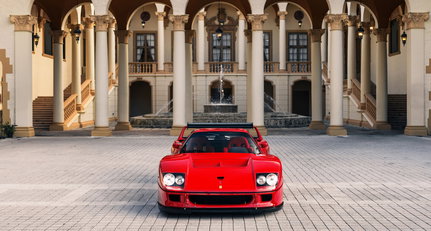
At the time of cataloguing this electrifying Prancing Horse with its underlying racing-DNA has been clocked 22,699 kilometres (approximately 14,105 miles). Upon inspection, the car was found to still have its matching-numbers engine and gearbox. The current exhaust fitted is a Tubi system, there is still no air conditioning, but in return the car retained a fire extinguisher system, the carbon fibre bucket seats and the Koni shocks. The braking system and pedal box are also still in the same specification as installed by Michelotto, as are the US-specification splitter and the OZ Racing wheels.
Jean Sage was a passionate authority on Ferraris, a genuine enthusiast who always sought the best examples for the events he organized in period. The Ferrari F40 'Jean Sage' by Michelotto stands far out from the crowd and has supreme performance and most prominent ownership to boot. At auctions Ferrari F40s constantly reach prices beyond the 2.0 million euros (2.3 million dollars) mark. The RM Sotheby's estimate for the Ex-Sage car – 3.55 to 4.23 million dollars (3.1 to 3.7 million euros) – proves how extraordinary and unique this one really is. We can't wait to see how it will perform at RM Sotheby's Woodcote Park Auction on July 8th.
Photos: Ashley Border for RM Sotheby's