

Some of the greatest cars in history weren’t conceived by their manufacturers themselves, but were born from the ideas of influential outsiders. Before companies mostly relied on consulting firms to shape their model line-ups, they were often driven by the requests of important customers and business partners.
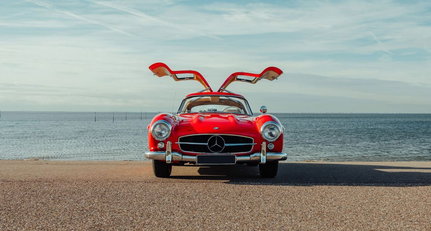
One of them was Max Hoffman. We can thank the Austrian-turned-American businessman’s persuasiveness for the creation of several true automotive icons. From 1947 onward, he became the most important importers of foreign cars to the United States, especially on the East Coast. At one point, he held official contracts with ten different brands—some of which achieved their first major U.S. sales thanks to his efforts. Hoffman famously convinced the Mercedes-Benz board to put the iconic 300 SL Gullwing into full-scale production by promising to purchase a batch of 1.000 cars if they do so.
Another brand he helped establish in the U.S. market was Porsche. Even though he had only recently emigrated to the States in the late 1930s, he had a keen sense for the tastes and demands of American customers. In October 1950, he held an important meeting with Porsche executives to plan the export of the 356 to the United States. During these talks, he tried to convince the small manufacturer to develop a lightweight and affordable roadster, wrapped in a elegant dress.
Growing interest in club races promised strong sales potential for a car like this. On the occasion of the meeting, Porsche engineer and designer Erwin Komenda quickly sketched the first outlines of an open two-seater to Hofmann's specifications. Ultimately, however, the project was put on hold for the time being, as Zuffenhausen lacked the necessary production resources at the time.

In Porsche’s hometown lived another prospective customer who promptly took the initiative himself. Wealthy industrialist Heinrich Sauter, heir to the Hahn+Kolb machine tool manufacturing dynasty and a former Luftwaffe fighter pilot, spent his weekends as a gentleman racer with strong ties to Porsche. After trying various German sports cars, he raced the fairly new 356 Coupé with success. He liked it overall but found it a bit heavy, not streamlined enough, and therefore too slow.
He teamed up with Hans Klenk, a renowned figure in the international racing scene after World War II. Main driver Karl Kling and Co-Pilot Hans Klenk drove the Mercedes 300 SL to overall victory at the 1952 Carrera Panamericana. The duo proved unstoppable in one of history’s toughest road races — not even a buzzard crashing through the Gullwing’s windshield and out the rear window could stop them, with Klenk at the wheel of this legendary machine.
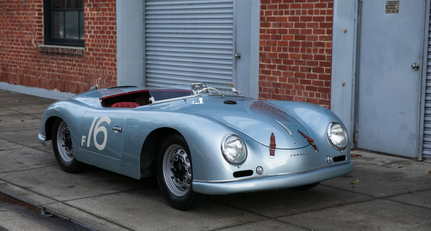
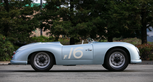
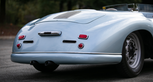
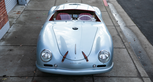
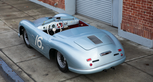
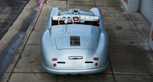
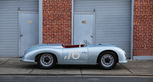
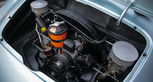
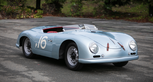
But he wasn’t just participating in races, his fabrication shop "Hans Klenk Karosserie" also bodied race cars, sometimes in direct collaboration with Porsche's designers and engineers. Heinrich Sauter ordered a brandnew Pre-A 356 chassis with the number #10359 straight from the factory, which was delivered to Klenk's company. They came up with a low slung and simple steel-body, whose shape was directly inspired by Komenda's sketches. The hard work paid off – the resulting 356 Sauter Roadster was almost eight centimeters lower than a standard 356 Cabriolet, which improved aerodynamics and the handling characteristics. It was also circa 200 kilograms lighter than a standard 356 Cabriolet, which was a huge improvement in combination with the 55 hp and 1,5 liter „type 527"-flatfour. The Sauter Roadster was the first competition car powered by this new engine, which had 12 horsepower more than the 1,3 liter.
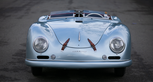
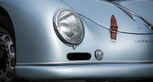
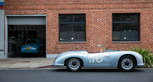
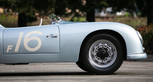
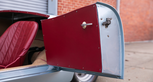
The main difference between Klenk's design and Komenda's initial drawings was that the Sauter Roadster ended up looking almost flattened in comparison. Even though it has the typical 356 face with the big, round eyes and bulging front fenders, Klenk's company gave Sauter's personal Roadster a unique look, which differentiated quite heavily from the 356s that are officially leaving the factory in Zuffenhausen. The missing bumpers and the stripped-down chrome trim are giving it a minimalistic appearance. Sauter demanded the car to have suicide doors, because he expected them to be practical at rallies with checkpoints or at the 24 Hours of Le Mans. The Roadster was never intended to have a roof.


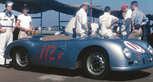
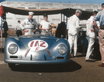
The car’s completion took six months and the Sauter Roadster immediately appeared at the first motorsport event, the Eifelrennen on the Nürburgring, after leaving Klenk’s bodyshop in Spring 1951. Because it basically wasn’t a factory Porsche by the classic definition, therefore not built in Zuffenhausen, the manufacturer suggested to Sauter that he should enter the car as a "VW-Special" instead of a Porsche. But the one-off delivered right from the start, finished the first lap in the lead and also achieved the second fastest qualification lap on its first outing, which led Porsche to rethink this decision. The company suddenly wanted Sauter to register his car under their brand name. An engine failure later forced him to drop out of the race, but the strong performance in the early stages turned the Eifelrennen into a considerable success for both Sauter and Porsche.
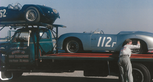
The car competed in a few European events in the following months, including the Liège-Rome-Liège Rally. By the end of the year, Porsche acquired it. The company made minor changes and improvements to the cooling system, stamped it as an official factory project, and sold it to François Picard, a friend of Sauter. The Frenchman participated in several events behind the wheel of the Sauter Roadster, for example at Montlhéry and in Morocco, where he sometimes even beat more powerful cars like the Ferrari 166 MM. This sparked speculation about which engine he used; some suggest he already had access to the new 1.5-liter Super engine (Type 528) with 70 hp. Picard achieved six overall class wins in the 1,500 cc category, for example at the Spring event in Hockenheim, and even entered the Monaco Grand Prix and the Mille Miglia, but didn’t reach the finish line at either of the legendary races. After the end of the season, the Sauter Roadster went back to the Porsche headquarters.
The staff was already busy working on a factory version of a 356 Roadster there. The engineers were quite inspired by the Sauter Roadster and the resulting „America Roadster“, which had a aluminium body and was built only 16 times, was regularly used in motorsports. It was also powered by the 1.5-liter engine, but ended up looking quite different and way more fashionable than the singularly racing-focused Sauter Roadster. It was the car Hoffman had envisioned after all.


Sauter's one-off ended up across the pond, because Porsche sold it to Sam Mullin in early 1953. The attorney was quite active and renowned in the Californian racing scene and continued using the car as it was intended at several events across the continent. It was actually his friend Jack Armstrong who found him this unique car while scouting for an adequate race tool in Europe. The Sauter Roadster somehow survived his racing career without being severely damaged and spent many years in the hands of a private owner after retiring from the circuit in 1954.
Fast forward to 1982, when the Porsche-authority and brand historian Dr. Ray Knight found the car in a Indiana junk yard. It was complete, but in a sorry state, because it’s been stored outside for years and fell victim to a fire, which destroyed most of its interior. After some convincing, the owner accepted his offer to buy it. At first Knight didn’t knew exactly what he had found, it could have been a real Porsche, a mixture between Porsche and VW-components or a Porsche Special, of which many saw the light of day during the fifties.
So he decided not to only thoroughly restore the vehicle in a process which took several years and involved renowned Porsche specialists, but also to completely research its history. From a certain point on, he received official help from the Porsche Archive for this, and he had direct contact with some people who had shaped the story of the one-of-a-kind race car – including Heinrich Sauter and Hans Klenk themselves.


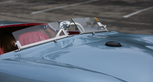
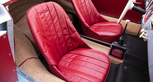
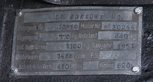
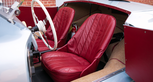
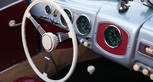
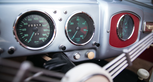
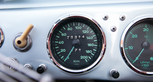
It is thanks to Knight that Fantasy Junction can present the Sauter Roadster today in such an excellent condition – the car carries VIN 10359 and currently shows around 5,300 kilometers on the odometer. The true mileage is unknown though. The blue-silver paintwork, a color scheme that Picard once chose for the vehicle, harmonizes perfectly with the red leather upholstery and the subtle chrome trim. In the rear sits 1.5-liter boxer engine with dual carburetors, like back in its racing days. Above all, Knight has brought the vehicle back into the light of day after decades of obscurity and made its historical significance clear. The Sauter Roadster ranks among the most important 356s and, to a certent extent, has paved the way for later milestones in Porsches racing history, like the Porsche 550 Spyder or the 356 Speedster.