





The year was 1938. Ferdinand Porsche’s design office, founded in Stuttgart in 1931, had completed the project that secured its survival for the long term: the KdF car, the “Volkswagen,” for which a new factory was being built near the town of Fallersleben in Lower Saxony. The cornerstone was laid there in May by Adolf Hitler in person.
Back in 1937, Porsche had already begun work on the Type 64, known internally as “60K10.” It was an aerodynamically refined record car with an aluminum body masterfully hammered into shape by Erwin Komenda. The intended power came from a rear-mounted, air-cooled four-cylinder boxer engine. Bored out from 61 to 92 cubic inches, it was supposed to enable a top speed of 100 mph at a weight of only 1,200 pounds. The project could not be realized right away, however, because of the large number of state-manufactured VW parts, which under the strict laws of the time could not be sold to a private company.


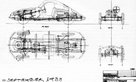
So Porsche decided to start a project of its own, since Ferdinand and his son Ferry Porsche had long recognized the potential of the KdF platform. Under the development code “114” (also called the F-Wagen, for Ferdinand), a coupe emerged that looked very similar to the Type 64 but followed a completely different drivetrain concept. Instead of the air-cooled boxer from the “People’s Car,” the Porsches envisioned a water-cooled V10 with two overhead camshafts, which was meant to extract roughly 72 hp from only 92 cubic inches and propel the car to an estimated 110 mph. The suspension consisted of trailing arms at the front and swing axles at the rear, with drum brakes on all four wheels.


The real highlight, though, was the mid-engine layout, with the transmission placed even farther back, behind the rear axle, as on the Auto Union Grand Prix car that Ferdinand Porsche had designed years earlier. Ultimately, the 114 never got beyond design drawings and small wooden models, which Porsche’s mathematician Josef Mickl used for wind tunnel tests. International tensions and soaring costs amid an uncertain political situation led to the project being canceled.
The preliminary work was not entirely in vain, however. For the “Berlin–Rome” propaganda long-distance race, conceived by Hitler and his fascist ally Benito Mussolini, Porsche now got the green light for the Type 64, of which three examples with bodies by Reutter in Zuffenhausen were built between August 1939 and June 1940. With just 40 hp, the streamlined racer, shaped like a UFO, was supposed to reach up to 100 mph, but because of the outbreak of World War II, the race never took place.


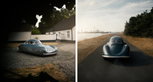
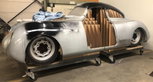
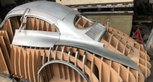
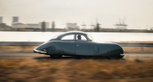
Fast forward to 2020, and enter Edwin Jespers, a Belgian with a rare gift for building a car body and its associated technology from scratch using traditional methods and templates, or even, as in this case, reconstructing it completely and as authentically as possible. It was the COVID era, and his children had to stay home because of school closures. So the decision was made to take on a project that was unique even for Edwin, with the whole family, and his daughter Demi in particular, at his side. As a blueprint, they had only a few drawings and photos, specifically of the second of three designs of the stillborn 114. They started with the body, crafted over an ash frame and then welded together by Demi, who was 16 at the time. Since she didn’t yet know how to weld aluminum, the body was made entirely of steel, with no body filler at all. In fabricating all the main panels, Edwin got help from another family member, his son Björn.


Next up was the chassis. Jespers built a tubular frame from 25CrMo4 steel tubing on a wheelbase of 106 inches (2.7 meters), longer than the Type 64’s 94.5 inches (2.4 meters). Since the 1.5-liter V10 never made it off the drawing board, Edwin did what Porsche did back in the day and chose a period-correct Volkswagen (KdF) drivetrain. In his view, that suits a car from that era much better anyway. Edwin built the engine on a 1944 Kübelwagen block, to which he added a crankshaft from a 1600 cc Porsche engine. This lengthened the stroke to 3.07 inches, and with a bore of 3.27 inches, displacement rose to 1,688 cc. He then fitted Denzel cylinder heads with four individual Solex 28 VFIS carburetors and added a full-flow oil system, an extra-capacity round oil sump and a 1951 Scintilla magneto ignition. He has not yet had time to put the engine on the dyno, but he estimates its output at 70 to 80 hp. The transmission, also from the 1944 Kübelwagen, was given longer gearing and full synchronization. The car still retains its original limited-slip differential, while the Kübelwagen’s reduction boxes have been replaced with straight axles.


Even the wheels are bespoke designs, with a 16-by-4-inch aluminum outer rim riveted to original 5x205 Volkswagen centers. The spare tire got the lightweight treatment, too, drilled out as much as possible. The window surrounds and various fittings are handcrafted in aluminum, and the bumpers are polished to a high shine. The taillights and door handles echo period-correct designs.


In the extremely cramped cockpit, there is just enough room for an alloy bucket seat for the driver with 550 Spyder-style adjustment and a makeshift passenger seat made of a simple frame with crisscrossed leather straps for some comfort (and arguably style). With its flip-over reverse lockout, the shift lever is a model of beautiful simplicity, while the recessed doors, subtly trimmed in cloth, exude a genuinely period-correct feel. The standout feature of the interior, however, is the pair of main instruments: a centrally mounted KdF speedometer (including the ignition switch) and a tachometer directly in front of the driver. Both have an incredible patina that transports us straight back to the feverish final years before the war!


Looking once again at the exterior in its final coat of paint, just epoxy and cellulose topcoats, you can’t help but admire the mesmerizing aerodynamic lines of the Type 114/2 and appreciate the great talent of Edwin Jespers and his children Demi and Björn.


In July, at European Bug In #11 in Chimay, Belgium, one of the world’s largest gatherings for air-cooled VWs and classic Beetles, Jespers won the “Best of Show” prize. Next, the Belgian father-daughter duo plans to take the replica of a Porsche that never came to be to the Bonneville Salt Flats in Utah for a record run!
Photos by Tom Wheatley