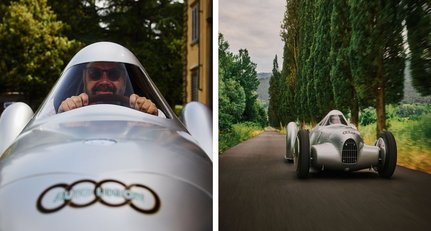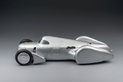


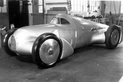
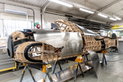
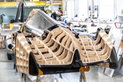
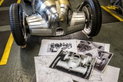
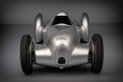
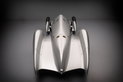

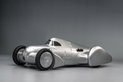
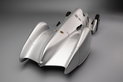
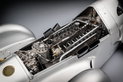
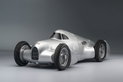
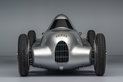
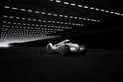



Audi Tradition has breathed new life into yet another historically significant member of its Silver Arrow family: the Auto Union Lucca. The reconstruction, carried out by specialist firm Crosthwaite & Gardiner, took a full three years and relied on black-and-white photographs and engineering drawings sourced from the manufacturer's historical archive. The renowned British restoration workshop approached the project with meticulous handcraft and an almost obsessive attention to detail. Getting the exact shape of the aerodynamically optimised bodywork right proved to be one of the most demanding challenges of the entire undertaking.
The effort, however, was more than worth it. The Lucca is a symbol of what was arguably the most intense technological rivalry in German automotive history, one made all the more relevant by its deeply political dimension. Shortly after the Nazi seizure of power, a fierce record-chasing rivalry broke out among Germany's major carmakers. Mercedes-Benz and the Auto Union, the latter having only been formed in June 1932 through the merger of Audi, DKW, Horch and Wanderer, threw everything they had at one another in a relentless pursuit of speed. But the targeted world records were never purely about polishing brand image or boosting sales. Above all, they were meant to demonstrate Germany's technological superiority, a narrative the regime promoted vigorously, with the automobile occupying a particularly prominent role.


Milestones of Technological Progress
Britain and the United States were also pushing into new speed territories during the 1930s, though their protagonists were largely independent constructors and wealthy privateers rather than official factory programmes. There was another crucial difference: While competitors abroad set their records on the Bonneville Salt Flats or similarly remote terrain, Mercedes and Auto Union focused on public roads. Both the three-pointed star and the then-Chemnitz-based automaker with the four-ring logo partly drew on government subsidies to fund their expensive motorsport programmes, of which the record runs formed an integral part.
Auto Union fired the opening shot in March 1934, when works driver Hans Stuck set three world records at the wheel of a record-optimised version of the Type A Grand Prix car. Mercedes, naturally, could not let that stand. In October of the same year, Auto Union scorched five more records into the Avus tarmac with the Type A, prompting Mercedes driver Rudolf Caracciola to respond just eight days later on a public road near the Hungarian city of Gyón, where he averaged 316.592 km/h over a flying-start mile in his front-engined W 25, powered by a potent straight-eight.


A futuristic wind tunnel pioneer
Despite those autumnal successes, the four rings had no intention of letting Caracciola and Mercedes have the last word. The racing development department in Zwickau set to work immediately on a new road record car capable of surpassing the Swabian Silver Arrow by a decisive margin. There was no winter lethargy in Saxony; the team worked at full tilt on a new machine that, while rooted in the Type A, represented a significant aerodynamic leap forward.
The car magazine Automobil Revue noted at the time that Auto Union had taken a particularly innovative approach to aerodynamic refinement. Developed scale models of the Type A, both open and enclosed, were tested in a wind tunnel belonging to the German Research Institute for Aviation in Berlin-Adlershof, something the magazine described as "a novelty in European racing car construction."
In late April of this year, Audi tested the newly rebuilt Lucca at its modern facilities in Ingolstadt, confirming a drag coefficient of 0.43 for the aviation-inspired record car. That is a remarkable figure for the era, even by prototype standards, though contemporary production models routinely achieve values between 0.20 and 0.30. It is a compelling illustration of the progress made through systematic wind tunnel optimisation, computer simulation and aeronautical research over the past nine decades.


Sixteen supercharged cylinders
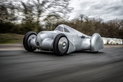
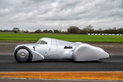
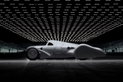
The 4,57-meter-long aluminium bodywork gave the Lucca a bat-like, futuristic appearance that was further amplified by enormous wheel covers over the spoked rims, teardrop-shaped wheel arches and a streamlined Kamm tail. At the rear, two openings feed fresh air to the carburettors, while the monstrous supercharged sixteen-cylinder breathes out through a pair of upward-facing dual exhaust pipes.
In the reconstruction, the 6.0-litre version of the V16 familiar from other Auto Union Silver Arrows was fitted, a practical decision that simplifies the task of keeping Audi Tradition's historical fleet running, as the engine can be swapped between cars. Originally, the Lucca was powered by an outwardly identical unit of five litres' displacement, which unleashed 343 horsepower onto the rear wheels during the February 1935 record attempt. Later in the racing season, output climbed to 375 hp.
The record car, dubbed a "racing saloon" by the contemporary press, was completed as early as December 1934, just weeks after the development programme had begun. Auto Union's original plan was to take on Caracciola's record at the very same location: the road near Gyón, south of Budapest. The silver machine was duly transported to the small West Hungarian town in early February 1935 following initial test runs on the Berlin Avus, but adverse weather conditions ultimately forced a change of plans.

From Hungary via Milan to Lucca
The whole entourage, including works driver Hans Stuck, father of German motorsport legend Hans-Joachim Stuck, moved on to Italy in search of more favourable conditions in the region south of Milan. When snow covered those roads too, Auto Union's racing department pushed further south, scouting for a suitable stretch of Autostrada. That search is how the car came to bear its name: on the Florence–Viareggio motorway, between Pescia and Altopascio, near the city of Lucca, they found the right piece of tarmac.
The chosen section was an almost perfectly straight, roughly five-kilometre-long passage with excellent grip, seemingly made for the task at hand. Word had clearly spread that something extraordinary was about to happen: thousands of spectators and numerous figures from the Italian sporting world had made their way to Lucca. Testing began on 14 February, with various configurations explored, radiator openings and wheel fairings adjusted, and data carefully analysed.


The four rings conquer Mercedes in Tuscany
The following morning, the racing saloon rolled out onto the road once more. After several runs and further fine-tuning, including partially sealing the radiator grille, the moment arrived: over the flying-start mile, Stuck posted a two-way average of 320.267 km/h in International Class C. And as if that weren't enough, independent timekeepers clocked just 11.01 seconds over the kilometre on the return run, equating to 326.975 km/h. The Auto Union Lucca was officially the fastest road racing car in the world.
Almost simultaneously with the record run, Auto Union unveiled a near-identical version of the Lucca to the public at the Berlin Motor Show. With the official homologation of the mile record still pending, the company boldly promoted the title of "fastest road racing car in the world" alongside the peak speed of 326.975 km/h. The racing saloon's next outing came in the heat of competition: at the Avus race in May 1935, it lined up alongside Auto Union's "regular" Grand Prix cars against the Stuttgart opposition. Prince zu Leiningen piloted the Lucca, while newcomer Bernd Rosemeyer drove its near-identical sibling. Rosemeyer retired early after a tyre failure; zu Leiningen's racing saloon fought its way to the front but eventually retired under the sustained pressure. That round went to Mercedes.

Dynamic debut at Goodwood — and on our YouTube channel
"Audi has so far had no Auto Union racing or record car from the early Grand Prix era in its historical vehicle collection. With the Auto Union Lucca, we are adding an extraordinarily emotive member of the Silver Arrow family to the AUDI AG collection. The Auto Union Lucca is a technical masterpiece, engineered for high speed and maximum performance, yet at the same time a genuinely beautiful car. That combination, to me, is unique," says Stefan Trauf, Head of Audi Tradition.
His colleague Timo Witt, who brings a decade of experience as a motorsport engineer to the project, was responsible for the record car's resurrection: "What excites me is the sheer speed and dynamism with which people reacted to the competition back then, both technically, in terms of car development, and organisationally. The weather turns and the whole team simply picks up and moves on at a moment's notice. Without that enormous flexibility and the ability to adapt rapidly to new situations, the record run at Lucca would simply not have been possible."
Anyone wishing to hear the whine of the supercharged V16 in full voice and to feel something of what those Italian spectators experienced in February 1935 should consider heading to England this summer. The Lucca will make its dynamic world premiere at the Festival of Speed in Goodwood from 9 to 12 July. Those who can't wait that long can look forward to an exclusive video arriving soon on the Classic Driver YouTube channel.
Photos: Audi Tradition / Unternehmensarchiv AUDI AG