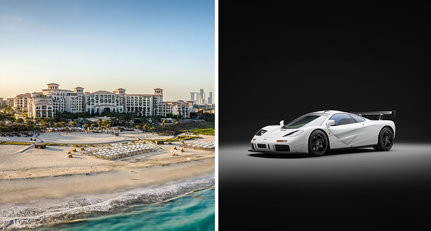























































In early December, Sotheby’s in partnership with the Abu Dhabi Investment Office (ADIO) will launch an exclusive programme of auctions, masterclasses, panel discussions and exhibitions to take place in Abu Dhabi. RM Sotheby's has just released a catalogue of spectacular cars. What makes the UAE the right stage for such an ambitious event?
The very first time RM Sotheby's conducted an auction in Abu Dhabi was in 2019. So we have a little bit of history with Abu Dhabi. But that was a one-off auction that happened in partnership with the Formula One Grand Prix. We came here, hosted the auction and flew back. This time it's very different: Abu Dhabi Collectors' Week is a groundbreaking event activation for Sotheby's in the region, and it has a very much long-term vision. It will be the start of a new consolidated presence for Sotheby's in Abu Dhabi and in the Middle East. As you might know, our mother company had a major investment from ADQ (Abu Dhabi Developmental Holding Company) in 2024. And of course, this has impacted our strategy globally. So it will be the start of a new chapter for both, our auction house and the collecting scene in the Middle East. Because if you look at the scale of what we're building, the product that we are going to bring to the region — the quality and curation of the event — this is something that the region and I think the world has never seen before. So it's going to be revolutionary and it's very much in line with our strategy.

You are based in Dubai. Why is the Middle East such an important region for collector cars and luxury goods?
For Sotheby's and for RM Sotheby's, the Middle East has become probably the key, the one, the single most important growth market on the global collectors map. From a macroeconomic level, the UAE is extremely interesting because it's a region that is first and foremost very safe. It's a region where a lot of wealthy people from all around the world come together. Due to the political instability in Europe and the US, with wars happening, with crime and inequality increasing in many parts of the world, Dubai and Abu Dhabi have become a global hub for very wealthy people to protect their assets. But the success of Abu Dhabi in particular is also due to the long-term vision of H.H. Sheikh Mohamed bin Zayed Al Nahyan who started developing this vision decades ago. The Sheikh wanted to create a new global capital where businesses can grow without interferences or changes of plans, like you might have them in Europe. And that's very much part of the governmental system that we have here. There's no government. There is the Sheikh and his close circle with a clear vision, which is very much capitalistic and very much business oriented. That makes the whole region extremely interesting for collectors as well, because they can, you know, have their assets here safe.
Does that also apply to cars?
Absolutely! You see a lot of collectible cars being driven on the streets. People drive their Bugatti Chiron or Aston Martin Valkyrie on the streets of Dubai and they park them, you know, outside overnight and nothing will happen. They could leave the keys in their cars. Nothing would happen to them. And that's a fundamental component. Because if you can play with your toys, then their usability becomes higher. And that's why the collector's market here has grown so fast.


In a way, the collectors scene in the Middle East feels wealthier, but in a way also younger and fresher than in other, more conservative parts of the world. How come?
Well, the average age here is extremely young. A lot of young people have relocated to the region. And these young people came here with an objective: They didn't just come here for vacation, they came here to set up a business. They came here for work. So it's people with a big level of ambition, with wealth, with ideas. And many of these people, at some point, when they made money, they want to spend this money on what they love. And we are here as an auction house to make their dream come true and find the objects that they desire. And that's why the Middle East is a crucial element for us and a crucial part of the world — because, as you see, demand for cars and watches is declining in Europe and in the US. This region could fill that gap.

With the Collectors' Week, are you mainly targeting regional collectors, or do you also want to bring people from the US and Europe?
It's a very good question. I think it's a mix of both. So in our strategy, we want to develop a global hub with a very local profile. We don't want to create another global auction similar to the others. We rather want to launch something that is very, very unique. Naturally, we're inviting a lot of international people — Americans, Asians, and Europeans who fly here for Collectors' Week. That's a key factor and one of the KPIs that we have from our investors. Because they want to put Abu Dhabi on the map. That's why we kick-started Collectors' Week: they want to create a cultured environment that is new, that is fresh, and different from Dubai. You know, Dubai did some things completely different. It was all about business, fast money, and fast growth. At the same time, Abu Dhabi has been rather quiet and careful. Because they wanted to focus on the growth of culture and high-qualitytourism. So less quantity, but more quality. So that's the plan.


What's the program of Collectors' Week? What can people traveling to Abu Dhabi from Europe, from the US, from Asia expect?
Let me give you a brief overview of what's going on during the week: From Tuesday to Friday, Sotheby's and RM Sotheby's will host a series of events culminating with the auctions that are taking place at the St. Regis in Saadiyat Island. So for four days, we will be having masterclasses, panel talks, exhibitions, private dinners in museums and other exciting VIP experiences. Every day there will be something new. We work with partners like Roarington, Zagato and global automotive partners that will showcase their legacy, their history. And then there is the auctions on Friday, 5 December, between 6pm and 10pm. The catalogue features watches, jewellery, collectibles and real estate, but the cars will most likely be the center of attention because we have the biggest value and the biggest space.

What are the most important cars coming up for auction?
The “Triple Crown” collaboration with McLaren Racing and Zac Brown leading to the sale of three future competition chassis is certainly unprecedented — and it allows a glimpse into the future of motorsport collecting. One of the lots allows you to acquire a Formula One car to be driven in 2026 by the official drivers for McLaren in the world championship. It's a once-in-a-lifetime opportunity to be part of the McLaren Racing team at every Formula 1 race in the future and become part of the close circle of very VIP clients. You will be traveling the world driving your car with full assistance. It's a genius move by McLaren and we're very happy to facilitate that deal. Besides the F1 chassis, we will also auction a slot McLaren's 2027 WEC car for Le Mans, and the 2026 Indy car. And it's the same deal as for the Formula One. It's never been done before at auction. First time ever.


That's amazing, and we are very excited to learn about the results. Now can you let us know about some of the other exceptional cars that will come up for sale?
Yes, I can give you some hints and exclusivity as well. So the top lot is a McLaren F1. That is a beautiful car in white. Very significant and valuable, exceeding 21 million euros. It's the 14th out of 64 road specification examples built. It was delivered new to the Brunei family. Then it was rebuilt by McLaren in 2007 and changed to the current specification, fitted with the high downforce kit and also LM specification interior. The great thing about the car is that it's coming up for auction alongside the 2025 Gordon Murray Automotive T.50. It's the very first time that a Gordon Murray Automotive creation is coming at auction. As you know, they're all sold out. So that car will attract a lot of interest.


Which other cars in the catalogue would you like to point out?
Most of the other cars will be modern, rare, exclusive supercars. We have a Pagani Zonda Riviera, a one-off model. Then we have a beautiful manual Lamborghini Murciélago Roadster that was originally owned by Nicolas Cage. And these cars are becoming quite hot in the market right now. So it's a great thing to have. We also have a beautiful Aston Martin One-77.


What will you bring for the Ferraristi in Abu Dhabi?
We have a beautiful Ferrari F40 coming that was originally ordered by Alain Prost as first owner. So it's quite a special car. And then we will have a special collection of limited edition tailor-made Ferraris that will be announced in the next two weeks.


What kind of collectibles can we expect from Sotheby's?
Obviously, there will be incredible watches. We will have a Patek Philippe Star Calibre 2000 pocket watch, which is incredibly special and important, and a Rolex “Oyster Albino” Daytona. There will be fantastic jewellery, like the Desert Rose Diamond, which is a 31.86 carat fancy vivid orange-pink diamond worth between five to seven million dollars. We will also offer a Hermès Birkin bag which was created for and owned by Jane Birkin herself. And there will be a selection of very special racing bikes: We also have a partnership with Colnago and will sell some very important racing bicycles. Did you know that there is a big cycling community in Abu Dhabi?

That's interesting! So far, the worlds of cars, bikes, jewellers, watches and collectibles rarely overlap. Are these 'fusion' auctions with collectibles from different genres a new trend?
Yeah, it is certainly a trend, especially when it comes to luxury goods. You see more and more brands doing cross-category partnerships. Mercedes did a partnership with Moncler and Virgil Abloh. Ferrari launched a fashion brand that is now fully accepted and does catwalks during the fashion weeks. Adidas and North Face are now partnering with Gucci. I guess the word is remix culture. Sotheby's were among the first to explore new categories of collecting. For example, we do auctions of game-worn basketball jerseys from the NBA, we do auctions of sneakers, and we sold Maradona's jersey for 12 million dollars. So anything nowadays that has a history, has a legacy, no matter what the object is, can be a collectible. And Sotheby's is steering that vision and that movement. When it comes to cars, it's crucial for us to approach collectors outside of the established automotive sphere and increase our global client base.


Can you tell us more about the curation process behind the automotive lots? What criteria do you use to select cars that appeal to Middle East buyers compared to Europe or the US?
I would say the standards here are quite high. As you can see from the consignments, the average value is well above one million dollars per car, which is way higher than a normal auction and even higher than Monterey. It's probably the highest value per car on average that has ever been offered. We are consigning around 75 million dollars worth of cars, which is quite something for a sale in the Middle East. We offer the best of the best — not just in terms of value, but also of quality, rarity. Naturally, the cars we offer are more modern. Classic cars are appreciated, but there is no fully developed ecosystem of workshops, restoration companies and events so people could use them. So we decided to focus this auction mostly on modern supercars.

Do you feel collectors in the Middle East will embrace classic cars once the ecosystem has expanded?
There is a lot of passion for cars in general in this region. There is a huge number of enthusiasts. There is this Flat 12 cars and coffee reunion in Dubai, they send out the invites literally three days before their events, and still there are 300 collectors showing up in the most interesting cars. Lancia Fulvia Zagatos and classic Fiat 500s parked next to Aston Martin Valkyries and Lamborghini Centenarios. There's also a big community for classic SUVs, first-generation Toyota Land Cruisers, Nissan Patrols and old Mercedes G-Wagons. Europe is obsessed with electrification, green mobility and the optimization of transport. They're limiting access to city centers. In Turin, in Milan, you cannot drive a classic car anymore in Milan unless, or maybe for a couple of days a year. Here these worlds coexist more naturally. So I'm very confident and positive about the future development of this market when it comes to classic cars.
For our readers in the US, in Europe and in Asia — what's your recommendation for visiting Abu Dhabi during Collectors' Week?
Well, surely try to find a hotel room because they're almost sold out. And then we are preparing a travel guide with Sotheby's that we will be sending out to our clients, featuring the best shopping destination,restaurants, hairdressers and beauty salons, so that you come here headache free. I encourage everybody to come and visit.

What's your vision for Collectors' Week? Will it become a regular part of the collectors' calendar?
Yes. So Collectors' Week will most probably become one of the key highlights for the annual automotive luxury calendar. It's not a one-off event, the objective is to create a new destination for all kinds of collectors. It's a multi-category approach and that's what we see will work best for this part of the world. But obviously we as RM Sotheby's will focus on the cars within this package, trying to create an ecosystem of partners and collectors. In Monterey you have all the established auctions, all the well-known events. Meanwhile, Collectors' Week Abu Dhabi is a whole new playground. And it will be like a plethora of different, exciting new things happening at the same time.
Photos: RM Sotheby's, Martina Botti (Portrait)

 5 Dec
5 Dec