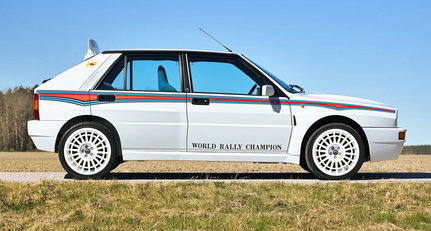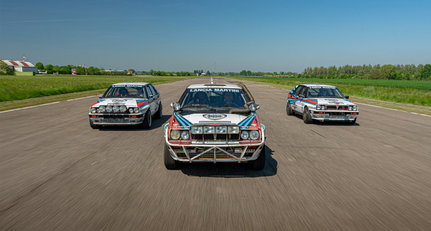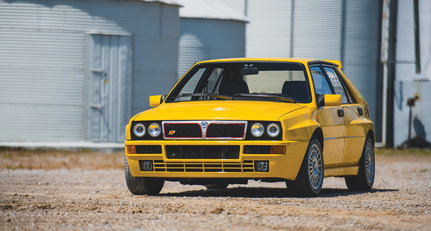
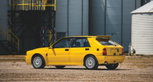





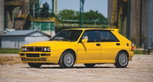
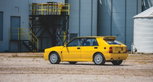



Lancia Delta HF Integrale. The very name almost automatically conjures up an image of a rally car in Martini livery, drifting around corners in the hands of virtuosos like Markku Alén, "Miki" Biasion, or Juha Kankkunen. Who would have guessed that the unassuming hatchback (Tipo 831) — designed by Giorgetto Giugiaro and launched in 1979 with a maximum power of 85 hp — would evolve into a rally weapon that brought the World Rally Championship (WRC) manufacturers' title to Italy six times in a row between 1987 and 1992?
The Integrale came into existence because of major changes to the rally rule book in the 1980s. After the extremely powerful Group B monsters—including the Lancia Delta S4 — were banned following a fatal accident at the Tour de Corse, the world motorsport governing body (FISA) made the production-based Group A category the premier class from 1987. Lancia reacted quickly, developing an all-wheel-drive model with a transversely mounted four-cylinder turbo engine based on the front-wheel-drive Delta HF. And right up until 1992, the company ensured that every new, more powerful rally weapon was matched by a corresponding road-going model!


For whom is the Lancia Delta Integrale the right car?
The Lancia Delta HF shaped the world of compact sports cars for decades and is closely linked to international rallying. This aspect alone makes it an object of desire for fans of homologation specials and Italian car design. Yet, thanks to its compact dimensions and all-wheel drive, driving pleasure is also guaranteed. That said, the Delta Integrale is less suitable as a daily driver, primarily due to its highly sophisticated technology and significant maintenance and repair costs.
Beyond rational considerations, emotional factors often play a role in the purchasing decision, too. Many buyers associate the angular powerhouse from Turin with historic motorsport triumphs or its appearances in films and magazines — and now wish to fulfill a long-held dream.
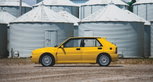
A passion for clever engineering and distinctive design is another driving force. After all, it was precisely that angular look with its flared wheel arches that made the Integrale an unmistakable head-turner. A blend of functionality and aesthetics transformed this Lancia into a cult classic.


Meanwhile, the pool of available Deltas is shrinking year by year; low production numbers mean that a well-maintained Delta, in particular, is a rare find today. Lancia produced only 5,298 units of the HF 4WD, while 9,841 examples of the HF Integrale 8V were built. The Integrale 16V saw a production run of 12,860 units, plus another 2,700 equipped with a catalytic converter and the 8V cylinder head. In addition, there were 4,841 Evo I units without a catalytic converter and 4,650 with one, as well as 1,224 Evo II units (all featuring a catalytic converter and a 16V engine). Finally, there was a combined total of 1,625 units of Evo I special editions (Martini 5 and 6, Verde York, Club Italia, Giallo Ferrari) and 1,255 units of Evo II Specials (Giallo Ginestra, Club Hi.Fi., Club Lancia, La Perla, Blu Lagos, Dealers Collection, Edizione Finale).
It therefore pays to take your time when looking for a car within your budget and, ideally, to bring a model specialist along to the inspection.
Anyone looking for a daily driver with low running costs — or lacking access to a reputable Integrale specialist in their area — would be better off steering clear of the Integrale. That is, unless they are prepared for intensive specialized maintenance, proactive work on known weak points, diligent rust prevention, and unexpected — and potentially very costly — repairs.


Which version should you buy?
For those who don't see the Delta as an investment and have a limited budget, the Delta HF 4WD — introduced in the spring of 1986 — is a great choice. Although it sits somewhat modestly on its 14-inch wheels, it already boasts permanent all-wheel drive, a front differential, a central transfer case with a Ferguson viscous coupling (providing a 56:44 front-to-rear torque split), and a Torsen differential on the rear axle — even if the 165 hp produced by its intercooled 8-valve turbo engine might not exactly dazzle anyone by today's standards.
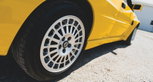
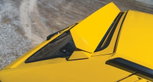
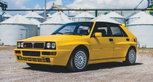
For those craving a bit more power and visual flair, the Delta HF Integrale — launched in September 1987 — is the ideal option. Externally, it is distinguished by flared wheel arches, modified bumpers and side skirts, a new hood air intake, and 15-inch alloy wheels. The suspension and brakes were also upgraded, while a larger turbocharger boosted output to 185 hp; even with a catalytic converter, it still delivered a respectable 177 hp.
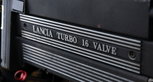
In the spring of 1989, the Delta lineup took a major step forward with the arrival of the HF Integrale 16V — a shift reflected in both the prices of that era and those of today. Its 200 hp engine, featuring piston-crown cooling and a new 16-valve cylinder head, delivered power to the road via a reversed torque split: a 47/53 front-to-rear ratio offered traction advantages, particularly on tarmac. Its most distinctive feature was the domed hood (also found on the 8V catalytic converter version from 1990 on), designed to provide sufficient space for the taller engine. Additionally, the width of the 15-inch wheels increased from 6 to 7 inches.

In late summer 1991, Lancia introduced the "Evoluzione" (unofficially known as the Delta Evo or later the Evo I) — a true homologation special. This 210 hp version was produced until the end of 1992 with a 16-valve engine (without a catalytic converter) or, for specific markets with stricter emissions regulations — such as Germany, Austria, and Switzerland—as an 8-valve model with catalytic converter. The Evo I even featured a water injection system designed to cool the intake air, thereby boosting engine power; the water reservoir required for this was located in the trunk.
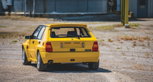
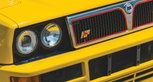
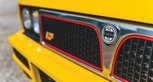
Distinctive features of the Evoluzione included a wider track, even more pronounced wheel arch extensions, a reshaped hood with revised air intakes, more powerful Brembo fixed-caliper brakes (replacing the previously used floating-caliper units), a more robust steering system, revised headlights and side skirts, an upgraded electrical system, and a larger-diameter exhaust system with a single tailpipe. The bumpers were also reworked, and the roof spoiler was now adjustable to three different positions.

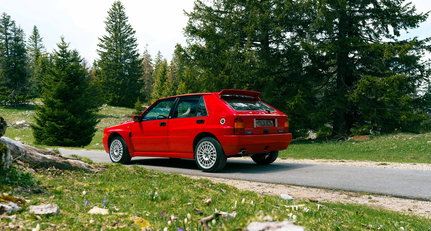
Following the Delta's final World Championship victory in 1992, the production model's career was also drawing to a close, with the Evo II 16V as its final evolution, manufactured in the Chivasso plant and featuring a version of the Aurelio Lampredi–designed two-liter engine boosted to 215 hp. The Evo II, now sitting on 16-inch wheels, is recognizable by its red valve cover and 45-series tires.
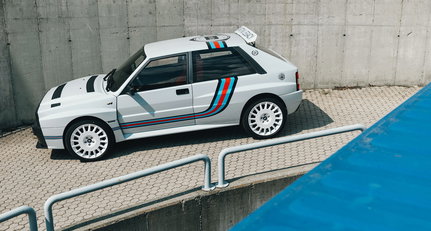
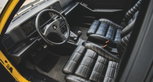
Exquisite special editions — featuring Recaro sports seats with Alcantara or Missoni upholstery, custom paint or liveries, and unique wheel designs — gave this highly decorated rally legend a fitting send-off. Its performance figures were equally impressive: while a top speed of 220 km/h (137 mph) is unremarkable for almost any mid-range car today, not too many can match a 0–60 mph sprint time of just 5.7 seconds.
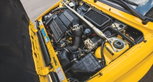
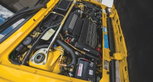
These models — as well as the regular Evo I and II versions — are highly desirable, but they also play in a different league financially. Consequently, they are an option only for customers and collectors with significant financial means. Maintenance costs are also at the high end of the spectrum, not least because the engine bay is so tightly packed that you first have to remove the engine entirely to access certain components.

What should you pay for a Lancia Delta Integrale?
Overall, market observers such as Classic Trader report a clear upward trend in value. Realistically, the prices for well-preserved Evo I and II models currently range from approximately €60,000 to €140,000, depending on condition, history, and originality; early 8V Integrale and 16V models generally start below this range. Models from the 1988–1994 period are increasingly traded as investment assets — particularly limited editions such as the "Martini 5" and "Martini 6." Evo II editions were assembled toward the end of production using remaining parts.
For buyers, this means that good, original Integrale models are rare and hold their value well; early 4WD models that are roadworthy and largely unmodified are comparatively accessible, though increasingly hard to find. In the 16V segment, meanwhile, it is difficult to find a good example for less than €40,000 today.

What are the technical issues?
The mechanical condition of a Delta depends heavily on how previous owners treated it; cars that have been modified or used in rallies should be approached with caution. Proof of regular maintenance performed by a knowledgeable shop is a major plus.
Well into the new millennium, many high-performance Lancia Deltas were still being driven as affordable daily drivers — including in winter, thanks to their all-wheel-drive systems. However, their owners — often younger buyers — rarely invested in effective rust protection.
Rust on the Delta develops from the inside out, meaning cars that look clean on the surface can conceal severe structural damage. Water collects in cavities where three layers of sheet metal are spot-welded together. Areas particularly prone to this include the rear roof edge where it meets the C-pillar and the windshield frame. If the seals in these areas are bulging upward, it is a sign of corrosion. You should also open the tailgate; rust can sometimes eat through the metal beneath the plastic trim panels to the right and left of the C-pillar.

Since the original 1979 Delta chassis (based on the Fiat Ritmo) was never designed for outputs exceeding 200 hp or for all-wheel drive, the structure is stressed beyond its original design limits. The drivetrain alone weighs 280 kg and pulls the front end down. Because the Ritmo and Delta did not yet have a subframe, some front ends can warp so severely that the doors are difficult to open. The front control arms, being mounted only in (too soft) rubber bushings, will eventually be unable to withstand this pressure. Jörg Brandt from the specialist company Integraltechnik.de in Barsinghausen (near Hanover, Germany) explains: "The control arm rods, which sit in the rubber bushings, are forced outward. This results in very negative camber, causing the tires to wear unevenly on the inside. PU (polyurethane) bushings or rubber with a higher Shore hardness offer a solution. These will work well for a while, but they too will wear out over time."
Stress cracks occur primarily when a car's suspension has been retrofitted with stiffer adjustable dampers, for example from Koni. In any case, you should inspect the corners of the windshield, the firewall area around the longitudinal member connection, and the area surrounding the rear strut mounts for such cracks, previous weld repairs, or reinforcement plates.

Lampredi's two-liter twin-cam engine is durable if properly maintained, but after more than 30 years, many units have accumulated significant wear. Crucially, the engine is not designed for sustained full-throttle operation; prolonged high-speed highway driving risks damage to the main and connecting rod bearings, valve seats, and the cylinder head gasket.
Strict adherence to maintenance intervals is therefore vital: the timing belt must be replaced every 60,000 kilometers or five years. An engine oil change (Brandt strongly recommends synthetic oil) is due every 7,500 kilometers — bearing in mind that oil consumption can easily reach one liter per 1,000 kilometers. The connecting rod bearings need to be replaced every 60,000 kilometers, as the upper bearings wear out quickly due to high boost pressure. The transmission and Torsen differential also require regular oil service.

Another potential source of trouble — with the risk of costly secondary damage — lurks in the timing belt drive for the two balance shafts. If the belt is overtightened, the engine will emit a whining sound. While some shops recommend removing the balance shafts entirely, Brandt favors a different approach: "We simply leave the belt off but keep the shafts in place and lock them. They have to stay in because otherwise, you lose oil pressure."
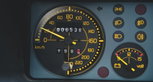
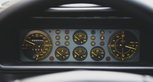
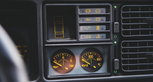
The Delta is also notorious for its fickle electrical system. The numerous dashboard warning lights can be a nuisance when they come on because of malfunctions, but the most common issue is headlight failure caused by poor ground connections. It is worth inspecting the visible wiring in the engine bay for cracked insulation, corroded connectors, and shoddy connections. Faulty grounds are also behind many instrument and switch failures.

What problems occur with age?
A specific issue with the 16-valve engines (particularly those from the 1989 model year) is worn cam lobes on the third and fourth cylinders. Because the exhaust manifold is routed upward here, the exhaust gases flow directly past the valves before entering the turbocharger. Brandt rejects the solution of using a tubular exhaust manifold (due to excessive heat generation), suggesting instead that hardened camshafts are a better option.
Another specific weakness of the 16V models involves differential pins coming loose and potentially destroying the bevel gear; this manifests as an unpleasant whining or clunking noise.
If the oil is not changed regularly, the Garrett turbocharger is the first component to suffer. It should spool up between 2,500 and 3,000 rpm. Whistling sounds are normal, but other noises are not. Blue smoke from the exhaust points to a failing turbocharger or worn piston rings, either of which is a costly repair. If oil is found floating on the coolant in the expansion tank, this points to a blown head gasket.

Incidentally, oil leaks are virtually ubiquitous on the Integrale. Once the car has covered a certain mileage, the upper oil pan gasket — originally made of rubber — gets forced out by crankcase pressure, and oil leaks onto the exhaust manifold, creating a fire risk. This can easily be mitigated by installing a cork gasket.
The plastic 90-degree elbows on the fuel pump assembly also pose an increased fire risk as they age and become brittle. Replacing them with aluminum elbows is an inexpensive (€30 to €60) preventive measure.
Regarding the suspension, worn wheel bearings make themselves felt early on. The rear strut mounts do not last forever either, especially if a sports suspension has been installed. Tires are consumed at an alarming rate; the front ones can wear out after just 10,000 to 15,000 kilometers of spirited driving.
The replacement parts situation is critical but not hopeless, as Frank Unger of Kfz-Unger in Wermelskirchen (near Cologne, Germany) knows. "Headlights, bumpers — especially for the Evo — and body panels in general are currently very hard to come by," says Unger.

Engine and transmission parts, on the other hand, are generally easier to find, partly because components from other models within the group — such as the Lancia Thema or Fiat Coupé — sometimes fit. However, specific parts for the 8V engine, such as oversize pistons, are sometimes no longer available at all; in those cases, the only option is to use forged pistons.
"Steering column switches are a major issue right now," notes Unger. "The same goes for rear-axle brake pressure regulators and fuel pressure regulators, which are hard to find for less than €500."
The Fiat Group ceased production of some replacement parts for the Delta Integrale as little as 10 to 15 years after the model's end of production. And although Stellantis Heritage (formerly FCA Heritage) recently reproduced components like hoods or bumpers using original molds, it has done so only in batches of 250 units — which sold out quickly. Consequently, exterior body panels are currently available only on the used market.
"However, many parts are now 3D-printed, such as plastic interior trim parts that would otherwise disintegrate. They are expensive, too, but at least you can get them," notes Unger. "I also have instruments in stock; the only tricky item is the electronic speedometer for the Evo."

Is it worth buying a Lancia Delta Integrale?
Yes, provided it is a well-maintained, regularly serviced, and unmodified example. The Lancia Delta, built in a total of 44,296 units across its various 4WD evolutions, combines Italian design, ambitious engineering, and a motorsport pedigree matched by few other compact cars — particularly in the 16V, Integrale, and Evoluzione versions. It is a highly coveted model for rally enthusiasts and fans of modern classics alike and — especially in the Evo or special editions like the "Martini" — represents an investment with steadily rising value. However, authenticity is key; given the multitude of versions and special editions, verifying it can be difficult for newcomers.
The Lancia Delta Integrale is more than just a car; it is a piece of motorsport history, and its engineering and rally successes make it an icon.
You can find plenty of Lancia Delta Integrales for sale in the Classic Driver Market
Photos: Darin Schnabel for RM Sotheby's