
















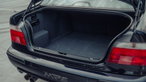
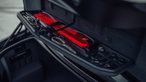
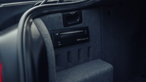


2000 BMW M5
-
Year of manufacture2000
-
Car typeOther
-
Lot number164
-
Reference number6308
-
DriveLHD
-
ConditionUsed
-
Exterior brand colourother
-
Location

-
Exterior colourOther

Description
Documents: Slovak Vehicle Registration Certificate
Chassis No. WBSDE91040GJ16436
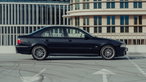
Joining Volkswagen on the brink of bankruptcy in 1993 as Chairman of the Board, Dr. Ferdinand Piëch brought an engineering-led focus on production quality. Among his projects was further development of the narrow-angle VR engine family. Familiar to many in VR6 guise, just a handful of experimental W10 units were built at Piëch's direction, a precursor to the W-engine concept later taken to its extreme in the Bugatti Veyron's 8.0-liter, quad-turbocharged W16. Reportedly, the W10 was conceived to explore a high-performance sedan engine at a time when neither Volkswagen nor Audi fielded a direct rival to the BMW M5. Rather than building a bespoke test car, Piëch fitted the W10 into an E39-generation M5 built on 2 March 1999, its own 400 PS S62 V8 removed to make room for the new unit.
The result is a naturally aspirated, all-aluminum 5.0-liter W10 producing 480 PS and 592 Nm of torque, 80 PS more than any factory-built E39 M5, paired with a six-speed manual transmission. Ten cylinders sharing a common crankshaft deliver that power with a smoothness few engines can match. Traction control, stability control, and the anti-lock brakes were all deactivated. The engine was controlled instead by its own stand-alone ECU for unhindered power delivery. It gives the car a more immediate, unfiltered character behind the wheel than any factory M5 offered, smooth in its delivery yet noticeably quicker in its response.
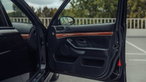
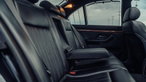
Finished in Carbon Black Metallic with a Black leather interior, the car is said by Sabine Willeke, who led the engineering team behind the project, to have served as Dr. Piëch's own personal transportation during its secret development. By the consignor's account, the project was never an official Volkswagen program, carried out outside the company's R&D department, instructed by Piëch and funded by Volkswagen Group at a reported cost approaching €2,000,000. Despite remaining in this informal prototyping phase, the W10 M5 was finished and fine-tuned into a fully drivable prototype.
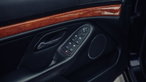
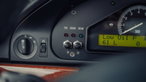
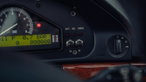
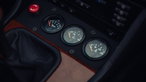
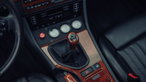
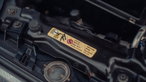
Piëch reportedly drove the car on temporary plates during testing, though its total mileage cannot be confirmed because the standard instrument cluster was replaced with an aftermarket Stack dashboard with no odometer reading. The interior is otherwise standard BMW aside from extra dials added to the center console, and that same attention to detail carries through the conversion itself, evident in the custom intake ducting, ignition system, and coolant expansion tank, all neatly installed.
The current owner acquired the M5 roughly a decade ago through connections in the engineering world, drawn to the car and its story. He has since road-registered it in Slovakia and drives it rather than keeping it in storage, true to its identity as a usable prototype, although the extent of its conversion means it lacks a certificate of conformity. It was most recently serviced in 2025, its upkeep drawing on standard Volkswagen catalog components rather than bespoke parts.
According to Sabine Willeke, only three W10 units were ever built. One remains in Germany, another is offered alongside this lot as a display example, and the third is the unit fitted to this M5. Volkswagen never returned to the W10 once the program concluded, and no other example was ever installed in a road-going car. Unbelievably, this car survives today, granting a rare chance to experience a powerful, experimental engine architecture, one that, at least in its time, found a home in the only chassis seemingly capable of containing it.


Watch our latest YouTube videos
More Listings related to BMW M5




Recommended Listings


