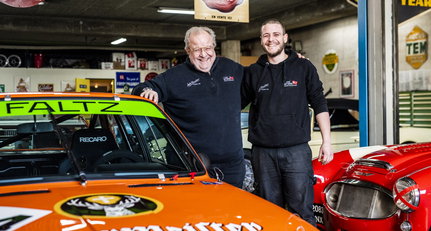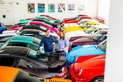


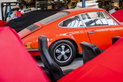

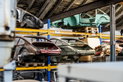

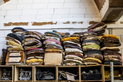
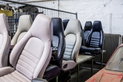


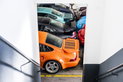


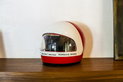


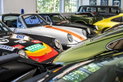
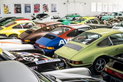


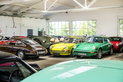
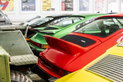

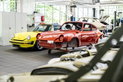

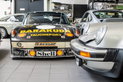
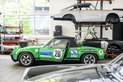


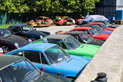
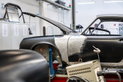
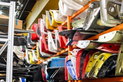
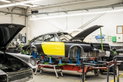


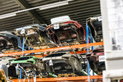





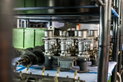


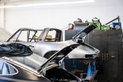

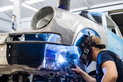
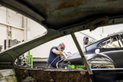
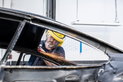
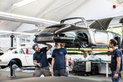
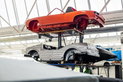
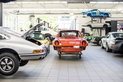


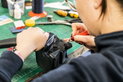



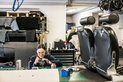

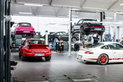

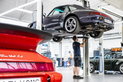
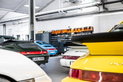

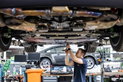


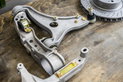
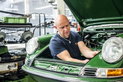

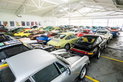

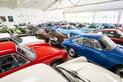

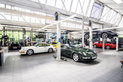
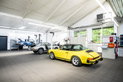
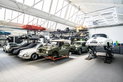
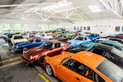
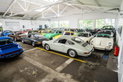




The Early 911S facility, located on the border between Wuppertal and Hilden, east of Düsseldorf, is so much more than just a workshop. The company moved into this larger complex—where automotive supplier Happich once manufactured components for Porsche, among others—in 2013, after its original premises in Wuppertal-Vohwinkel had become too small. Today, the site integrates restoration, bodywork, mechanical services, upholstery, parts supply and maintenance under one roof.


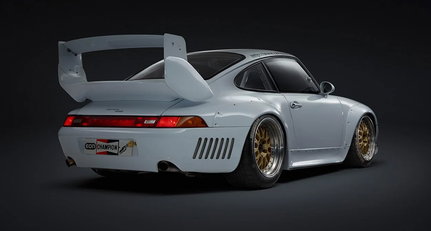
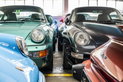
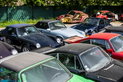
The sheer variety is evident right in the courtyard: early 911s in rare colours, cars with racing pedigrees, models featuring Fuchs wheels and “ducktail” spoilers, and 911 S models with auxiliary driving lights—all whet the appetite for more. Indeed, this neatly arranged line-up in the yard is merely the overture to what awaits visitors inside the hallowed halls. Bumper to bumper and door handle to door handle, Porsches of every vintage are stored there—either ready for delivery to customers or awaiting their turn in the workshop. Among them are racing 911s such as a Claudia Hürtgen 993 GT2, a 993 Carrera Cup car in USP livery, a 934 that raced at Le Mans in 1974 and a 911 entered in the 1967 Gulf London Rally.


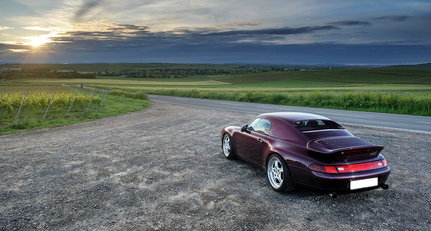
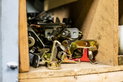
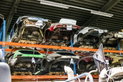
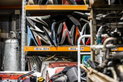
Meanwhile, in two other workshops, specialists are working on Porsche 356s, a 914/6, early 911 models and cars from the final air-cooled generations—the 964 and 993. And tucked away amidst it all, there is even a 959! A parts warehouse spanning several thousand square metres forms the backbone of many restorations, preserving components, knowledge and craftsmanship that have long since been lost elsewhere. Meanwhile, at the rear of the building, bare bodyshells in varying states of preservation sit on outdoor racks, awaiting their awakening from a long slumber.
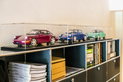
Manfred Hering and his wife Sarah welcome us for the interview in the small, stylishly appointed reception area of Early 911S. It houses an espresso machine, a small library of coffee-table books and vintage car magazines, model cars displayed in glass cabinets and a fully restored 2.0-litre 911 TR engine in all its flat-six glory.


Manfred, thank you for taking the time to give us a major update on Early 911S. Eleven years have passed since Classic Driver’s last visit, and you are now celebrating your 20th anniversary. Looking back at the developments over that period, what has changed the most?
When we moved here in 2013, we had a staff of 16. By 2015, that number had risen to around 50, and today we have nearly 100 employees. At the same time, our range of services has expanded. While our roots lie with the early 911 models, we now cover the entire world of air-cooled Porsches—from the 356, the 914/6 and the various 911 generations all the way to the 959. However, size alone isn’t the decisive factor for us. Over the years, we have built up expertise, trained specialists and established structures that enable us to execute even highly complex projects with great depth and to the highest standards of quality.


Which projects exemplify this development?
We are currently working on several Porsche 959s, among other vehicles. We have always held the technical complexity of this model in high regard—which is precisely why we are approaching the task so thoroughly. We have acquired stocks of parts and built up the necessary expertise, thereby creating the conditions to provide professional, long-term support for this Porsche technology showcase. In addition, we are working on a green Porsche 916—one of only eleven examples ever built. Another extraordinary long-term project is an early prototype from the Dakar development programme that we discovered in Switzerland. Such vehicles present a particular technical challenge for us, yet they also tell significant stories from Porsche’s history.


How large is Early 911S today?
Our current inventory comprises around 700 vehicles. We are working on approximately 140 projects in parallel, ranging from specific mechanical or bodywork tasks to complete restorations. Between our various locations and additional facilities, we now cover a total area of more than 20,000 square metres (215,000 square feet). This scale is necessary because a truly uncompromising restoration requires a vast array of specialised trades, parts, documentation and—above all—time.


What developments have taken place regarding infrastructure?
We have gradually expanded our capabilities. These include a paint shop in nearby Wülfrath—where we can professionally apply even historic paint systems—and a machining facility equipped with CNC milling machines. We also offer storage facilities, currently accommodating around 60 vehicles. A further hall for approximately 140 of our own vehicles is planned; this will free up space at our main site for six additional vehicle lifts. Every one of these steps serves the same goal: to keep as many services as possible under our own control and ensure consistently high quality across the board.


How important is the role of the people behind the vehicles?
A crucial one. We have an excellent mix of seasoned experts and young colleagues. Training is particularly important to us: we are currently supporting 17 apprentices in fields such as upholstery, bodywork, warehouse logistics and mechatronics. The fact that we receive around 600 applications a year demonstrates the fascination this craft holds. We aim to preserve not only the vehicles but also the knowledge and skills required to maintain them.


For all its international significance, Early 911S is also a family business. What role does your family play in it?
A very significant one, too. My wife, Sarah, works in the business and is a key partner for Early 911S. She brings her own perspective, takes on responsibility and has a great instinct for people, communication and the many details involved in the company. We complement each other in many areas—and for me, it is special to continue developing Early 911S together with my family. We have a four-year-old son, and through him, the idea of preserving values, knowledge and automotive culture for the next generation takes on a deeply personal meaning. Of course, he should eventually follow his own path and pursue what he is passionate about—whether that path eventually leads to Early 911S or somewhere else entirely is not the deciding factor for us. What matters to us is that he is free to make his own choices. My family provides support, keeps me grounded and reminds me of what truly counts in life.


Was your passion for Porsche always a given?
No — at least not in the conventional sense. The first car I bought myself was a blue Renault 5. Today, I drive a blue R5 Roland Garros again — a model I spotted in Paris last year — though this time it’s electric. I’m not fascinated by cars for their own sake; what really excites me is the underlying aesthetics: the styling, proportions, materiality and cultural significance of a design. My great passion lies in art, architecture and design—particularly from the 1960s and 1970s. That is precisely the perspective from which I view a classic Porsche: as a piece of designed cultural heritage that needs to be understood and preserved.


How did Early 911S grow out of this passion?
At the time, I ran my own advertising agency in Wuppertal with a staff of around 20. Around 2003 and 2004, I bought an Aston Martin DB5 and a 1966 Porsche 911 for two fashion-industry advertising campaigns. I realised that the Porsche hadn’t been restored particularly well. I thought to myself: “It can be done better.” I began buying up stocks of parts and looking for suitable projects. Finally, in 2006, I started the business with one employee. It didn’t begin as a fully fleshed-out business plan, but rather as a genuine passion that just kept growing.

What remains the core of your philosophy to this day?
We aim to restore a Porsche so that it matches its original factory-delivery condition in every relevant detail. This requires research, original parts, precision craftsmanship and a deep understanding of the specific era. However, a restoration must do more than just look impressive; the car must also function and drive exactly as it should. That is why we test-drive every fully restored vehicle for 500 to 1,000 km (310 to 620 miles) before handing it over—unless customers specifically wish to experience those first kilometres themselves.


What does originality mean to you—and where do you draw the line between preservation and renewal?
For us, originality does not mean simply starting from scratch. First and foremost, it is about fully understanding a vehicle’s substance, history and original factory specifications. Whatever can be preserved should be preserved. Where renewal is necessary, the work must be carried out correctly, transparently and to the same standard as the original. A good restoration should not obscure a car’s history, but rather make it visible and tangible once again.

How is the market for classic Porsches changing?
The market has consolidated following the extraordinary boom of the low-interest-rate era. Vehicles that are superbly restored and boast a compelling history, rare specifications or special colours remain in high demand and stable in the long term. Buyers are scrutinising vehicles more closely today—and that is fundamentally a positive development. As a result, quality, documentation and authenticity are becoming increasingly important.
Early 911S has long been operating internationally. Where do your customers come from?
By now, around 80 percent of our vehicles are exported. We have already delivered Porsches as far afield as Manila and the Maldives. At the same time, we actively source specific, special vehicles for international clients—currently, for instance, right-hand-drive classics. Our customers come from a wide range of regions, but they share a desire for quality, reliability and a partner capable of providing long-term vehicle support.


Where do you see Early 911S in five or ten years?
After 20 years, it feels more like the halfway point than the home stretch to me. We still have plenty of ideas and areas where we can improve. Our overarching goal remains the preservation of automotive culture. International expansion will play a role in this; for instance, there have been inquiries regarding a location in Dubai. However, the actual workshop and our restoration operations will remain in Germany. We envision having a select partner in the Americas, the Middle East and Asia—each handling vehicle deliveries and providing services such as sales, storage and maintenance. The aim is for Early 911S to be accessible internationally without losing its identity or its commitment to “Made in Germany” quality.
What would you like to see from Porsche in the future?
I would like to see a Cayenne with a V8 diesel engine again—and a genuine Porsche family van with room for up to six people. Regarding the 911, I fancy the idea that the next generation might become more compact again. A Porsche is allowed to evolve, but it should always retain its clarity, its proportions and its unmistakable character.


And which car is still missing from your own collection?
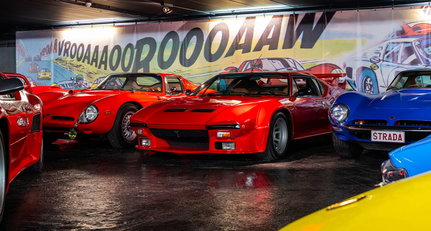
Right at the top of the list is the 911 S from the opening scene of Le Mans with Steve McQueen. We had the privilege of restoring that car here; today, it belongs to a German collector and is not for sale. Among other brands, alongside the Lamborghini Miura and an Aston Martin Shooting Brake, I am particularly fascinated by the BMW 507 designed by Albrecht Graf von Goertz. They all represent a great design concept—something that goes far beyond the engineering itself.
Manfred, thank you very much for the conversation.
My pleasure.
Photos: Rémi Dargegen for Classic Driver © 2026