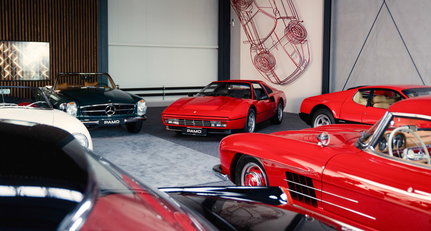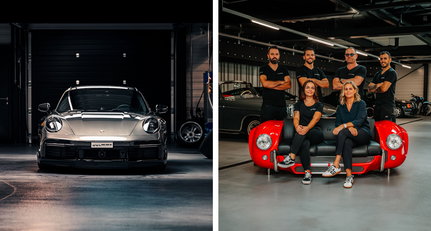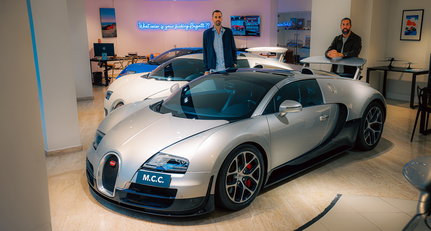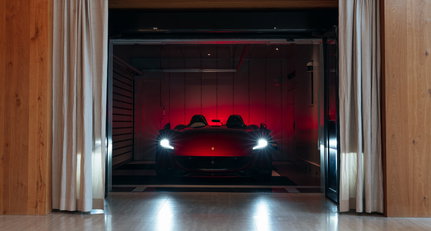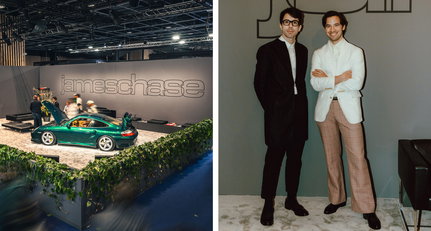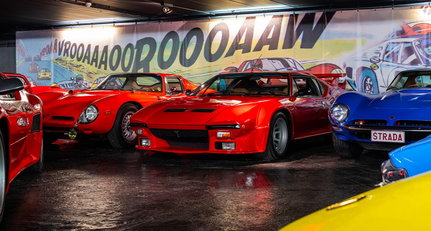



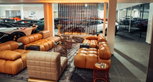





We meet the 31-year-old company head in a seating area designed by the Zurich-based architecture firm Kalfopoulos, at the heart of the expansive, glass-walled showroom. High-gloss lacquered and polished Makassar wood, a fireplace clad in Brazilian faux marble, and small tables made of Italian copper wire create a pleasant atmosphere. A multilevel display cabinet, filled with model cars, automotive coffee-table books, and premium spirits, enhances the ambiance. It is the sort of piece that could easily grace the living rooms of APU’s own customers.


Hello, Benjamin, thank you for taking the time to speak with us today about the origins of APU and how the business has evolved since then. But first, we’d love to know: how did you first come to the car business?
My father built up the company starting around 2000. Even in my school days, around the age of 16, I was frequently at the business helping out. I practically grew up in it. Later, I also earned a degree in business administration.
Was APU always operating from the same location?
No. Initially we were in Wetzikon, and then in Uznach from 2020 onward.
And when did you take over management from your father?
That was also in 2020.


How would you describe your business model? What can customers expect from APU that they might not find elsewhere?
First, there’s the atmosphere of a family business. For instance, my brother Kenan works in purchasing and sales. We are a small but highly specialized and motivated team, currently thirteen employees, three of whom work in the workshop. Many have been with us for a long time, and our staff turnover rate is very low.
Which brand makes up the largest share of the portfolio?
Ferrari, without a doubt, and its share has been growing in recent years.


And which brand or model is currently missing from the lineup that you would still like to have?
A clear answer: Pagani-Zonda!
What current trends are you observing in the collector market? Which models are selling particularly well right now, and which are seeing declining interest?
Models from 2000 onward are definitely on the rise. Demand for anything built before 1950 keeps declining. Demand is also weaker for electric cars and even hybrids.


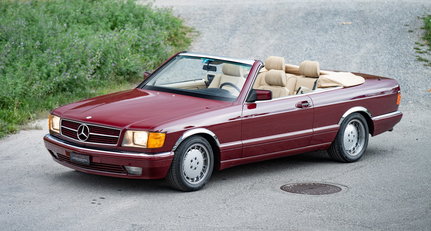
The current showroom opened in 2020. It once housed a beautiful Mercedes 190 SL. How much of a focus are vintage and classic cars for APU?
We can handle such requests on a case-by-case basis, but, as mentioned, our core business is supercars and hypercars in the league of Ferrari, Lamborghini, Bugatti, and the like.
APU also has its own workshop. What services do you offer there?
Using state-of-the-art technology, we offer a full spectrum of services, from gentle paint cleaning and precise interior treatments to high-end sealants. We also provide custom vehicle wrapping and tire changes for our customers.


There is also talk of modifications and customization. Can you give one or two recent examples?
Novitec upgrades—we are an official partner—and work by Brabus.
What connections do you have with authorized dealers and their workshops, in case complex repairs are required for these technically sophisticated models?
We rely on a network of specialist workshops nearby. For example, Emil Frey handles Brabus models—mostly work on G-Wagons.


Regarding sourcing, if someone contacts APU to find their dream car, how can you help?
We benefit from our longstanding international network and the industry expertise we’ve accumulated over the years. Auctions and trade shows are, of course, also must-attend events for us.
What are the essential components of a worry-free, full-service experience for customers today?
A vehicle pickup and delivery service, as well as a shuttle service to and from the airport or train station. We work with international shipping companies that can ship vehicles from anywhere in the world.


What has been the longest shipment recently?
To Australia and Hong Kong.
What does the near future hold for Autopark Uznach?
We are planning to build a second, four-story showroom. That would also give us the option—speaking of storage—to house customer vehicles securely in a climate-controlled environment. We are currently in discussions with the local municipality about the exact details and the timeline.
And looking further ahead?
We don’t want to grow headcount or vehicle volume at any cost. Instead, we want to focus even more on sports cars and specialized vehicles. In fact, we might even reduce the number of vehicles we handle so we can serve our customers even better.


How many vehicles does APU handle each year?
Around 700 at the moment.
Is there a particular vehicle you wish you had kept for your own garage rather than sold?
If I had to choose just one: a Ferrari F40.
Benjamin, thank you for talking to us!