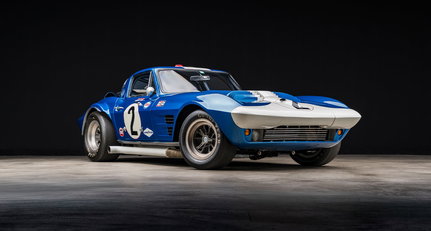
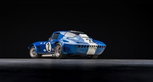


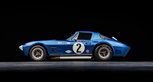
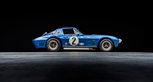
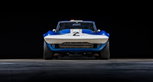
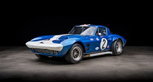




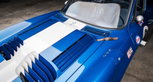
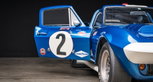

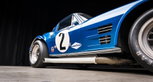


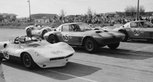


The importance of this quintessential American Sport-Prototype GT for American motorsport and General Motors’ racing heritage can’t be underestimated. Even though that project never enjoyed the full backing of GM top management, Zora Arkus-Duntov, the engineer famously known as the “father of the Corvette”, continued developing the car through unofficial channels. This example, chassis #003, was successfully driven at the Bahamas Speed Week in late 1963. It later scored two successive podium class finishes at the 12 hours of Sebring of 1964 and 1965 driven by US racing legends A.J. Foyt, Jim Hall, Roger Penske or Augie Pabst.
While the standard production Chevrolet Corvette, first launched in 1953, is an American sportscar icon in its own right, the Grand Sport, developed for the 1963 season with a view to challenge and beat Carroll Shelby’s Cobras, became the ultimate expression of Corvette performance.

Few individuals have ever shaped the history of the Corvette more profoundly than Zora Arkus-Duntov. Born 1909 in Brussels to Russian parents, the gifted engineer and accomplished racing driver immediately recognized his untapped potential after is arrival at Chevrolet from England in 1953. The Grand Sport now on offer at the forthcoming RM Sotheby’s Monterey Auction bears chassis number 003. It is one of only five Grand Sport built and the first of three Coupes. A purpose-built prototype that differed from any production car in hundreds of unique parts.


New “Split-Window” Sting Ray as ideal starting point
The arrival of the all-new Sting Ray for 1963 (with the iconic split-window) provided the ideal foundation for what would become the Grand Sport. At the pinnacle of the Corvette C2-production lineup stood the Z06 performance package. But its success was short-lived because compared to the Cobra it was too heavy. Therefore Arkus-Duntov embarked upon an uncompromising lightweight strategy. The resulting Grand Sport not only bore a passing resemblance to a production Sting Ray but thanks to a lightweight tubular structure and fiberglass body enjoyed a weight reduction from the 3,199 lb of the standard model to just 1,900 lb.Combined with V8 power and sophisticated chassis engineering this Corvette was now ready to challenge the Shelby Cobra and even the Ferrari GTO on equal terms.
Because GM had withdrawn form works-backed motorsport some years ago, the Gran Sport directly contradicted corporate policy. Therefore, the board ordered Arkus-Duntov to close the project and destroy all the cars. He agreed to stop work but discreetly handed over the three Coupes to John Mecom, Texan oil-tycoon and team owner, and stored the remaining two (later converted into Roadsters) in a Chevrolet research garage. Chassis 003 was first entrusted to Dick Doane, proprietor of a Chevy dealership in Illinois, proudly known in adverts as the "World's Best Known Corvette Dealer." Between July and November 1963, Doane campaigned the car in eight SCCA events, earning class victories at Wilmot and Greenwood. At Road America, he famously led the prestigious Road America 500 outright for 93 laps before engine failure ended an otherwise remarkable performance. By autumn 1963, chassis 003 and 004 returned to Chevrolet Engineering for an intensive transformation ahead of the prestigious Bahamas Speed Week. The cars received comprehensive upgrades designed with one objective in mind: Defeating Carroll Shelby.

After Nassau it earned the famous nickname “Snake Eater”
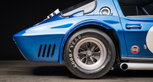
Officially, all three Grand Sports were now entered by Mecom, with wider Halibrand magnesium wheels carrying fat Goodyear Stock Car Special tires beneath dramatically flared fenders, additional cooling vents and most importantly, a new all-aluminum 377-cubic-inch V-8 pumping out more than 485 horsepower. They beat all competitors by 10 seconds and outperformed Shelby's Cobras on Nassau’s long straights. It was this weekend that earned the Corvette Grand Sport one of motorsport's most enduring nicknames: “Snake Eaters.”Buoyed by Nassau's success, Arkus-Duntov immediately began preparing for the 1964 Daytona and Sebring races. While Daytona disappeared from the schedule. Sebring, however, remained within reach. For the grueling Florida Enduro, the lightweight aluminum engines in the three Coupés gave way to more robust iron-block V-8s equipped with four Weber carburetors for exceptional durability and prodigious power. #003 was again entrusted to John Mecom's racing organization, driven by Canadian John Cannon and rising young American superstar A.J. Foyt. Mechanical gremlins during qualifying left the Grand Sport mired at the back end of the field. What followed became one of Sebring's legendary opening laps. Already on the first lap Foyt sliced past approximately 50 competitors. Within hours the Corvette had climbed into the overall top 10, reaching as high as eighth place. Just beyond the halfway point, a worn axle spline allowed a wheel to loosen, forcing an unscheduled pit stop. Despite the setback, Cannon and Foyt finishing 23rd overall and second in class.

“Like a dragster: It lifted the front wheels in all four gears”
Chassis 003 remained with John Mecom until January 1965, when it was acquired by 19-year-old Texas enthusiast Alan Sevadjian. Even after Chevrolet's withdrawal, Arkus-Duntov continued offering whatever assistance he could. He supplied the team with a fresh big-block engine out of a new production Corvette. At the 1965 12 Hours of Sebring, the Grand Sport was shared by Delmo Johnson, Ed Sevadjian, and Dave Morgan. Against formidable international competition, they finished an impressive third in class. Johnson later summarized the Grand Sport's astonishing performance with this blunt response: “It was like a dragster—the only car I ever drove that would lift the front wheels off the ground in all four gears."
As the decade progressed, chassis 003 gradually transitioned from front-line competition into the hands of increasingly knowledgeable enthusiasts and collectors. Fortunately, this period of relative inactivity preserved one of the #003’s greatest assets: it’s remarkable originality. Unlike many competition cars that endured repeated crashes, extensive rebuilding, or wholesale component replacement, it retained its original structure, its unique lightweight body, and many irreplaceable factory-built components.


After a $1 million restoration back to Sebring 1964 specs
In 2003, chassis 003 entered perhaps the most meticulous chapter of its remarkable history when it was acquired by its current caretaker, a distinguished California collector. Remarkably, he became only the third long-term owner in the preceding half-century. Rather than simply preserve the car, the consignor embarked upon an ambitious mission: to return #003 to the exact specification in which it competed at Sebring in 1964.
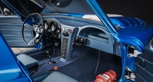
The task was entrusted to Terry Scarborough Racing (TSR) of Sonoma, California, one of the nation's foremost authorities on historic competition Corvettes. What followed was a restoration spanning more than four years and representing an investment approaching $1 million. A restoration that ranks among the most comprehensive ever performed on a Corvette Grand Sport and which benefitted from an unusually complete and remarkably original automobile – even the dashboard and seats were believed to be original to the car.

Following completion, chassis 003 resumed the role for which it was built—as a living, breathing competition automobile. Most notably in 2010, it crossed the Atlantic to participate in the Goodwood Festival of Speed. On home ground it appeared at premier historic motorsport events including the Sonoma Motorsports Festival and the Rolex Monterey Motorsports Reunion.
More than 60 years after Zora Arkus-Duntov quietly pursued his impossible dream, chassis 003 remains the purest expression of that ambition—a factory-built racing Corvette conceived to defeat the Cobra, preserved with exceptional care, and presented now at RM Sotheby’s Monterey Auction, accompanied by an extensive collection of spare components, as one of the most important American competition cars ever offered for public sale.
 Monterey, 15 Aug