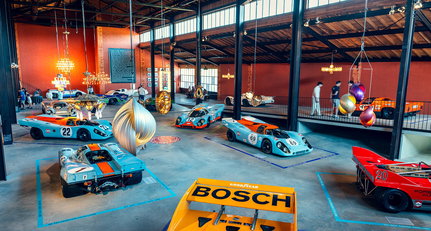
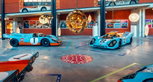
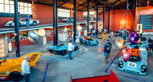
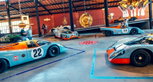


In our world, legends are often formed out on the racetrack, setting lap records, finishing gruelling endurance races and racking up podiums like they are parking tickets. But when the champagne and burned rubber is washed away, so too is the memories that specific car holds for eternity. Preserving and celebrating those memories leads us to the Provençal village of Gargas, where this summer, inside the workshop of Mathieu Lustrerie, a chandelier maker, an unlikely stage has been set for the largest gathering of 917s ever assembled in Europe.


The man behind it is Arthur Mathieu, who we caught up with as the event opens officially and runs until August 10th. Everything within these stunning four walls begins with Hans Herrmann. "This guy was really inspiring," recalling years of childhood encounters at historic events, watching the driver grow older while he himself grew up. “He always remembered me and made an effort to ask how I was, I carried that with me as I grew up.” It's a small detail, but it tells you everything about why this exhibition exists.

Herrmann's own story supplies the emotional spine of the show. Racing for Porsche, Mercedes and even dabbling in the rolling circus of Formula 1, he had made a quiet promise to his wife that he would retire from racing the day he won Le Mans. In 1970, at the wheel of a Porsche 917, he finally did and kept his word. Following Herrmann's passing earlier this year, what began as a tribute has taken on the weight of a farewell.


The Gargas exhibition is the first true outing for Arthur's own venture, Global Reunion, a successor, in spirit, to earlier 912 anniversary gatherings he organised across Provence, Japan and the United States for the model's 60th anniversary. But where those were pure celebrations of the car among enthusiasts, Global Reunion has a different, more deliberate ambition. "What I want to do with Global Reunion is create emotions for the public," he explains. "I want them to perceive the object I'm showing from another perspective." His target, gently but firmly, is the way his own generation has come to see the 917. It is now, sadly, a number on an auction estimate rather than a machine with a story. "People that get passionate about it reaching figures of forty million euros or more, that's really not the point for me."
His antidote was to stage the event in two acts. The first took the cars back to Le Mans itself, running on track, engines lit, drivers aboard. It was a chance, he says, for the public to feel the object as it was built to be felt, "seeing the drivers in them, hearing it starting", an experience he describes as genuinely emotional for everyone present. Only then does the exhibition move to its second act at Gargas, where the cars are presented not as race cars but as objects of art, deliberately placed in dialogue with Mathieu Lustrerie's own chandeliers.


That pairing is the show's real party piece. "The car is shown as an object of art related to other objects of art, to make a dialogue, so that both worlds can serve each other," Arthur says. He has fielded the same question in interview after interview, ‘which car-and-chandelier pairing is his favourite?’, the answer is truly one to be answered only after you attend the exhibition. Beyond the immediate spectacle, he sees a longer-term purpose of lending exposure to lesser-known artists by putting their work in front of an audience a major automotive name can draw in numbers most galleries could never match.

For all the conceptual framing, the exhibition's substance is formidable. Ten 917s form the core of the display, all of which are privately owned, alongside five cars charting the model's prototype lineage: the 904, 906, 907, 910 and 908, tracing the path that led to the 917's creation. There is also the body of a 1969 917 LH, shown as bare coachwork rather than as a complete car, since Arthur couldn't source one with a verifiable history to match. Placed next to the 908, it lets visitors see just how closely related the two designs really are.
Around the cars, Arthur has assembled a genuinely rare collection of ephemera. Original period posters, as well as trophies loaned by the family of Jo Siffert, including material from his 1971 Firestone World Championship and a 1971 Le Mans class win in a 906. For the photography lovers, the exhibition also boasts a stunning array of period prints from the French agency Gamma Rapho, shot at Le Mans in 1969, 1970 and 1971, and rare behind-the-scenes stills from the set of Le Mans, taken while Steve McQueen himself operated a camera. Each car, Arthur notes, carries a written story told in the first person, as if speaking for itself, a small touch he considers essential to the whole experience.


What seems to have moved those lucky early and eager visitors most, though, has nothing to do with rarity or provenance. It's proximity, as Arthur explains, “No barriers, no glass, time to look properly, to read the stories, to take photographs from angles that simply aren't possible at a factory museum. For many, it is the first time they have seen even one 917 in the flesh; here, they can walk around ten at once.”
The Global 917 Reunion runs at Mathieu Lustrerie in Gargas, Provence, until 10 August.
Photos by Simon Gosselin for Classic Driver