
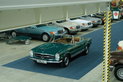
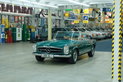
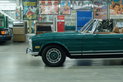
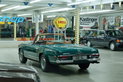
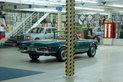
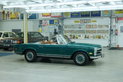
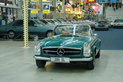
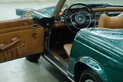
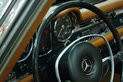
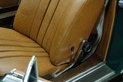
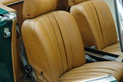
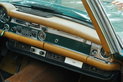
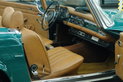
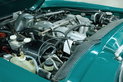
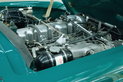
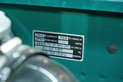
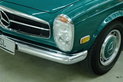
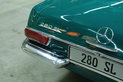
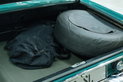
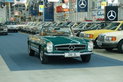
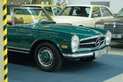
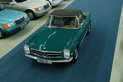
1968 Mercedes-Benz SL Pagode
280 SL-
Year of manufacture1968
-
Car typeOther
-
Chassis number113.044-10-004989
-
Engine number130.983-10-002047
-
Lot number015
-
Reference numberhg_7d7527f7e095
-
DriveLHD
-
ConditionUsed
-
Exterior brand colourDark Green
-
Interior colourBrown
-
Interior brand colourMB-Tex Light Brown
-
Location

-
Exterior colourGreen

Description
One of 23,885 ever made
Strongest engine paired with manual transmission
Rare and attractive color combination
Air conditioner and power steering
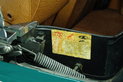
Chassis no.: 113.044-10-004989
Engine no.: 130.983-10-002047
Body no.: 84478
Production no.: 960151
Paint: 268 Dark Green
Interior: 278 MB-Tex Light Brown
Factory options:
401 Single seats
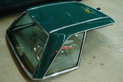
416 Hardtop mounted
422 Mercedes-Benz power steering
461 Instrument with mileage reading reading and English lettering
491 U.S. version
503 Outside rearview mirror, left
515 Becker radio Europa (AM/FM, USA)
524 Paintcoat preservation
598 Heat-insulating glass, windshield shot-colored, heat-insulating glass, side window panes, heat-insulating glass, rear window pane
600 Trim strips on hardtop
641 White-wall tires
745 Folding top fabric beige (8022)
Provenance:
1969 – Dr. Virgil Smith, Unbekannt, USA
1971 – Norman Gearhart, Unbekannt, USA
1994 – Matthias Karl, Gaggenau, DE
20/07/1995 – Hermann Mayringer, Neukirchen, AT
29/08/2024 – Christian Landa, Marchtrenk, AT
Documents:
US registration (1992, copy)
Austrian Einzelgenehmigung (1995)
About the model line:
W 113
By the late 1950s, Mercedes-Benz found itself grappling with a problem for which there seemed to be no obvious solution. The task was to replace the superlative, the ultimate automobile, the Mercedes of all Mercedes—the legendary 300 SL. As if that were not challenge enough, its smaller brother, the 190 SL, also required a successor. Better still, both cars were to be replaced by one and the same automobile.
Friedrich Geiger, head of the Experimental Design Department and himself a self-taught automotive designer, enlisted two young stylists to help shoulder the burden: the Frenchman Paul Bracq and the Italian Bruno Sacco. To the two newcomers he entrusted what must have seemed little short of a suicide mission.
Since the tragedy of Le Mans in 1955, Mercedes-Benz had turned its back on motor racing. There was no longer a competition car that could simply be civilised for the road. The world, too, had changed. The era of one-off thoroughbreds was drawing to a close. Prosperity was becoming attainable, and the gateway across the Atlantic to the New World stood wide open. Both outgoing models had already proved highly successful there, and their successor was expected to do the same—only in far greater numbers. At least, that was the plan.
The new saloon range provided the technical foundation. Its platform was shortened by 30 centimetres, while its six-cylinder engine was enlarged to 2.3 litres and, thanks to fuel injection, tuned to produce 150 horsepower. Add a suspension that struck an ideal balance between sporting agility and long-distance comfort, and the all-rounder was almost complete. Occupant safety remained the final piece of the puzzle, and with Béla Barényi—the father and tireless champion of the crumple zone—Mercedes had the right man for the job.
Paul Bracq took the lead, and after several design iterations the finished 230 SL made its debut at the Geneva Motor Show in March 1963. Its lines were clean, restrained and yet timelessly elegant. Or perhaps because of that. The removable hardtop, however, caused more than a few raised eyebrows. Its roof curved in precisely the opposite direction from what convention dictated. Some journalists fancied they saw echoes of Far Eastern temple architecture, when in reality the distinctive shape was dictated purely by structural rigidity. Nevertheless, the SL acquired a nickname that has endured to this day: the „Pagoda.“
The moment it appeared on the Mercedes stand, all nostalgia for its predecessors evaporated. Such was the excitement surrounding the new 230 SL that the older models seemed instantly forgotten. Others may have been more powerful, faster or more expensive, but none captured the spirit of the times quite as perfectly. Any doubts about the impossibility of the task vanished overnight. Success was assured from the very first day, despite a suitably aristocratic price tag of DM 22,000.
Late in 1966 came the 250 SL, intended to improve on its predecessor in almost every respect. Four-wheel disc brakes, greater displacement and more torque, all without increasing power. The first improvement alone would have sufficed, for the revised engine proved rather coarse and less than happy under sustained full-throttle driving. Salvation arrived just a year later in the form of the 280 SL, the ultimate and final evolution of Mercedes‘ consummate all-rounder.
Looking back many years later, Bruno Sacco once described the Pagoda as a step in the wrong direction. In his view, it had remained too close in character to the 190 SL and not close enough to the 300 SL. It is, one suspects, a mistake many manufacturers would have been delighted to make.

Watch our latest YouTube videos
More Listings related to Mercedes-Benz SL Pagode


Recommended Listings


