
1978 Porsche 911 "Turbo"
911 (930) Turbo 3.3-
Year of manufacture1978
-
Car typeOther
-
Lot number224
-
Reference numberhg_8d4940b757e9
-
DriveLHD
-
ConditionUsed
-
Interior colourOther
-
Location

-
Exterior colourOther

Description
One of the very first 300 hp 930 Turbos
Preserved in exceptionally original condition
Stylish and rare colour scheme and specification
Delivered new through Tölke & Fischer in Düsseldorf
Original service booklet and Porsche Certificate
With collectors in Austria since 2011
Fully matching numbers
By the early 1970s, the 917 had evolved from an endurance racer into an almost otherworldly Can-Am machine. The regulations of the North American series gave engineers considerable freedom, and Porsche made full use of it. By 1972, the turbocharged twelve-cylinder in the 917/10 was already producing around 1,000 hp. A year later, the 917/30 went one better: 5.4 litres, around 1,100 hp and a degree of superiority that was ultimately curtailed less by the opposition than by the regulations. In the process, however, Porsche had learned something crucial: how to make a turbocharged engine not only powerful, but reasonably durable and controllable as well.
Because that was precisely the problem. Using exhaust gases to force more air into an engine and thereby produce considerably more power was hardly a new idea. Teaching it some manners was another matter. Turbo lag, heat and sometimes rather abrupt power delivery did not necessarily make early turbo engines ideal companions for a Sunday drive to the coffee house. Porsche worked with smaller, faster-responding turbochargers and controlled boost pressure by means of a bypass valve on the exhaust side.
What worked in racing was now destined for the road. That the 911 should be chosen for the job was both logical and slightly mad. Even without a turbocharger, the 911, with its engine hanging out behind the rear axle, had always demanded its own particular approach to the laws of physics. Now Porsche intended to give it considerably more power as well. A lot more. Not somewhere beyond five-figure engine speeds, but after a brief pause for thought and then with appropriate force.
The most direct link between circuit and road came in 1974 with the Carrera RSR Turbo 2.1. Because of the capacity equivalency factor applied to turbocharged engines, the flat-six nominally remained just over 2.1 litres, yet with turbocharging it developed around 500 hp. It already featured an intercooler and finished second overall at the 24 Hours of Le Mans. Only a purpose-built prototype finished ahead of it. For a car whose silhouette still looked very much like a 911, that was quite a statement.
By then, the public had already been given a preview. At the Frankfurt Motor Show in September 1973 stood a silver 911 with enormous rear wheelarches, a substantial rear wing and a word that would soon carry considerable weight: Turbo. A year later, Porsche presented the production version in Paris. Originally, it had been envisaged as a prestigious limited-production model. After all, this was the middle of the oil crisis, and an especially thirsty, especially fast sports car did not appear to be precisely what the world had been waiting for. Customers thought otherwise.
Known internally as the 930, the 911 Turbo used an enlarged 3.0-litre flat-six with Bosch K-Jetronic fuel injection and an exhaust-driven turbocharger. There were 260 hp on tap, enough for more than 250 km/h and 0–100 km/h in around five and a half seconds. In a production car in 1975, those were extraordinary figures. Porsche built 2,850 examples of the first 3.0-litre version over three model years – considerably more than the originally envisaged small series might have suggested.
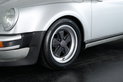
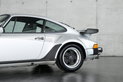
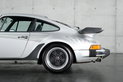
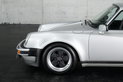
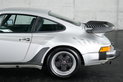
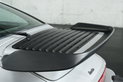
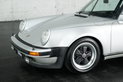
Visually, the Turbo made no secret of its special status. The wheelarches went properly wide, there was a spoiler at the front and, at the rear, sat the vast wing that would soon become its trademark. Wide Fuchs wheels filled the arches. The 911 had evolved from a slender sports car into something considerably more muscular.
Yet this was no blunt instrument. Porsche reached deep into its motorsport parts cupboard. Elements of the wheel-carrier design had their conceptual roots in the 917, while the suspension geometry drew on experience from the Carrera RSR. At the same time, the Turbo received what was, by contemporary standards, a luxurious specification. This mattered, because Porsche was not trying to sell a stripped-out homologation racer, but a new flagship. Performance and luxury were not to be mutually exclusive. The Turbo was supposed to do both.
Its reputation as a demanding car was nevertheless well earned. Below effective boost, the early Turbo was comparatively docile. Then came the power. Lots of it. And because physics was not an optional extra, some drivers found the manner in which the Turbo delivered its performance rather more than they could handle. The 930 demanded attention. In time, that became a substantial part of its legend.
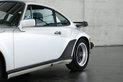
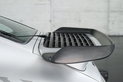
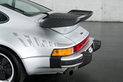
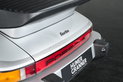
For the 1978 model year, capacity increased to 3.3 litres. Even more significant was the addition of an intercooler, a principle long proven in motorsport. Cooler air is denser, denser air contains more oxygen, and more oxygen is generally a welcome development when one is trying to make power. The intercooler sat beneath an even larger rear wing, whose shape also gave the 3.3 a different face – or, more accurately, a different backside. Power rose to a neat 300 hp, with maximum torque of 412 Nm. Top speed was 260 km/h.
To ensure that the whole affair did not merely go quickly forwards, the Turbo received a braking system whose technical roots also lay with the 917: internally ventilated discs and aluminium fixed calipers. Once again, motorsport served as the development department under rather more demanding conditions.
The 3.3 was therefore not merely the more powerful 930. It was the more mature one. The basic principle remained gloriously unreasonable – rear engine, rear-wheel drive, turbocharger and plenty of power – but Porsche refined the details year after year. It is precisely this long production life that makes the 930 so interesting. There are worlds between an early 3.0 from 1975 and a late 3.3 from 1989, even though at first glance both are unmistakably members of the same family.
During the 1980s, the Turbo increasingly evolved from a wild flagship into an exclusive object for customers who considered an ordinary Porsche insufficiently individual. The Sonderwunsch programme made almost anything possible, provided imagination and wallet could keep pace with one another. Leather, colours, power upgrades, body modifications – the Turbo had long since ceased to be merely the fastest 911. It became a calling card for what Porsche could offer in terms of engineering and craftsmanship.
It is remarkable how long Porsche persisted with the four-speed gearbox. In a car with this much performance, that might initially sound like penny-pinching, but there were sound technical reasons behind it. The enormous torque and characteristics of the turbocharged engine meant that four widely spaced ratios were sufficient, while the existing five-speed gearboxes were not initially capable of handling the Turbo’s torque without further development. So for years the shift pattern remained remarkably straightforward: four forward gears, each providing ample reason to keep both hands on the steering wheel.
The choice of body styles also took its time to become more democratic. For more than a decade, the Turbo was available exclusively as a Coupé. Only for the 1987 model year did the Targa and Cabriolet join the range. Suddenly, the full Turbo drama could also be enjoyed beneath an open sky.
After a long 16 years, the G-series was approaching the end of its life. The new 964 was already waiting in the wings and showed where the 911 was heading: greater comfort, more modern suspension technology, ABS, power steering and, in the Carrera 4, even four-wheel drive. The 930, meanwhile, finally received a five-speed gearbox for its last model year. Then it was over. For the time being, at least.
The successor based on the 964 took its time and did not appear until the 1991 model year. Initially, even that car continued to use a further development of the 3.3-litre turbo engine.
The 930 had changed more than just Porsche. What had begun in the mid-1970s as a fairly audacious experiment had become an institution a decade and a half later.
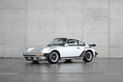
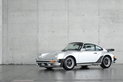
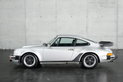
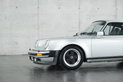
This Porsche 930 is one of the first 911 Turbos built with the new 3.3-litre engine introduced for 1978. More precisely, it is the 265th example built for the European market. Unlike its American cousins, it was therefore allowed the full 300 hp.
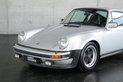
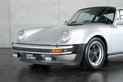
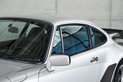
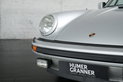
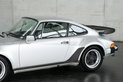
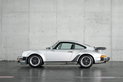
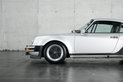
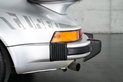
And the Turbo still presents today much as it did when it was handed over to Mr Petersen through Porsche dealer Tölke & Fischer on 4 April 1978. Forty-six years appear to have passed almost without trace. Where time has left small and charming marks, they have either been preserved or carefully touched in. Much of the Turbo still wears its original paint. Even the original Turbo side stripes have survived. The black leather interior remains completely untouched and presents beautifully. That the same applies to the Turbo’s mechanical condition becomes apparent the moment the engine fires into life.
Mr Petersen was presumably not a man particularly interested in attracting attention. While others chose the brightest colours available for their Turbos, his Porsche in Z2Z2 Silver Metallic looks almost elegant and restrained. Insofar as one can say such a thing about a Turbo. He showed equally good taste when specifying the car: sports seats on both sides (409) in black leather (68) and a black headlining (469) demonstrate a certain sense of style. Electrically adjustable exterior mirrors (261) and air conditioning (559) provided comfort and wellbeing. With the black Turbo script along the sides (393), however, Mr Petersen may perhaps have wanted to make it clear that, for all his restraint, his Porsche was no ordinary 911.
Equally unusual for a Turbo is the visibly gentle life this Porsche has led. Its owner’s manual and accompanying service booklet tell muc

Watch our latest YouTube videos
More Listings related to Porsche 911 "Turbo"


Recommended Listings


