
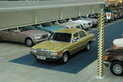
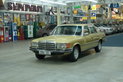
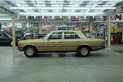
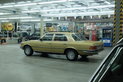
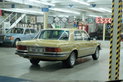
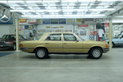
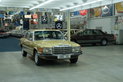
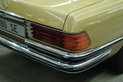
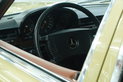
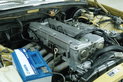
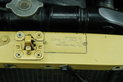
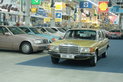
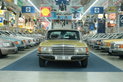
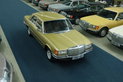
1975 Mercedes-Benz S-Class
280 SE-
Year of manufacture1975
-
Car typeOther
-
Chassis number116.024-10-041496
-
Engine number110.983-10-011656
-
Lot number008
-
SunroofYes
-
Reference numberhg_37317b60d0d0
-
DriveLHD
-
ConditionUsed
-
Exterior brand colourIcon Gold Metallic
-
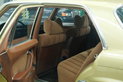
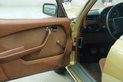
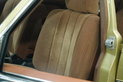
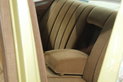
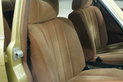
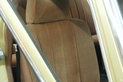
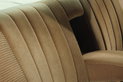
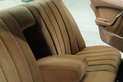
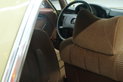
Interior colourBrown
-
Interior brand colourVelours Brazil Brown
-
Location

-
Exterior colourGold
Description
One of 150,593 ever made
The most successful version of the model line
Sublime color combination
Only three registered owners
Chassis no.: 116.024-10-041496
Engine no.: 110.983-10-011656
Body no.: 15639
Production no.: 5005162
Paint: 419 Icon Gold Metallic
Interior: 963 Velours Brazil Brown
Factory options:
401 Single seats
410 Sliding roof, electrically operated
466 Central locking system
482 Harder spring suspension and shock absorbers
592 Heat-absorbing glass, wrap-around, heated rear window pane (compound glass), band filter
621 Export license plate (elimination of license plate moulding)
665 Mode of packing, VE I
673 High-capacity battery
811 Loudspeaker, sound package in the rear
Provenance:
04/02/1975 – Guenther Kerkow, Graz, AT
17/12/1986 – Peter Karl Resch, Graz, AT
20/03/2017 – Georg Sarkoezi, Hausleiten, AT
Documents:
Austrian Typenschein (1975)
Original service booklet
About the model line:
W 116
In the early 1970s, Friedrich Geiger was to deliver his final masterpiece: a new flagship Mercedes saloon. Development under Technical Director Hans Scherenberg had begun almost immediately after the introduction of the W 108 and W 109 series. At the very top of the specification sheet stood two priorities: passive safety and uncompromising comfort. No one understood the science of crumple zones and the safety passenger cell better than Béla Barényi. The Austrian-born engineer of Hungarian descent had already spent many years at Mercedes-Benz and was widely regarded as the father of passive safety.
The W 116 incorporated a remarkable number of innovations designed tostem the rapidly rising death toll on Germany’s roads. Compared with its predecessor, the body shell was significantly stronger, while every major surface inside the cabin – including the steering wheel – was carefully padded. A completely new feature was the front double-wishbone suspension. Developed and refined on the experimental C 111, its geometry achieved a zero scrub radius, greatly improving steering stability under heavy braking while simultaneously reducing stopping distances. From 1978 onwards, the W 116 also became the world’s first production car to offer an anti-lock braking system. The fuel tank was relocated above the rear axle, providing additional protection in the event of a collision while at the same time increasing luggage capacity.
Stylistically, the SL and SLC introduced in 1971 had already pointed the way forward, while under the bonnet Mercedes drew from its proven engine family. The overall result was nothing short of revolutionary – so much so that, for the first and still only time, a luxury saloon was crowned *Car of the Year*. With the W 116, Mercedes-Benz also officially introduced the name „S-Class.“ The „S“ stood for „Sonderklasse“, „special class“ in English. And that is precisely what the W 116 was.
In May 1975 came the ultimate expression of the S-Class, or, as Germany’s leading motoring magazine *auto, motor und sport* famously described it, „the best car in the world.“ Mercedes took the formidable M100 V8 from the 600 and the legendary 300 SEL 6.3, subjected it to a thorough transformation and installed it beneath the bonnet of its new flagship. Bosch K-Jetronic fuel injection, dry-sump lubrication and an enlarged displacement of 6.8 litres were enough to make even the most sporting competitors break into a cold sweat. With 286 horsepower and torque peaking at 550 Nm – never dropping below 490 Nm – the mighty 450 SEL 6.9 effortlessly exceeded 200 km/h. Yet it did so with remarkable discretion. Only the discreet „6.9“ badge and its wider tyres betrayed the king of the Autobahn.
Replacing the temperamental air suspension was a sophisticated hydropneumatic suspension with automatic self-levelling. Citroën sends its regards. The options list was virtually limitless, allowing customers to drive the price into truly dizzying territory. Breaking through the DM 100,000 barrier required little effort when the basic car already cost almost DM 70,000—roughly twice the price of the next model down. During its production run of just over five years, 7,380 buyers treated themselves to the ultimate Mercedes before the next generation of S-Class brought its reign to an end.
The 6.9 was a statement of intent. It showed the world what was technically possible when Mercedes-Benz not only wanted to achieve something, but possessed the ability to do so. It stood alone in its day, became a legend almost immediately and remains one to this day. Perhaps »auto, motor und sport« was right after all – it really was the best car in the world.

Watch our latest YouTube videos
More Listings related to Mercedes-Benz S-Class


Recommended Listings


