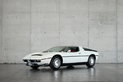
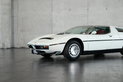
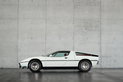
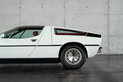
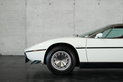
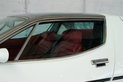
1976 Maserati Bora
Bora 4900-
Year of manufacture1976
-
Car typeOther
-
Chassis numberAM117/49*884*
-
Lot number184
-
Reference numberhg_d5d1479a14a7
-
DriveLHD
-
ConditionUsed
-
Interior colourOther
-
Location

-
Exterior colourOther
Description
One of only a very few European Bora 4900s
The most powerful version, with an unrestricted 330 bhp
Breathtakingly beautiful and rare colour combination
One of the most sophisticated sports cars of its era
Matching numbers
When Maserati unveiled the Bora at the Geneva Motor Show in 1971, the mid-engined layout was no longer a sensation. Lamborghini had long since shown with the Miura where the engine belonged in a truly exciting sports car. De Tomaso had followed suit, while Ferrari had created a sculpture of a sports car with the Dino. Maserati alone had preferred to keep things rather more traditional: long bonnet, big engine up front, two people behind it. Gran Turismo, in other words. A well-established order of things. The Bora thoroughly upset it.
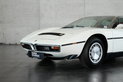
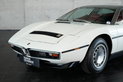
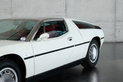
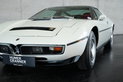
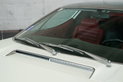
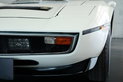
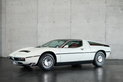
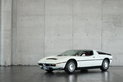
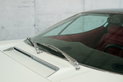
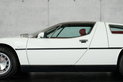
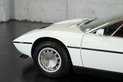
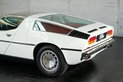
For the shape, Maserati turned to Giorgetto Giugiaro, who had just launched his own studio, Italdesign. Rather than another sculpture like the Miura, he drew a wedge: low, clean and remarkably free of fuss. Plenty of glass, pop-up headlights and a roof panel in brushed stainless steel provided just the right amount of theatre. At the rear, a large window offered a fairly uninhibited view of what the whole thing was really about. The Bora was unmistakably a child of the Seventies. Just one in a tailored suit.
Behind the seats, after all, sat no small fry. Maserati’s racing-derived V8 initially displaced 4.7 litres and produced around 310 bhp. Customers overseas could even have 4.9 litres, albeit with slightly less power thanks to stricter emissions regulations. From 1976, the Bora 4900 was also available in Europe, here without the power restrictions and with the full 330 horses. Four twin-choke Weber carburettors took care of the feeding, while a five-speed ZF gearbox made sure the power arrived where it belonged. When all eight cylinders turned up for work, more than 280 km/h was possible. The Bora had little reason to feel intimidated by the assembled exotica of its day.
Yet Maserati had no intention of building a racing car. The Bora remained every inch a Gran Turismo. There were comfortable, chaise-longue-like seats, electric windows, air conditioning, luggage space and even respectable sound insulation. A double-glazed partition between engine and passengers ensured that the V8 did not leave one’s ears permanently ringing. Not that the soundtrack failed to raise goosebumps. One could travel very quickly and very far in a Bora without needing to consult either an orthopaedic surgeon or an ear specialist afterwards. That was by no means a given at the time.
Technical extravagance came, of all places, from Citroën. The French had been in charge at Maserati since 1968 and brought their high-pressure hydraulics with them to Modena. Among other things, the system operated the brakes and adjusted the pedal box. Rather than endlessly sliding the seat backwards and forwards, the pedals themselves could be moved to suit. Other supercars expected the driver to adapt to the car. In the Bora, he was allowed to stay where he was.
Nor was Maserati’s first mid-engined road car some hastily assembled experiment. Independent suspension all round, inboard rear disc brakes and balanced weight distribution showed that Modena knew perfectly well what it was doing. It had, after all, spent decades building racing cars. Now the result simply came with carpets.
Then came the oil crisis in 1973. For a thirsty Italian mid-engined V8, about as welcome as snowfall on the first swimming day in May. At the same time, Citroën ran into difficulties of its own, and by 1975 Maserati itself had nearly gone under. Alejandro de Tomaso took the helm with support from the Italian state. The Bora was allowed to remain until 1978, but its moment had effectively passed before it had properly begun.
By then, 564 examples had been built, 275 of them with the larger engine and only a very few with the full 330 bhp. Hardly a sales sensation, but quite a statement. It was Maserati’s first mid-engined road car and one of the last sports cars to carry the great V8 that had defined the marque’s classic Gran Turismos.
And therein lies its appeal. The Bora was not a supercar that punished its occupants for going quickly. It could be loud, fast and very serious when asked. It simply did not have to be. It was supercar and grand tourer in one. A contradiction, really, from which Maserati somehow made a car. A damn good-looking one at that.
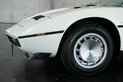
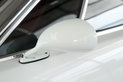
Rare, rarer, rarest. It is the superlative that best describes this particular Maserati Bora. For one thing, it is one of only a very few European examples among the mere 275 Bora 4900s built with the larger engine. And with the full 330 bhp at its disposal, it wants for nothing in the power department. Then there is its original Certificato di Garanzia, effectively its service book, still preserved in the leather document wallet. It not only names the first owner, Gianni Giacomini of Varazze, but also documents the mere 63,000 kilometres covered to date. And as though that were not enough, it is finished in Bianco Polo Park, a rare colour on a Bora, combined with an intensely red interior to quite spectacular effect.
In 1996, former Austrian Maserati concessionaire Bruno de Cillia brought the Bora to Austria and sold it to an owner in Klagenfurt. From his estate, the Maserati passed to its current owner, who set about bringing the Modenese sports car thoroughly up to scratch mechanically. Only last winter, a marque specialist renewed or overhauled the entire hydraulic system, the clutch, water pump, brakes and, not least, the air conditioning.
What stands before us today is therefore a work of Italian sporting art whose qualities beneath the skin are every bit the equal of its thrillingly simple design. This rare and beautiful exception to the rule is proof enough.

Watch our latest YouTube videos
More Listings related to Maserati Bora


