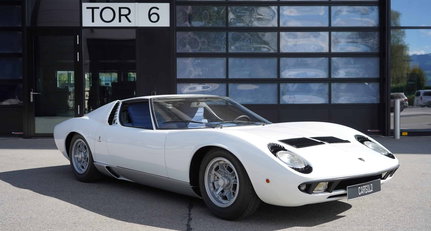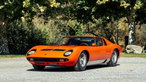
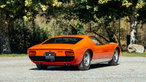
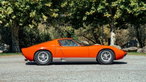
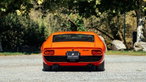
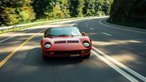

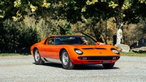
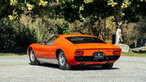









1967 Lamborghini Miura
-
Year of manufacture1967
-
Mileage44 817 km / 27 848 mi
-
Car typeOther
-
Lot number119
-
Reference number4684
-
DriveLHD
-
ConditionUsed
-
Exterior brand colourother
-
Location

-
Exterior colourOther
Description
Please note: Online Bidding is not available for this lot, unless specifically pre-arranged with Broad Arrow before the auction begins. For further information and alternative bidding options please reach out to [email protected]
Chassis No. 3135
Engine No. 1352
Body No. 68065
The Italian Job (1969) opens in stillness, as the untouched Alpine peaks set the scene. Gradually, the silence gives way to the distant harmony of a V12 engine, its mechanical song weaving into the mountain air. Around a sweeping bend emerges a radiant Lamborghini Miura, gliding effortlessly through the Great St Bernard Pass, a high-altitude road linking Italy and Switzerland. The asphalt is dry and clear, framed by steep rock faces and lingering snow. Bold yet graceful, the Miura's silhouette slices through the alpine landscape with the poise of something born to belong there.
Less than six years before this scene appeared on cinema screens, neither the brand nor the myth it carried existed. Lamborghini, founded in 1963 by Ferruccio Lamborghini, was still a very discreet name in the automotive world. At the time, the company had a fraction of the recognition it enjoys today, and certainly not the prestige of Italian giants like Maserati, Alfa Romeo, or Ferrari. To change that, Lamborghini knew he had to make a bold statement. The plan was ambitious: to create the fastest road car the world had ever seen, something entirely new, both in spirit and in performance.
The Lamborghini Miura was revolutionary both technically and aesthetically, breaking all the rules. Inspired by racing cars but designed exclusively for the road, it quickly became the benchmark for performance. What made the Miura truly revolutionary was the energy of the team behind it. Its modernity came from a group of designers and engineers all under the age of 30. Beyond Ferruccio Lamborghini himself and the renowned Giotto Bizzarrini from Alfa Romeo and Ferrari, who worked on the legendary 250 Testa Rossa and 250 GTO engines, the core team was remarkably young. Giampaolo Dallara and Paolo Stanzani, lead and assistant engineers, were both 29 years old; Bob Wallace, the chief test driver, and Marcello Gandini, the designer, were only 27. This youthful team brought bold ideas and an innovative spirit that shaped the Miura into a true icon.
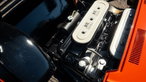
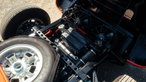
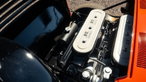
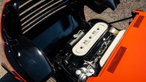
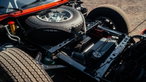
Designed by Giampaolo Dallara, the chassis featured a lightweight semi-monocoque structure, lightened in several places to reduce mass while maintaining rigidity. The engine, born from a confidential engineering project led by Giotto Bizzarrini, was later acquired by Lamborghini and entrusted to Dallara's team for completion. The result was remarkable: a 4.0-liter aluminum V12 engine, mounted transversely at the rear, just behind the seats. It featured dual overhead camshafts per cylinder bank, operating two valves per cylinder, and was fed by four Weber carburetors. It produced a maximum output of 350 PS at 7,000 rpm. In a further innovation, the engine and five-speed manual gearbox were built as a single unit, minimizing weight and optimizing packaging. True to the engineering-led concept, the name "P400" itself reflected the car's mechanical nature: Posteriore for the rear-mounted engine, and 400 for the displacement: 3,929 cc.
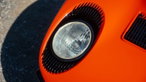
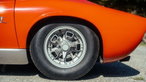
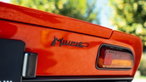
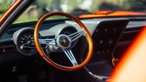
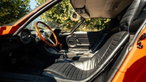
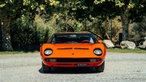
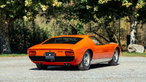
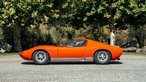
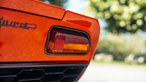
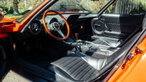
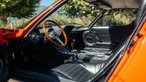
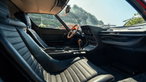
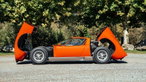
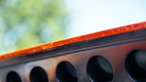
Chassis number 3135, fitted with engine number 1352 and Bertone body number 65, was delivered on 24 September 1967, to Signor Arminio Scanzi in Chiavari, a town in the province of Genoa. The Polo Storico Lamborghini archives reveal that it was finished in Rosso Miura with a Nero leather interior, a color combination the car still proudly wears today.
According to the copy of the ACI PRA cronologico (Pubblico Registro Automobilistico, a public chronological ownership record), Signor Scanzi purchased the Miura directly from the Lamborghini factory for 7,700,000 Italian lire. The car was first registered five days later, on 29 September 1967. This initial registration was later canceled with a stamp dated 15 March 1988, and lists no other Italian owners. However, the car was subsequently registered in Germany on 17 October 1974, under the ownership of Auto-Shop. In 1990, it was sold for DM 210,000 to Mario Bernardi, who, in turn, passed it on in 1994 to its next owner, a passionate and highly knowledgeable Swedish Miura enthusiast. Notably, this owner also owned a white Miura, which was eventually sold to none other than Giampaolo Dallara himself! This Swedish collector cherished the car for an impressive 25 years. From 2016 until he parted with it in 2019, the Miura underwent a significant restoration during which it notably regained its original engine, from which it had previously been, according to a respected marque historian report, separated in the past. It was from this collector that the current Swiss owner acquired the car.
Wishing to perfect and complete the restoration previously undertaken, the new and current owner entrusted the car to Polo Storico Lamborghini, with the goal of ensuring the factory's authenticity and excellence. In collaboration with Officina Classiche Gabbioneta in Italy, a comprehensive inspection was conducted to identify any non-original or worn components and to oversee a faithful restoration to original factory specifications.
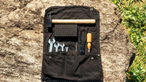
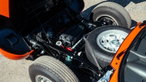
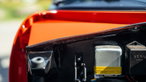
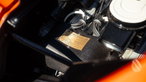
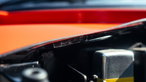
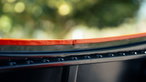
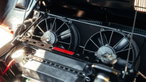
This initial inspection took place at the end of 2019. All discrepancies were meticulously documented and subsequently addressed during the restoration process, which was carried out in strict accordance with Polo Storico's detailed recommendations. From the shock absorbers to the smallest nuts and bolts, even the U-profile black rubber front hood seal, which had to measure exactly 7mm, or the Lucas switch for the engine compartment courtesy lights, no detail was overlooked. It is worth noting, however, that the owner opted to install an aftermarket cooling fan for improved functionality; the original parts will, however, accompany the car upon sale.
Upon completion of the work by Officina Classiche Gabbioneta in 2022, the car was re-inspected by Polo Storico Lamborghini, who issued the Certificato di Autenticità, a certification that includes an official grading system along with supporting documentation from the factory archives. The accompanying report, available for consultation, is succinctly summed up by two words: "excellent" and "compliant." Its conclusion confirms: "Lamborghini Polo Storico has ascertained the authenticity of the identification elements of the Miura P400."
Born to glide through the Alps, now restored to glide through time, this Miura proudly wears lines crafted by Bertone, strikingly modern and timeless, and stands ready once again to grace the asphalt under the hands of its new owner.
Documents: Swiss Carte Grise


Watch our latest YouTube videos
More Listings related to Lamborghini Miura


Recommended Listings