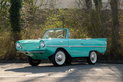

1963 Amphicar 770
Fresh, high-quality restoration, Rare original factory color combination, Fjord Green examples are generally considered among the rarer survivors-
Year of manufacture1963
-
Car typeConvertible / Roadster
-
DriveLHD
-
ConditionRestored
-
Interior colourWhite
-
Number of doors2
-
Number of seats4
-
Location

-
Exterior colourBlue
-
GearboxManual
-
Drivetrain2wd
-
Fuel typePetrol
Description
- Designed by legendary engineer Hanns Trippel
- Manufactured in Germany (Lübeck & Berlin-Borsigwalde)
- Descendant of the iconic Volkswagen Schwimmwagen
- A rare fusion of engineering ambition, playful spirit, and unmistakable 1960s charm
- Fresh, high-quality restoration
- Capable of 70 mph on land / 7 mph on water
- Extremely eye-catching, draws more attention than many supercars
- Experts and enthusiasts estimate that around 500–600 Amphicars still exist today
- Rare original factory color combination, Fjord Green examples are generally considered among the rarer survivors
- We could reasonably estimate just a few dozen Fjord Green Amphicars still exist worldwide today, possibly 20–50+, but there’s no definitive registry confirming an exact number
- Just stop for a moment and think about reaching your destination by road, enjoy a relaxing boat excursion on the water, and then simply drive back home. Afterwards, you can even take it to a regular car wash, just as you would with any normal car
The Amphicar Model 770 is a truly unique amphibious automobile, launched at the 1961 New York Auto Show.
Manufactured in Germany and marketed primarily in the United States between 1961 and 1967 (with production ending in 1965), it remains one of the most fascinating vehicles ever built.
Designed by German engineer Hanns Trippel, the Amphicar was produced by the Quandt Group in Lübeck and Berlin-Borsigwalde. Only 3,878 examples were manufactured in a single generation, making it highly collectible today.
A spiritual successor to the WWII-era Volkswagen Schwimmwagen, the Amphicar delivered modest performance compared to conventional cars or boats of its time.
However, what it lacked in speed, it more than made up for in innovation and character.
The name “Amphicar” is a combination of “amphibious” and “car.” The model designation “770” reflects its performance capabilities: 7 mph in the water and 70 mph on land.
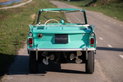
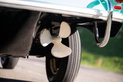
In the water, a simple lever switches the drivetrain from rear-wheel drive to twin rear-mounted propellers. The front wheels provide steering both on land and in the water.
Model 770s were offered in only four factory colors:
– Beach White
– Lagoon Blue
– Fjord Green
– Classic Regatta Red
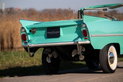
Constructed from mild steel, the Amphicar features twin propellers mounted beneath the rear bumper for water propulsion.
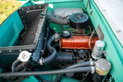
The engine is mounted at the rear, driving the rear wheels through a 4-speed manual transmission. For water use, the same engine powers two reversible propellers via a secondary gear lever that engages forward or reverse thrust.
Once afloat, the main gear lever is typically left in neutral. When exiting the water via a boat ramp, engaging first gear together with the propeller drive allows the Amphicar to propel itself smoothly back onto land.
Power comes from a 1,147 cc engine derived from the Triumph Herald 1200. At the time of its introduction in 1961, this engine was considered state-of-the-art, offering a strong balance of performance, weight, cooling efficiency, and reliability. Updated versions of this engine continued in production in the Triumph Spitfire until 1980.
In Popular Culture:
The Amphicar has enjoyed a colorful history:
– In 1965, two Amphicars successfully navigated the Yukon River in Alaska.
– In 1968, two crossed the English Channel, enduring 20-foot waves and gale-force winds.
– In the late 1970s, Howard Singer sailed an Amphicar from mainland California to Catalina Island.
The Amphicar also appeared in several films, including:
– The President’s Analyst
– Inspector Clouseau
– Savannah Smiles
– Pontiac Moon
U.S. President Lyndon B. Johnson famously owned an Amphicar. Known for his sense of humor, he reportedly delighted in driving guests downhill at his Texas ranch straight into a lake while pretending the brakes had failed.
Today, visitors to Disney Springs at Walt Disney World can still experience a ride in an Amphicar, piloted across the water.
Most examples were sold in the United States, with United Kingdom sales beginning in 1964.
A total of 3,878 vehicles were produced before the company ceased operations.
Experts and enthusiasts estimate that around 500 Amphicars still exist today.
Fjord Green was one of just four factory colors offered (alongside Beach White, Lagoon Blue and Classic Regatta Red).
Based on rarity and collector interest, Fjord Green examples are generally considered among the rarer survivors, but precise numbers aren’t documented in any public database.
We could reasonably estimate just a few dozen Fjord Green Amphicars still exist worldwide today, possibly 20–50+, but there’s no definitive registry confirming an exact number.
ABOUT THIS SPECIFIC EXAMPLE
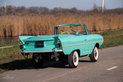
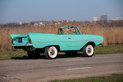
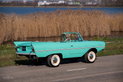
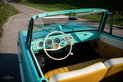
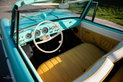
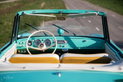
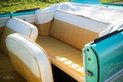
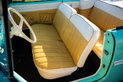
This 1963 Amphicar 770 is presented in beautiful Fjord Green with a striking Yellow and White interior.
A rare and exceptionally attractive original color combination that enhances its unmistakable 1960s charm.
The car has benefited from a relatively recent, high-quality restoration carried out thoroughly and with great attention to detail.
It is fully operational both as a car and as a boat. Its navigation lights and amphibious controls function properly, allowing for a seamless transition from road to water.
Having been personally tested in the canals of Amsterdam, this Amphicar has proven to be an incredibly impressive and enjoyable machine on the water.
The experience of driving into the water is unforgettable. Initially thrilling and slightly surreal, but within moments, it becomes clear that this is a genuine and capable boat offering immense fun.
Wherever it goes, the Amphicar draws extraordinary attention. On the road and on the water alike, the reaction from passersby and fellow boaters is overwhelming.
Restored in such a rare and vibrant original color scheme, this example commands even greater presence and admiration.
CONDITION EXTERIOR
Overall, the exterior of this Amphicar is fresh, highly attractive, and ready to be admired both on land and on water.
The exterior of this Amphicar 770 reflects the high quality of its recent restoration. The bodywork is well preserved, showing virtually no signs of use.
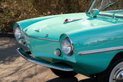
The paint finish is beautifully executed, with an even gloss and excellent depth that highlight the Amphicar’s distinctive lines and charming proportions.
During the restoration, the soft top was replaced with a brand-new example, ensuring both correct appearance and proper functionality.
All chrome components have been professionally re-chromed and present in superb condition, with a brilliant shine that complements the Fjord Green exterior perfectly.
CONDITION INTERIOR
The interior of this Amphicar 770 has been fully restored, combining originality with a fresh, factory-like appearance.
It features a white manual soft top in brand-new condition, perfectly complementing the distinctive yellow and brown leather interior.
Every element inside the cabin has been carefully refurbished. The seats have been reupholstered in high-quality vynil, offering both comfort and an elegant vintage look.
The use of vinyl is entirely faithful to the car’s original nautical concept.
Vinyl is the material typically chosen for marine applications due to its high resistance to water splashes, humidity, and sun exposure.
Unlike leather, which can quickly deteriorate, stain, or lose its color when exposed to moisture, vinyl maintains its appearance and durability even in demanding conditions.
For an amphibious vehicle like the Amphicar 770, this choice is both practical and historically correct.
The matching door panels, handles, and trim pieces have all been restored, maintaining the car’s authentic character while presenting a crisp, renewed finish.
Even the floor mats are in immaculate condition, reinforcing the overall sense of attention to detail.
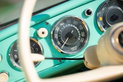
The dashboard retains its classic nautical-inspired design, and all gauges and meters are fully functional, ensuring both practicality and originality. Adding to the charm, the radio is in working order as well, enhancing the authentic 1960s driving experience.
Overall, the interior presents as fresh, clean, and beautifully restored, faithful to the spirit of the Amphicar while offering the appeal of a newly refurbished classic.
DRIVING EXPERIENCE
Imagine driving a 1963 Amphicar 770 through the historic streets of Amsterdam.
The engine runs smoothly, the gearbox shifts easily, and the car feels solid and reassuring on the road. It’s not about high performance, it’s about the unmistakable charm of something truly different.
Then imagine approaching one of the city’s canals. You gently enter the water, and within seconds the car transforms into a boat.
The sensation is unique: the same steering wheel in your hands, but you’re gliding past houseboats and under old brick bridges.
People stop, smile, and wave, because seeing an Amphicar in its natural dual environment is always a special moment.
The fact that it is both a car and a boat at the same time makes the experience truly unforgettable.
Just stop for a moment and think about it: you can reach your destination by road, enjoy a relaxing boat excursion on the water, and then simply drive back home.
Afterwards, you can even take it to a regular car wash, just as you would with any normal car.
It’s this seamless transition between land and water that makes the experience so special and unlike anything else.
Disclaimer
The information provided on this website has been compiled by The Houtkamp Collection with the utmost care. The information contained within this advert is provided ‘as-is’, without warranties as to its accuracy whether expressed or implied and is intended for informational purposes only. The Houtkamp Collection is not liable for any errors or mistakes.

Watch our latest YouTube videos
More Listings related to Amphicar 770

