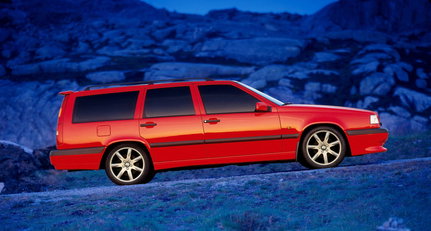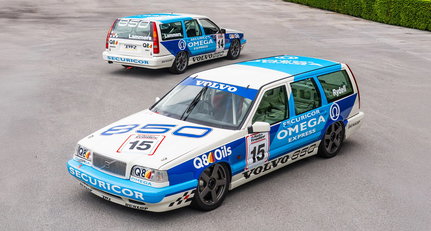


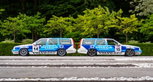


It was the first weekend of April 1994, the season opener for the star-studded British Touring Car Championship (BTCC) at Thruxton. Alfa Romeo, BMW, Ford, Vauxhall, Toyota, Mazda, Renault, Peugeot, and Nissan were all lining up their saloons when two complete outliers disrupted the scene. Much like the fans at this year's Nürburgring 24-Hour race — who initially thought the No. 81 BMW M3 Touring (which eventually finished fifth overall!) was an April Fools' joke, which is precisely what it had been in 2025 before BMW turned the gag into a real race car in just eight months — spectators back then looked on in disbelief. For right in the midst of the pack of saloons, the "Volvo 850 Racing" team had pulled a real surprise out of the hat: two 850 station wagons built by TWR (Tom Walkinshaw Racing) on Volvo's behalf — a global first in motorsport.
1994 marked the launch of a three-year project through which the Swedes — primarily well established among and loved by educated, middle-class demographics — sought to demonstrate that class-leading safety (both active and passive) and family practicality need not be at odds with driving pleasure and sportiness. To this end, they signed TWR as their technology and operational partner — none other than the squad that had triumphed at Le Mans (with Jaguar) in 1988.


The decision to compete with a station wagon was taken months before the season opener but was only announced in March — roughly four weeks prior to the start of the season — at the Geneva Motor Show. The marketing strategists in Gothenburg had prevailed, even though the advantage of slightly greater stability — the wagon's longer roof steadied the car on the straights but also increased drag — was offset by more significant drawbacks. Due to the higher weight on the rear axle and a higher center of gravity, the wagon lacked traction in tight, slow corners, and the body's lower torsional rigidity also proved to be a disadvantage.


While in 2026 the M3 Touring achieved a completely unexpected fifth-place overall finish in the Eifel, in 1994 the Volvos managed only consistent mid-field runs, with two fifth-place finishes marking their best results. Nevertheless, the technical package was impressive: based on the production Volvo 850 Turbo's 2.3-liter 20-valve five-cylinder in-line engine, TWR developed a 2.0-liter, naturally aspirated five-cylinder unit — compliant with the regulations — that produced a solid 280 hp at 8,500 rpm and sent power to the front axle via a sequential six-speed Xtrac gearbox. Key features included a limited-slip differential, racing suspension, AP racing brakes, and 18-inch wheels, alongside a car pared down to just 2,150 lb. Furthermore, Volvo installed a catalytic converter — a component that was not actually mandatory until the 1995 season. Once again, the Scandinavians demonstrated their role as pioneers, even in environmental technology.


Drivers following one of the tall-bodied Volvos in a BTCC race were not amused, given the obstructed forward visibility. Consequently, rivals frequently took jabs at the team, mocking the white-and-blue wagons as "baker's vans" or "pizza delivery vans." Volvo responded with a sense of humor, once sending a car around the track on a parade lap with a stuffed Border Collie in the load bay.


Swedish touring car specialist and former Formula 3 driver Rickard Rydell and Dutchman Jan Lammers — who had won Le Mans in 1988 with TWR and Jaguar — were signed as drivers for 1994. Best results were fifth-place finishes for Rydell at Oulton Park and Lammers at Brands Hatch. Ultimately, however, the team finished only eighth in the constructors' championship, with Rydell and Lammers placing 14th and 15th respectively in the drivers' standings. By the end of the season, the FIA's new Super Touring regulations for 1995 made a switch to the 850 saloon inevitable: the rules required the rear wing to sit below the roof line and ahead of the rear bumper, which was impossible with the wagon body. At the wheel of the saloon, Rydell in particular promptly began making regular appearances on the podium, taking four wins in 1996 alone and finishing third in the final standings of the 850's last season.


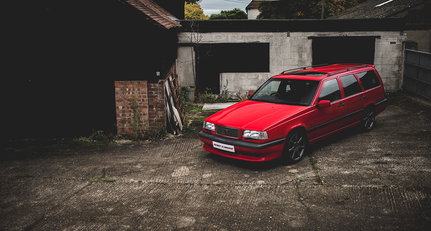
In total, three Volvo 850 wagons were transformed into full Super Touring race cars at the TWR workshops in Oxfordshire. One example (chassis 002) is housed in the Volvo Museum, but chassis 003 — the car driven by Rydell in 1994 at Brands Hatch, Silverstone, and Donington — is now up for sale with British dealer Duncan Hamilton ROFGO. According to the dealer, it is the first time one of the three has ever been publicly offered; 001 and 002, he says, will never be for sale. Although the 850 wagons competed for only a single season and achieved only mediocre results, they remain vividly remembered to this day by anyone who saw them — whether at the track or on TV. Their ability to grab attention was simply unmatched, a marketer's dream!