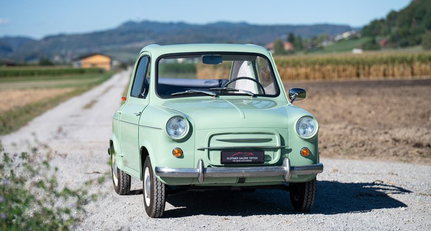

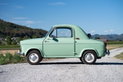
1961 Piaggio Vespa
400-
Baujahr1961
-
AutomobiltypCoupé
-
Chassisnummer27967
-
Losnummer01
-
Referenznummerunique_id_127_01
-
LenkungLenkung links
-
ZustandRestauriert
-
Standort

-
AußenfarbeSonstige

Beschreibung
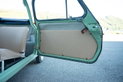
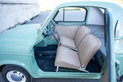
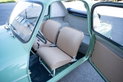
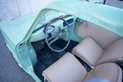
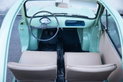
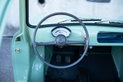
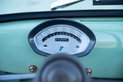
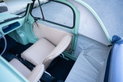
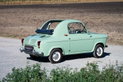
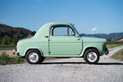
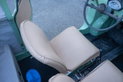
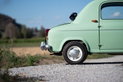
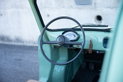
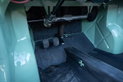
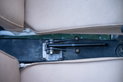
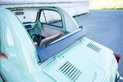
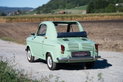
In Europe, people wanted to enjoy the long-awaited peace after the war and discover the world, but mobility was slow to take off. Following a boom in scooters such as the Vespa and the Lambretta, open-top scooters hit the roads in Germany, whilst in Italy the Fiat 500 Topolino became the vehicle of choice. The popular ‘Topo’ was replaced in 1955 by the 600, which was to be followed by the 500 in 1957. From 1952 onwards, Vespa manufacturer Piaggio also developed a two-seater with four wheels, which was launched in 1957 almost simultaneously with the Fiat Nuova 500. Presumably, Piaggio reckoned it had little chance of success in its home market due to competition from the ‘Cinquecento’ and therefore focused on France as its market. Consequently, the Piaggio Vespa 400 was then built at the subsidiary ‘Société ACMA’ (Ateliers de Construction de Motocycles et Automobiles) in Fourchambault near Nevers. The launch on 26 September 1956 in Monaco attracted a great deal of attention, not least because three famous Grand Prix drivers – Juan Manuel Fangio, Jean Behra and the Monegasque Louis Chiron – were invited. On 3 October 1957 at the Paris Motor Show, the tiny vehicle received much acclaim from the trade press and the public. As with Fiat, Piaggio’s two-seater was powered by an air-cooled, two-cylinder rear-mounted engine driving the rear wheels, with a displacement of 394 cc. Whilst the Fiat was fitted with a four-stroke engine, the Vespa 400 featured a two-stroke engine, which required the oil to be manually mixed in every time the vehicle was refueled. Next to the engine was the oil reservoir, fitted with a mixing mechanism. After refueling, the number of liters of petrol added could be set, and the mechanism mixed in the required amount of oil by turning a crank. The Italians gave this tiny vehicle – just 285 cm long and 127 cm wide – a simple, attractive, self-supporting body with rear-hinged doors and a folding roof that could be lowered to waist height, turning it into a convertible coupé. Between 1957 and 1961, Piaggio produced 30'976 Vespa 400s, the vast majority of which were sold in France. This charming Vespa 400, with its 14 hp 2-cylinder two-stroke engine and three-speed gearbox, was, like most of these vehicles, first registered in France on 23 February 1961. The little car remained there until it was purchased in a dilapidated condition from the seller in 2006. The seller – a qualified mechanic and bodywork specialist – set about restoring it, a process that was to take almost three years. The bodywork was completely restored, repainted in the original color and treated with underbody sealant. The engine and gearbox were rebuilt, and all mechanical components were overhauled or replaced. A new wiring loom was fitted, an electronic ignition system was installed, and the interior was reupholstered or refitted with leatherette. Since its completion, the Vespa has been driven for only around 800 km and is therefore in good to very good condition. This cool microcar will be handed over to a new owner with its most recent veteran MOT completed in August 2021 and can be registered immediately in most German-speaking cantons of Switzerland.

Watch our latest YouTube videos
Verwandte Anzeigen zu Piaggio Vespa


Empfohlene Angebote


