
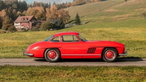
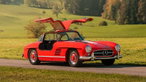
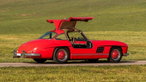
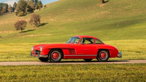

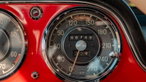
1955 Mercedes-Benz 300 SL
-
Baujahr1955
-
Kilometerstand66 748 km / 41 476 mi
-
AutomobiltypSonstige
-
LosnummerDG26Lot_172
-
Referenznummer6859
-
LenkungLenkung links
-
ZustandGebraucht
-
Markenfarbe außenother
-
Standort

-
AußenfarbeSonstige
Beschreibung
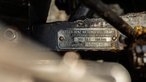
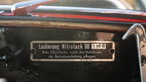
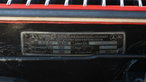
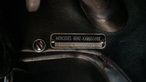
Chassis No. 198.040.5500680
Engine No. 198.9805500636
Body No. 198.0405500659
On 1 May 1955, Stirling Moss and Denis Jenkinson brought their Mercedes-Benz 300 SLR back into Brescia to win the Mille Miglia in record time. Four places behind them came a car far closer to anything a customer could buy. John Fitch and navigator Kurt Gesell had driven a largely standard 300 SL Gullwing Coupe across roughly 1,600 kilometers of Italian roads, finishing fifth overall and first in the Gran Turismo class. Later that season, Werner Engel drove another 300 SL to the 1955 European Rally Championship.
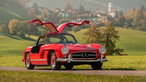
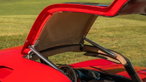
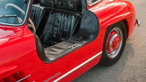
Competition shaped the design from the start. Mercedes-Benz returned to sports car racing in 1952 with the W194 300 SL, developed under technical director Fritz Nallinger and test department head Rudolf Uhlenhaut. Its welded tubular space frame was light and very stiff, but its tall side members left no room for conventional doors. The engineers hinged the doors at the roof instead. That season the W194 finished second at the Mille Miglia, swept the sports car race at Bern, and scored one-two finishes at Le Mans and the Carrera Panamericana.
Max Hoffman, the New York importer then handling Mercedes-Benz sales in the eastern United States, saw a market for a road-going version. In September 1953 he persuaded the Daimler-Benz board to build one, and in February 1954 the production 300 SL made its debut at the International Motor Sports Show in New York, before it had been shown in Germany.
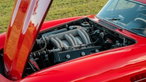
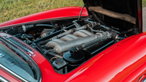
Known internally as the W198, the road car kept the racer's space frame and roof-hinged doors while gaining Bosch mechanical direct fuel injection for its 2,996-cc inline-six. Mercedes-Benz credits the 300 SL as the first four-stroke production car with this arrangement. The engine was canted 50 degrees for a low hood line, with dry-sump lubrication letting it sit lower still. Output was 215 PS, and depending on the rear axle ratio, top speed reached 250 km/h, making the 300 SL the fastest production car of its day.
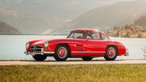
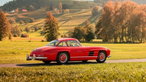
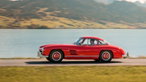
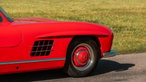
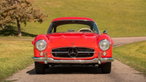
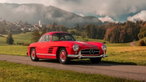
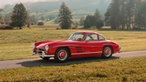
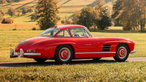
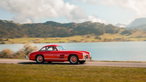
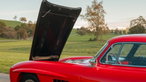
The Gull Wing Group Registry records that this car was completed on 30 August 1955 under order number 759 212, with shipment on 1 September 1955. Marked as a special order, it was consigned to Mercedes-Benz Distributors, Inc, the New York distributorship operated by Max Hoffman. It was finished in Fire Engine Red (534), with a Black leather interior (953). As one of the 10 standard colors offered on the Gullwing, Fire Engine Red was selected for only 155 Gullwings when new as researched by Chris Kramer.
Its original service book shows the car was first registered on 1 December 1955 and delivered four days later, on 5 December, to Alexander G. Raymond of Stamford, Connecticut. Raymond was the illustrator who created the Flash Gordon comic strip for King Features Syndicate in 1934, and by the 1950s he was drawing the detective strip Rip Kirby. He put his new Gullwing to use straight away. By 22 December it had already covered 1,226 miles and received its second service. A 300 SL Gullwing later found its way into his work, appearing in the Rip Kirby strip, quite possibly drawn from the one in his own garage. While Raymond passed in September 1956, and stamps continue in the book through 21 August 1959.
The car then crossed the Atlantic, heading back to Europe, The registries record Jürg Heer of Zürich as an early Swiss owner. The car later passed to Klaus Brand of Meersburg, Germany. In 1970, Brand and Heinrich Baumgartner founded BBS in the Black Forest town of Schiltach, naming it after their surnames and the town. It began by making plastic body parts and introduced its first wheel in 1972. The cross-spoke design that became its signature followed in 1975. BBS has since become one of the world's most respected and recognizable wheel makers.
In 1994, the 300 SL went from Brand to Hans Hürlimann of Wil, Switzerland, a 300 SL dealer and the model's first historian. His connection to the Gullwing began in March 1956, when his father bought an ivory 300 SL directly off the Mercedes-Benz stand at the Geneva Motor Show. Hürlimann went on to handle some 30 Gullwings. Buyers kept asking about each car's origin and equipment, so in 1978 he began gathering records from clubs, dealers, and owners. The result, published in 1981, was the first 300 SL Register. Hürlimann then sold the car on 14 June 1994 to the current owner's mother. The family has owned it for more than three decades, now with the son offering it today.
In March 2025, LIGA Lindengut-Garage in Wil gave it a major service, including overhauled brakes and new front drums. The following year, in July 2026, marque specialist Michael Plag of Plag Classic examined the car in detail. He found that it has never been fully restored or disassembled, only repaired where needed and refinished in its original Fire Engine Red. The body has never been lifted from its frame, which remains unrestored and accident-free in its original nitrocellulose paint. The original felt strips still sit between the fuel tank and its mounts, and the panel gaps match the car as delivered.
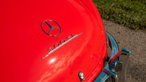
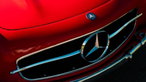
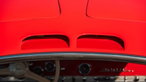
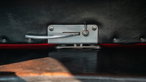
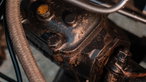
It retains its correct Coupe hood, which Plag notes many coupes have lost to a Roadster hood, along with the early concave star and the original battery cover. All Sigla glass is original except the windshield, and the main wiring harness is unaltered. Plag's report also finds every major assembly from its chassis, engine, body, front spindles, steering box, and rear axle original to the car, apart from the transmission, which comes from a 300 SL Roadster. The engine is original to the car, with its cast-iron block and aluminum cylinder head, and it now carries the desirable NSL sport camshaft.
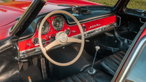
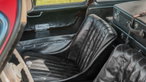
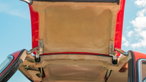
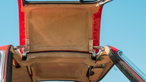
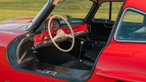
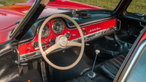
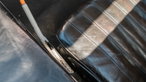
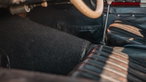
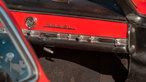
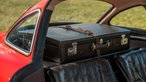
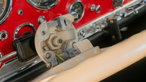
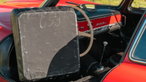
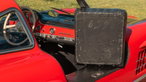
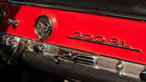
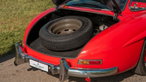
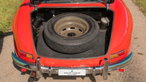
Plag also found the cabin highly original. Its Black leather has taken on a charming patina, the light beige cloth headliner remains, and the underside of the seat cushions still carries the body number. Factory chalk markings survive there too. Plag notes the mechanical clock, which must still be wound by hand, as a part many owners replaced with an electric unit. His report also lists the fitted luggage set by Baisch of Cannstatt. The car is also furnished with its original service and owner's manuals. Today, the odometer shows just under 67,000 miles at cataloging, which are believed to be original.
With just 1,400 examples produced from 1954 through 1957, the 300 SL has long been treasured by collectors for its innovative engineering that brought true race-car technology to the road, from its space-frame chassis to the first fuel-injected four-stroke engine in a production car. Beyond the numbers and technical daring, its unmistakable silhouette and direct connection to endurance-racing triumphs have allowed the 300 SL Gullwing to transcend eras as a defining icon of postwar automotive history. Delivered new to Alex Raymond, the illustrator who created Flash Gordon, this highly original example stands as the ideal addition to any collection, as it would surely be considered for some of the world's most prestigious motoring events, including future entry into the Mille Miglia Storica, or as the ideal candidate for the preservation class at Concorso d'Eleganza Villa d'Este.


Watch our latest YouTube videos
Verwandte Anzeigen zu Mercedes-Benz 300 SL


Empfohlene Angebote


