







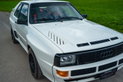



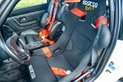
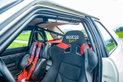




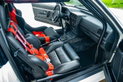
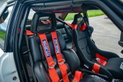
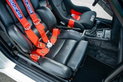
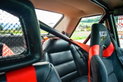
1985 Audi Sportquattro
-
Baujahr1985
-
AutomobiltypCoupé
-
ChassisnummerWAUZZZ85ZEA905156
-
Motornummerhttps://www.oldtimer
-
Losnummer135
-
Referenznummerunique_id_124_35
-
ZustandRestauriert
-
Markenfarbe außenhttps://www.oldtimergalerie.ch/image/Audi%20Sport%20Quattro%2C%20weiss%2C%201985/Audi%20Sport%20Quattro_44.JPG
-
Standort

Beschreibung
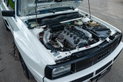
After Audi entered rallying in 1981, the factory team won the Manufacturers‘ World Championship with the Audi Quattro in 1982. This was followed in 1983 by the World Drivers‘ Championship title won by Hannu Mikkola. However, the competition became increasingly fierce over time. With pure racing machines such as the Peugeot 205 Turbo 16 with a mid-engine, the Rally Quattro, which had been designed on the basis of a production car, could no longer keep up. So, in 1983, Audi decided to design a new vehicle – the Sport Quattro, also known as ‘the short one’. Although the Sport Quattro looks quite similar to the Quattro on the outside, the two have little in common apart from their name. In addition, Walter Röhrl was signed for the 1984 season. His main role at Audi was to carry out development work. Audi was able to use its wide range of models in a modular system for the body of the Sport Quattro. The basis of the Sport Quattro is the two-door Audi 80 saloon up to the B-pillar and the Audi Quattro from the B-pillar onwards. The Sport Quattro is 320 mm shorter than the normal Quattro. The tailgate is made of glass fiber-reinforced polyester resin, as was also used for the front spoiler of the Audi Quattro. The fenders, rear side panels, roof, bonnet, front and rear aprons were manufactured by Seger und Hoffmann in Switzerland and delivered to Ingolstadt. These parts are made of multi-layer aramid fabric, epoxy resin and various additives. Never before had all the technical possibilities for increasing performance been used together in series production of automobiles as they were here. In addition to the exhaust gas turbocharging already familiar from the Audi 200 Turbo and Audi Quattro, the Audi Sport Quattro used a cylinder head with four valves per cylinder. In order to remain below 3 liters despite the so-called ‘turbo factor’ of 1.4 specified for turbo engines in competition, the displacement was reduced by reducing the bore from 2’144 to 2‘133 cc. This was important because, according to the regulations, vehicles with a displacement of less than 3 liters were allowed to weigh less than 1’000 kg. In line with the Audi Sport Quattro‘s role as the planned winning car on national and international rally tracks, the overall concept of the engine was designed in such a way that a further increase in power to 450 or even 650 hp was relatively easy to achieve for sporting use. To compensate for the additional weight of the four-valve cylinder head and the larger turbocharger, the engine block was made of aluminium. In addition, a new, fully electronic fuel injection system was used for the first time in an Audi turbo engine. The engine in the production version achieved an output of 306 hp. The Sport Quattro was unveiled to the public for the first time at the 1983 International Motor Show. Deliveries began in December 1984, and by the summer of 1985, only 214 units of the Sport Quattro had been produced for the required FIA Group B homologation.

Watch our latest YouTube videos
Verwandte Anzeigen zu Audi Sportquattro

